Key Takeaways
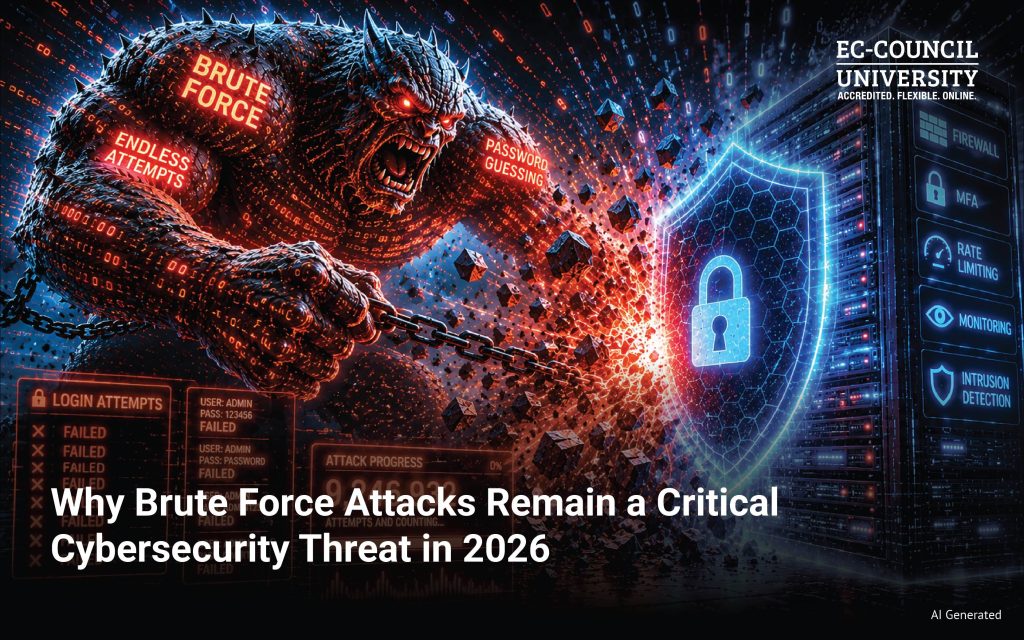
- Brute force attacks continue to be one of the most common methods used to compromise user accounts and systems.
- Attackers are combining automation, AI, credential theft, and cloud computing to accelerate attacks.
- Modern brute force attacks extend beyond simple password guessing to include password spraying, credential stuffing, and hybrid identity attacks.
- AI enables attackers to identify likely passwords, automate reconnaissance, and evade detection.
- Organizations must adopt phishing-resistant MFA, passwordless authentication, behavioral analytics, and Zero Trust security models.
- Cybersecurity professionals need expertise in identity security, authentication technologies, threat detection, and incident response to combat modern brute force attacks.
What Are Brute Force Attacks?
Think of a burglar trying every key on a keyring until one unlocks the door. A brute force attack follows the same principle in cyberspace. A brute force attack is a cyberattack in which threat actors systematically attempt numerous username-password combinations until they gain access to an account, application, network, or system. While the concept is simple, modern attackers use powerful automation tools, distributed infrastructure, and increasingly sophisticated techniques to perform millions of login attempts within a short span of time.
Brute force attacks continue to thrive because passwords remain one of the most widely used authentication methods. Despite growing adoption of multifactor authentication (MFA) and passwordless technologies, weak passwords, credential reuse, and poor identity management continue to create opportunities for attackers.
In 2026, brute force attacks have become a core component of broader identity-focused attack campaigns rather than an isolated cyberthreat category.
How Brute Force Attacks Have Evolved Over Time
Brute force attacks were relatively straightforward 20 years ago. Attackers targeted individual systems with simple scripts that repeatedly tested password combinations. But they look very different today.
Early Era: Direct Password Guessing
Traditional brute force attacks relied on exhaustive password guessing. Attackers attempted every possible character combination until they found the correct password. While effective against weak passwords, these attacks were often noisy and easily detected.
Modern Era: Intelligent Credential Attacks
Modern attackers rarely rely solely on random guessing. Instead, they leverage:
- Data breaches containing billions of leaked credentials
- Password reuse across multiple platforms
- Cloud computing resources
- Botnets with thousands of distributed IP addresses
- AI-powered password prediction models
- Automated credential testing frameworks
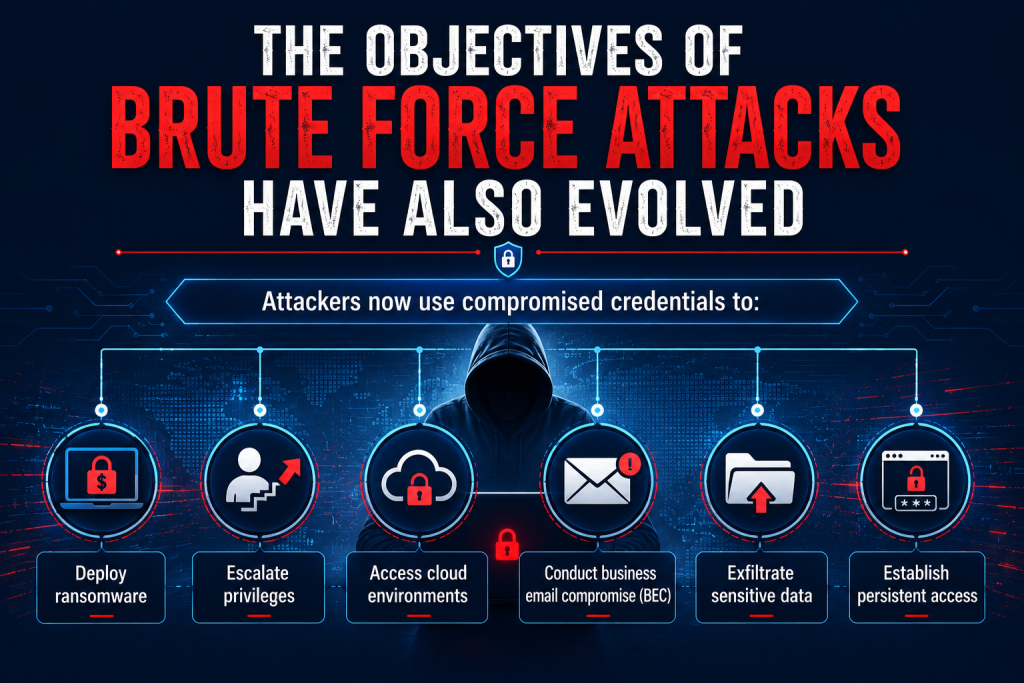
As a result, attackers can launch highly targeted campaigns while avoiding traditional rate-limiting controls.
Real-World Example of Brute Force Attacks
T-Mobile Breaches (1)
T-Mobile has experienced multiple security incidents over the years involving exposed systems and authentication weaknesses. These incidents demonstrated how inadequate identity protections can contribute to large-scale customer data exposure. The consequences included exposure of customer records, heightened regulatory scrutiny, financial losses, and reputational damage.Types of Brute Force Attacks
| Attack Type | Description | Attack Vector | Potential Harm |
|---|---|---|---|
| Simple Brute Force | Tries every possible password combination | User accounts | Unauthorized access |
| Dictionary Attack | Uses common words and phrases | Login portals | Credential compromise |
| Credential Stuffing | Uses stolen username-password pairs from previous breaches | Web applications | Account takeover |
| Password Spraying | Uses common passwords against many accounts | Enterprise identities | Large-scale compromise |
| Reverse Brute Force | Starts with a known password and searches for matching usernames | Corporate directories | Unauthorized access |
| Hybrid Brute Force | Combines dictionary attacks with variations and patterns | Cloud services | Expanded attack success |
| Distributed Brute Force | Uses botnets and multiple IP addresses | Internet-facing systems | Detection evasion |
| AI-Assisted Brute Force | Uses machine learning to predict likely passwords and attack paths | Identity systems | Faster compromise |
How AI Has Impacted Brute Force Attacks
Instead of manually crafting brute force attack campaigns, threat actors now use AI to automate large portions of the attack lifecycle, enabling them to:
- Generate Smarter Password Guesses: AI models can analyze leaked password databases to identify common password-creation trends. Examples include seasonal references, company names, sports teams, keyboard patterns, and predictable substitutions.
- Accelerate Reconnaissance: Generative AI can gather publicly available information from social media, corporate websites, and professional networking platforms to create highly targeted password lists.
- Improve Attack Automation: AI-powered systems can prioritize high-value targets, adjust attack timing, rotate infrastructure, and mimic legitimate user behavior.
Recent industry reports (2) indicate that AI is increasingly reducing the time between vulnerability discovery and exploitation, allowing attackers to operate at unprecedented speed.
Tools Commonly Used in Brute Force Attacks
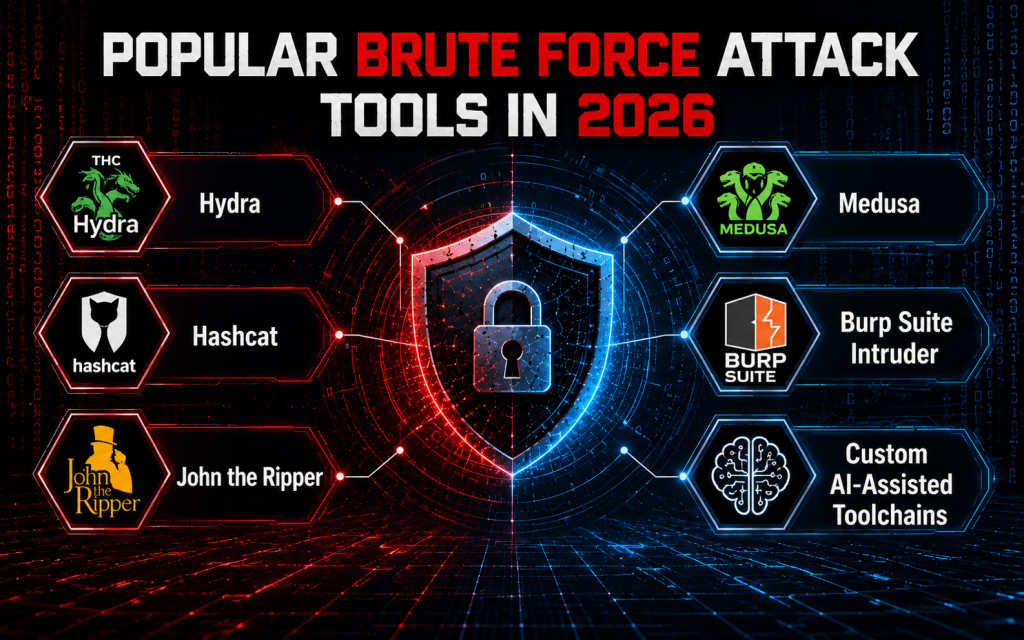
Cybersecurity professionals should understand and know how to use the tools attackers frequently use:
- Hydra: A popular open-source password-cracking tool that supports numerous authentication protocols.
- Hashcat: Widely considered one of the fastest password recovery tools available. It leverages GPU acceleration to crack password hashes.
- John the Ripper: A well-known password auditing and recovery platform used by both security professionals and attackers.
- Medusa: A parallelized login brute forcing tool that supports multiple protocols.
- Burp Suite Intruder: Often used during penetration testing to automate credential testing and authentication assessments.
- Custom AI-Assisted Toolchains: In 2026, attackers are integrating generative AI with traditional offensive security tools, creating highly adaptive attack frameworks.
How to Defend Against Brute Force Attacks in 2026
Defending against brute force attacks requires organizations and cybersecurity professionals to adopt a layered security strategy:
- Deploy Phishing-Resistant MFA: Modern MFA solutions that use FIDO2 security keys significantly reduce credential-based attacks.
- Implement Passwordless Authentication: Passwordless technologies eliminate one of the primary targets that attackers seek to exploit.
- Enforce Strong Identity Governance: Organizations should eliminate dormant accounts, apply least privilege access, and conduct periodic access reviews.
- Use Intelligent Rate Limiting: Adaptive controls can detect suspicious authentication patterns and slow attackers without disrupting legitimate users.
- Deploy Behavioral Analytics: Modern identity security platforms analyze user behavior, device fingerprints, geographic locations, and login patterns to detect and flag anomalies.
- Adopt Zero Trust Principles: Zero Trust assumes no user or device is automatically trustworthy and continuously validates access requests.
- Monitor Authentication Logs: Cybersecurity teams should actively hunt for failed login spikes, password-spraying indicators, geographic anomalies, and credential-stuffing attempts.
What to Learn to Become Skilled at Defending Against Brute Force Attacks
Cybersecurity professionals should master these key knowledge areas to become experts in defending against brute force attacks:
- Identity and Access Management (IAM): Understand authentication, authorization, federation, and identity lifecycle management.
- Cloud Security: Learn how authentication works across AWS, Azure, and Google Cloud environments.
- Threat Detection and Response: Develop skills in SIEM platforms, threat hunting, incident response, and security operations.
- Passwordless Technologies: Gain familiarity with FIDO2, WebAuthn, passkeys, and adaptive authentication.
- Offensive Security: Study attacker techniques to identify weaknesses before adversaries exploit them.
ECCU: Preparing Cybersecurity Professionals to Combat Brute Force Attacks
Brute force attacks may be among cybersecurity’s oldest threats, but they remain highly relevant in 2026. The combination of AI, automation, credential theft, and increasingly complex digital ecosystems has transformed brute force attacks into large-scale, identity-focused campaigns. Defending against these threats requires more than technical controls.
Organizations need cybersecurity professionals who understand identity security, threat intelligence, cloud environments, incident response, and emerging authentication technologies. EC-Council University’s online cybersecurity degrees and courses are designed to help you develop these in-demand skills. Through practical, career-focused cybersecurity education, learners gain the knowledge and skills to identify evolving threats, implement effective security controls, and protect organizations against modern cyberattacks, including increasingly powerful brute force attacks. To know more about how studying at EC-Council University (ECCU) can elevate your cybersecurity career: