Goodbye Passwords, Hello FIDO2?
Imagine it’s 8:15 a.m. on a Monday. You arrive at work, grab a coffee, and log in to your laptop using your fingerprint. You access your email without typing a password. You sign in to cloud applications without answering security questions. You authenticate a financial transaction using Face ID. Throughout the day, you never enter a password, yet your accounts are significantly more secure than before. A decade ago, this would have sounded unrealistic. Today, it’s becoming a new standard.
When it comes to defending against AI-powered phishing attacks, credential theft, and account takeovers, passwords are one of the most vulnerable entry points for cybercriminals. This is precisely why FIDO2 has become one of the most important authentication standards of the modern era.
FIDO2 is not simply another security technology. It represents a fundamental shift in how we prove our identity online, and may finally deliver what cybersecurity professionals have sought for decades: a practical path toward a future without passwords.
What Is FIDO2?
FIDO2 stands for Fast Identity Online 2. It’s an open authentication standard developed by the FIDO Alliance (1) in partnership with the World Wide Web Consortium (2).
The goal of FIDO2 is straightforward:
Replace passwords with stronger, phishing-resistant authentication methods.
Instead of relying on something you know (a password), FIDO2 uses cryptographic credentials stored securely on your device. Users authenticate themselves through:
- Fingerprints
- Facial recognition
- Device PINs
- Hardware security keys
- Passkeys
FIDO2 relies on public-key cryptography, creating a unique key pair for every account. The private key stays on your device, while the website or service stores the public key. This eliminates many of the risks associated with traditional passwords.
The Password Problem: Why FIDO2 is Gaining Traction
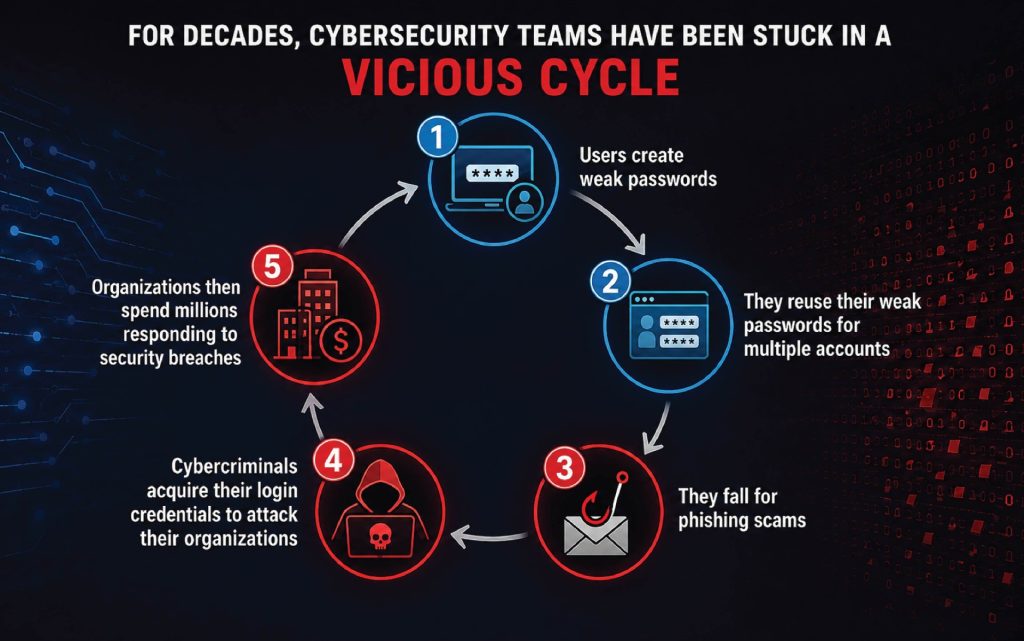
According to Verizon’s 2026 Data Breach Investigations Report (3), 77% of hacking-related breaches involve stolen credentials. But the problem isn’t that people are careless. The problem is that passwords were never designed for today’s threat landscape.
Modern attackers use combinations of:
- Automated and hyper-personalized phishing campaigns
- Credential stuffing attacks
- Malware
- Deepfakes
- Social engineering
- Password database hacks
In response, organizations added multi-factor authentication (MFA). While MFA improved security, it also increased friction for users. FIDO2 addresses both challenges simultaneously by offering stronger security and a better user experience.
How FIDO2 Works
One of the biggest misconceptions about FIDO2 is that it is complicated. In reality, the user experience is remarkably simple. The following occurs when you register with a FIDO2-enabled service:
- Step 1: Key Pair Creation – Your device generates two cryptographic keys, a private key and a public one. The public key is shared with the service, while the private key never leaves your device.
- Step 2: Authentication Request – The service sends a unique authentication challenge when you log in.
- Step 3: Local Verification – You verify your identity using your fingerprint, face scan, PIN, or security key.
- Step 4: Cryptographic Proof – Your device uses the private key to sign the challenge. The server verifies the signature using the public key.
Access is granted after completing these steps. No password is transmitted, and no shared secret exists. Which means nothing useful can be stolen from the login process.
Why FIDO2 Is Resistant to Phishing
Phishing remains one of the most successful cyberattack techniques because users willingly provide passwords to fake websites. FIDO2 changes the equation.
Each credential is bound to a specific website domain. A passkey created for a legitimate banking website cannot authenticate a phishing website pretending to be that bank. Cornell University’s recent research (4) analyzing FIDO2 attack vectors concluded that passkeys significantly raise the barrier for attackers and that claims of phishing resistance are largely accurate. This is one reason many cybersecurity experts consider FIDO2 the most important authentication advancement since the introduction of MFA.
The Rise of Passkeys
If FIDO2 is the engine, passkeys are the vehicle driving mass adoption. Passkeys are FIDO credentials synchronized across devices through trusted ecosystems such as those of Apple, Google, and Microsoft.
The results have been remarkable. According to the FIDO Alliance (5):
- Passkey awareness increased from 39% in 2022 to 57% in 2024.
- 53% of users reported enabling passkeys on at least one account.
- More than 15 billion online accounts can now support passkeys.
- 61% of users believe passkeys are more secure than passwords.
These figures clearly show that the momentum behind password-free authentication is growing day by day.
Where FIDO2 Is Being Used
FIDO2 adoption spans nearly every industry:
- Enterprise Security: Organizations use FIDO2 to secure employee access to cloud platforms, VPNs, corporate networks, and administrative systems.
- Financial Services: Banks and Fintech platforms use FIDO2 to reduce fraud and account hijacking.
- Healthcare: Healthcare providers use passwordless authentication to protect patient data and improve clinician workflows.
- Government: Government agencies increasingly view phishing-resistant authentication as a national security priority.
- Consumer Applications: Major tech companies, including Apple, Google, Microsoft, and Amazon, now support passkeys based on FIDO standards.
The Main Benefits of FIDO2
Key benefits of FIDO2 include:
- Stronger Security: There are no reusable passwords to steal.
- Phishing Resistance: Credentials work only with their registered service.
- Better User Experience: Users authenticate with biometrics or a simple PIN.
- Lower IT Costs: Password resets remain one of the most common help desk requests. Passwordless authentication reduces this burden.
- Support for Zero Trust: FIDO2 aligns closely with modern Zero Trust security architectures that emphasize strong identity verification.
FIDO2 is Not Perfect
While FIDO2 can be transformative, it also poses unique challenges. Organizations should keep the following in mind:
- Legacy Systems: Older applications may not support WebAuthn or passkeys.
- User Education: Many users still do not understand concepts of passwordless authentication. Community discussions frequently highlight confusion around device recovery and cross-device access.
- Recovery Planning: Organizations must establish secure account recovery procedures when devices are lost or replaced.
- Implementation Complexity: Large enterprises often need to modernize identity infrastructure before deploying FIDO2 at scale.
These challenges are manageable, but they require planning.
Why Cybersecurity Professionals Should Learn FIDO2
The cybersecurity industry is rapidly shifting toward identity-centric security, making FIDO2 expertise increasingly valuable.
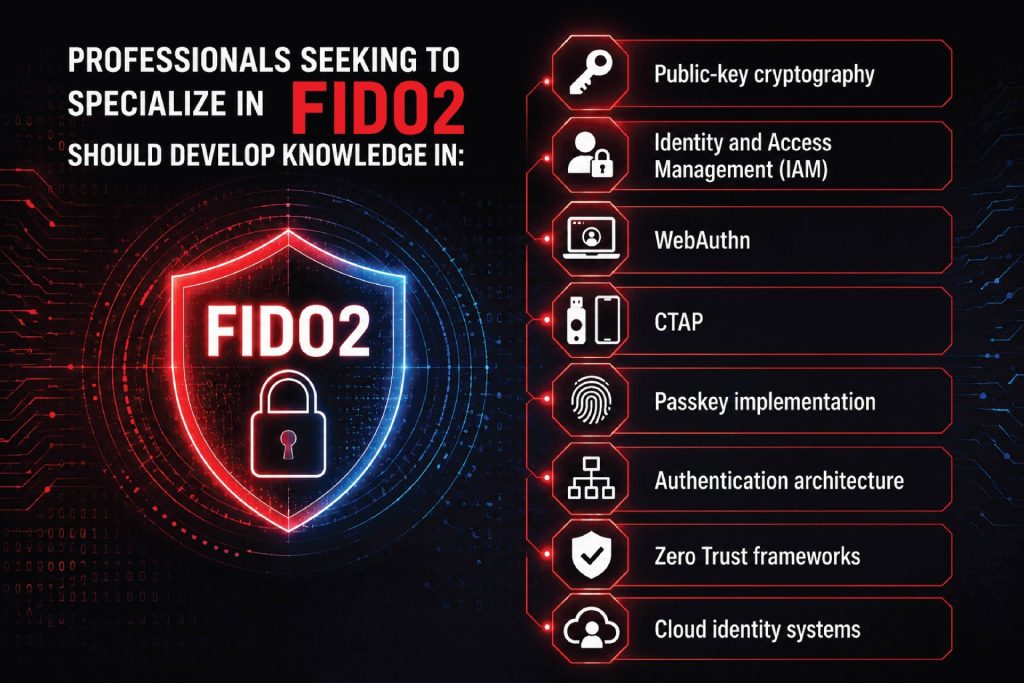
The professionals who understand these technologies today will help shape the next generation of digital identity.
The Future of FIDO2
For years, cybersecurity innovators have talked about eliminating passwords. Now, for the first time, the industry has a realistic path forward. Microsoft, Google, Apple, and many other organizations are actively promoting passkeys and passwordless authentication as the future of identity security.
Will passwords disappear entirely? Probably not overnight, but the direction is clear. Authentication in the future will rely less on secrets that users must remember and more on cryptographic proof that attackers cannot easily steal. FIDO2 is at the center of that transformation.
For cybersecurity professionals, understanding FIDO2 is essential for becoming experts in passwordless security. EC-Council University helps develop this understanding through our range of online cybersecurity degrees and certification courses, where learners can gain unique insights into core FIDO2 concepts, such as Zero Trust, IAM, cryptography, cloud security, and more.
Frequently Asked Questions
What does FIDO2 stand for?
FIDO2 stands for Fast Identity Online 2, an open authentication standard that enables passwordless, phishing-resistant authentication.
Is FIDO2 the same as a passkey?
No. FIDO2 is the underlying standard, while passkeys are a user-friendly implementation of FIDO2 authentication.
Does FIDO2 eliminate passwords completely?
It can, although some organizations maintain passwords as backup authentication methods during migration.
What is WebAuthn?
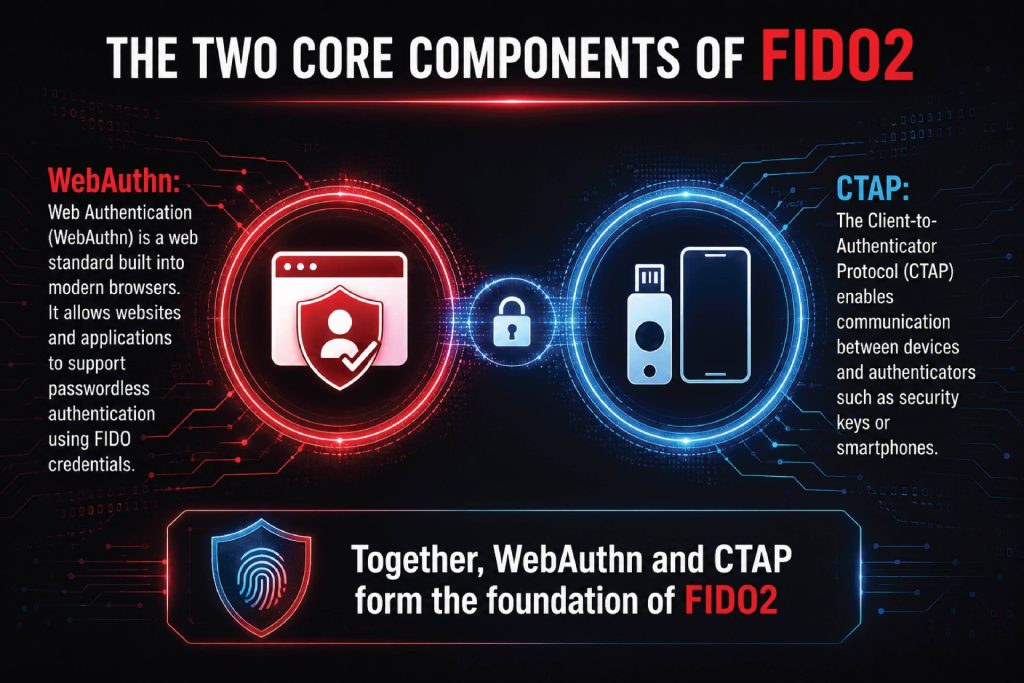
WebAuthn is shorthand for Web Authentication. It’s the web standard that enables browsers and applications to support FIDO2 authentication.
What is the purpose of CTAP?
CTAP (Client-to-Authenticator Protocol) allows devices and security authenticators to communicate securely.
Is FIDO2 resistant to phishing?
Yes. FIDO2 credentials are bound to specific domains, making traditional phishing attacks far less effective
Do I need special hardware to use FIDO2?
Not necessarily. Many smartphones, laptops, and tablets already include built-in FIDO2 authenticators through biometrics or PINs.
Why is FIDO2 important for cybersecurity professionals?
FIDO2 is becoming a core component of Zero Trust, identity security, and passwordless authentication strategies across modern enterprises.