Most security professionals are technically sharp. They know the tools, the threats, and the protocols cold. But technical depth alone rarely gets you to the C-suite. Boards do not want another technician at the table. They want someone who understands business risk. That gap stops most mid-career professionals before the boardroom.
An MBA in Cybersecurity is built to bridge that gap. It does not replace your technical expertise. It gives that expertise a language that boards and CFOs actually understand. You learn to frame security as a business risk function. You gain financial literacy, governance depth, and leadership range. This blog covers what the degree actually teaches, which roles it opens, how it compares to a technical master’s, and how ECCU’s two online MBA tracks differ.
Key Takeaways
- Technical expertise alone rarely leads to the C-suite.
- Boards measure CISOs by risk framing, not technical proficiency.
- A cybersecurity MBA builds financial literacy, GRC skills, and leadership range.
- SEC disclosure rules have made cyber governance a board-level obligation.
- CISO total compensation at large enterprises exceeds $320,000.
- A cybersecurity MBA and an MS in cybersecurity solve different problems, not competing ones.
- ECCU offers two MBA tracks built for distinct career trajectories.
- Working professionals can complete this degree in 18 to 24 months.
What Is an MBA in Cybersecurity?
An MBA in Cybersecurity is a business administration degree with a cybersecurity specialization built into the core. It differs from a standard MBA in one specific way: the strategy, finance, and leadership coursework is applied directly to security decisions instead of generic case studies.
You still study financial management, organizational behavior, and marketing, the same foundation every MBA student covers. Layered on top, you study risk quantification, regulatory compliance, governance frameworks, and how to communicate cyber risk to a board. Some programs, ECCU’s included, bundle industry certifications directly into coursework, so you graduate with credentials alongside the degree instead of pursuing them separately.
The degree targets a specific gap. Certifications like CISSP or CEH prove technical competence. They do not teach you how to build a budget case, negotiate with a CFO, or sit on a risk committee. An MBA in Cybersecurity is built for that second skill set.
The Gap Between Security Expertise and Business Leadership
The numbers make this concrete. There are only 35,0001 CISOs worldwide. They serve roughly 359 million businesses. That is a 10,000-to-1 ratio. The supply of security-ready executives has never matched demand.
The reason this gap persists is structural. Security professionals get promoted for technical skill. Then they reach the boardroom, and the rules change. A 2026 IANS benchmark report studied CISO-board dynamics across hundreds of organizations. It found that those interactions average just 302 minutes per quarter. Only 30% of boards rate their relationship with the CISO as strong.
The NACD’s 2025 Board Practices and Oversight Survey spells it out. Boards want business metrics. That means revenue loss, downtime costs, and regulatory exposure. Not CVE counts. Not patch timelines.
Regulatory stakes have sharpened this further. Since December 2023, the SEC has tighter breach disclosure rules in effect. Public companies must disclose material breaches within 4 business days. The filing goes through Form 8-K. Legal, investor, and reputational exposure all now come with the CISO role. That is an executive function, not a technical one.
Budget pressure compounds it. In 2025, only 47%3 of CISOs reported a budget increase. That is down from 62% the prior year. Winning that conversation requires ROI framing, not just threat data.
What a Cybersecurity MBA Actually Teaches
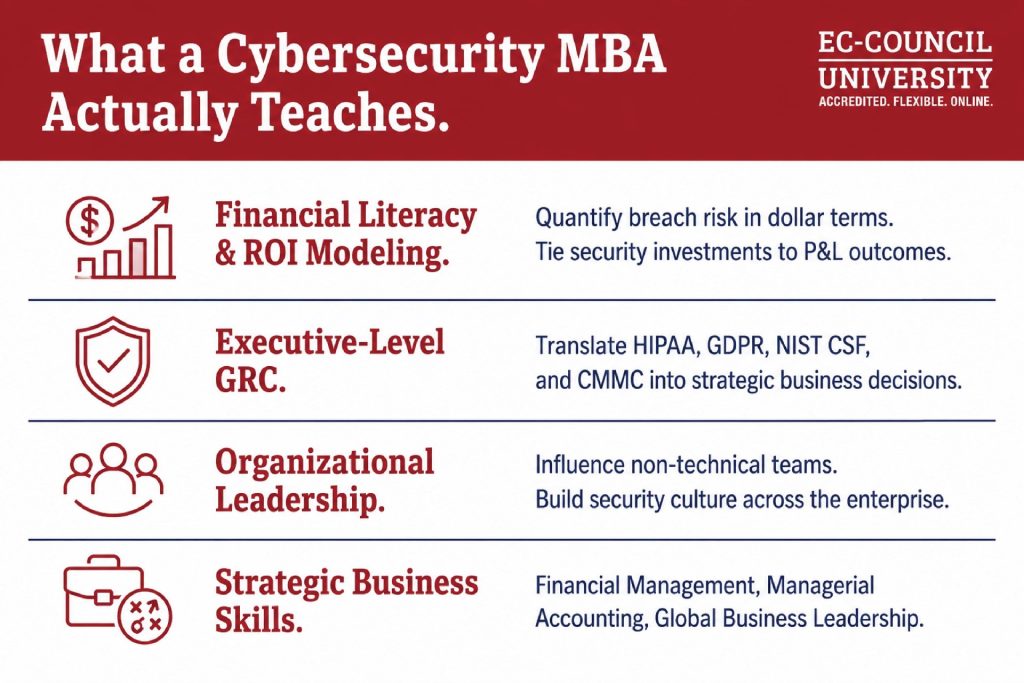
A cybersecurity MBA does not revisit vulnerability assessments. It does not rehash pen testing fundamentals. It adds the business layer that technical training consistently skips. Here is what you actually build:
- Financial literacy and ROI modeling: You learn to quantify breach risk in dollar terms. Security investments get tied to P&L outcomes. This changes how leadership hears your proposals.
- Executive-level GRC: These regulatory frameworks all carry direct business consequences: HIPAA, PCI-DSS, GDPR, NIST CSF, and CMMC. You learn to translate those obligations into strategic decisions.
- Organizational leadership: Security culture does not get built through policy documents. You learn to influence non-technical teams and drive change at scale.
- Strategic business skills: Core courses cover Financial Management, Managerial Accounting, and Global Business Leadership. These tools let you sit credibly at the executive table.
EC-Council’s Certified CISO Hall of Fame Report makes this shift concrete. Three in four CISOs ranked AI risk communication as most critical for executive leadership. That is a governance challenge. No security certification prepares you for it like a businessintegrated degree does.
MBA in Cybersecurity vs. MS in Cybersecurity
Both degrees sit at the master’s level. Both take working professionals 18 to 24 months to finish online. The similarity ends at the curriculum.
An MS in Cybersecurity goes deeper technically. Expect coursework in penetration testing, digital forensics, cloud security architecture, or incident response, depending on the specialization. It prepares you to lead technical teams and own security architecture decisions.
An MBA in Cybersecurity goes deeper on the business side. Expect coursework in financial management, organizational leadership, and enterprise risk governance, applied to a security context. It prepares you to sit in the room where budget, regulatory exposure, and enterprise risk decisions get made.
Neither degree replaces the other. The right choice depends on where your career plateaus:
- Choose an MS in Cybersecurity if you want to go deeper technically. Roles like Security Architect, Cloud Security Engineer, or Digital Forensics Lead reward this path.
- Choose an MBA in Cybersecurity if your technical skills are already strong and the barrier is business fluency. Roles like CISO, Director of Information Security, or Chief Risk Officer reward this path.
Some professionals pursue both over time. Technical depth gets you promoted into a leadership track. Business fluency gets you promoted through it.
ECCU's Two MBA Tracks
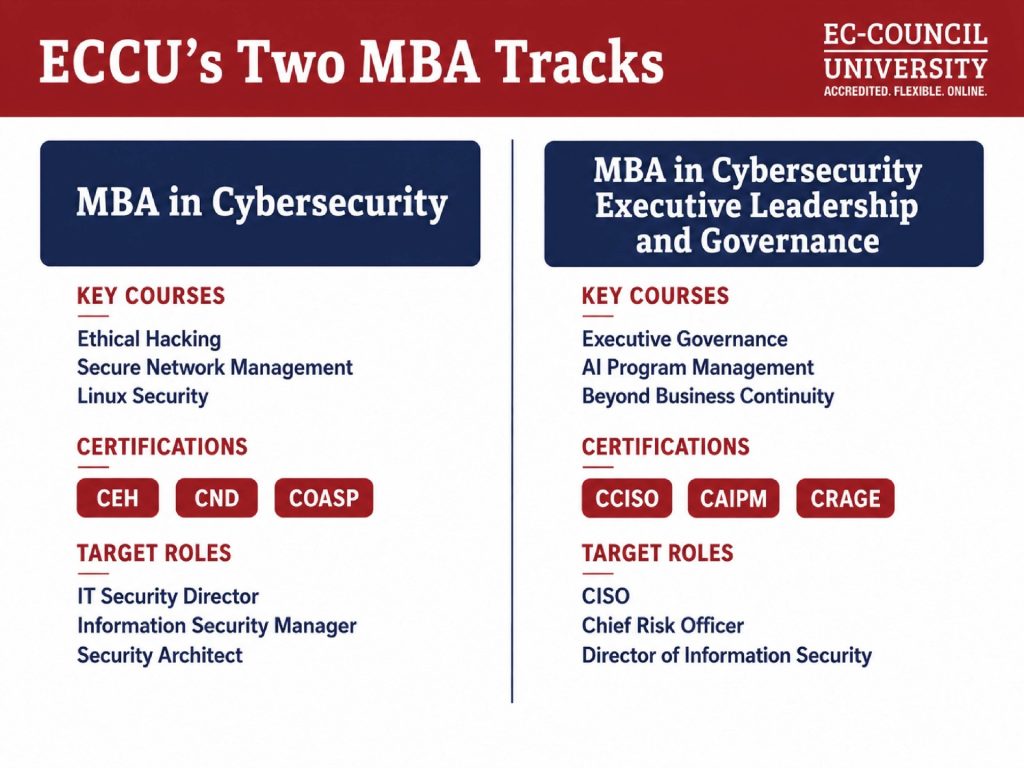
ECCU offers two MBA specializations in cybersecurity. Both run 18 to 24 months and are 100% online. Each includes up to three EC-Council certifications, earned as part of coursework rather than pursued separately. They serve different career goals.
The MBA in Cybersecurity blends technical security with core business skills. Core courses cover Financial Management, Marketing Management, and Leadership in
Organizations. Specialization courses include Ethical Hacking, Secure Network Management, and Linux Security. Certifications included are CEH, CND, and COASP. It targets professionals moving toward roles like IT Security Director, Information Security Manager, or Security Architect. According to Indeed, salaries for this track range from $83,651 to $182,719.
The MBA in Cybersecurity Executive Leadership and Governance is built for the CISO track. Courses include Executive Governance and Management, AI Program Management and Governance, and Beyond Business Continuity. Certifications include CCISO, CAIPM, and CRAGE. Roles include CISO, Chief Risk Officer, and Director of Information Security. According to Payscale, salary ranges from $246,758 to $454,683.
Both tracks share the same 27-credit core: Business Essentials, Foundations of Organizational Behavior, Global Business Leadership, Leadership and Management in Organizations, Managerial Accounting, Financial Management, Marketing Management, Introduction to Research and Writing, and the Capstone. From there, each track adds three specialization courses chosen from a track-specific list, for 36 credits total across 12 courses. Both programs close with the same capstone project, applied to whichever specialization track the student chose. ECCU is accredited through DEAC and recognized by CHEA. Fortune has ranked it among the Top 10 online cybersecurity master’s programs. ECCU reports that 95% of graduates find jobs within one year, and 92.2% say they achieved their career goals after graduating.
Industries That Value MBA-Credentialed Security Leaders
Demand for business-literate security leaders is not evenly spread. It concentrates in industries where regulatory exposure and breach cost are highest:
- Financial services: Banks and fintechs face the tightest regulatory stack (SOX, GLBA, PCI-DSS) and carry some of the highest average breach costs of any sector.
- Healthcare: HIPAA liability and the sensitivity of patient data make governanceliterate security leadership a board-level requirement, not a nice-to-have.
- Government and defense contracting: CMMC compliance has turned cybersecurity governance into a condition of doing business with federal agencies, not an internal policy choice.
- Critical infrastructure and energy: NIST CSF alignment and operational technology risk require leaders who can translate engineering risk into business and regulatory terms.
- Insurance: Cyber insurers increasingly require documented governance maturity before underwriting a policy, which puts security leadership directly in the risktransfer conversation.
Across all five, the common thread is the same one this blog opened with. Technical teams manage the risk. Business-literate leaders are the ones trusted to represent that risk to a board, a regulator, or an underwriter.
MBA in Cybersecurity Cost and ROI
ECCU’s Master’s-level tuition runs $540 per semester credit hour. At 36 credits, the MBA totals $19,440 in core tuition, before the one-time application fee, per-term technology fee, and graduation fee that apply to every ECCU graduate program. That figure sits well below the national average for a cybersecurity MBA, which Programs.com puts at roughly $41,850 across more than 600 programs analyzed.
The investment makes sense when you look at where the salary ceiling actually sits. Glassdoor’s March 2026 data places CISO total compensation at approximately $320,800. Director of Cybersecurity roles average $264,900. Both figures sit well above the Information Security Manager range. The gap you are bridging changes how the program cost looks.
Funding options matter too. SHRM’s 2024 data shows 46% of US employers offer graduate tuition assistance. ECCU’s asynchronous format means you stay employed throughout. That makes the employer conversation considerably easier. Veterans can apply Post-9/11 GI Bill benefits toward ECCU’s programs. Coverage runs up to $29,920 per year for the 2025/26 term. For professionals with 5+ years in security, delay is expensive. This degree is an accelerant.
Is an MBA in Cybersecurity Worth It?
For a specific profile of professional, yes. The degree pays off fastest for security practitioners who already have 5 or more years of technical experience and are stuck below director level because the next promotion requires budget ownership, board exposure, or cross-functional leadership rather than deeper technical skill.
It is a weaker fit for two groups. Early-career analysts still building technical depth usually get more immediate career value from a technical certification or an MS in Cybersecurity. Professionals already operating at CISO or VP level with strong business fluency may find the coursework covers ground they have already learned on the job.
The honest way to evaluate it: this degree accelerates a transition that is already underway. It does not create that transition from nothing.
Conclusion
The CISO role has changed. Boards expect risk framing. Regulators expect breach accountability. CFOs expect ROI. Technical professionals stuck in threat-speak keep hitting the same wall. Nothing changes that, regardless of how deep the expertise goes.
An MBA in Cybersecurity does not make you less technical. It makes your technical knowledge far more useful at the level where real decisions get made.
Ready to move from the technical trenches to the boardroom? Explore ECCU’s MBA in Cybersecurity. It is built for security professionals who are ready to lead.
Frequently Asked Questions
An MBA in Cybersecurity is a business administration degree that applies core MBA coursework, finance, strategy, and leadership, directly to security decisions. It is built to give technically strong professionals the business fluency needed for executive roles, not to teach new technical skills.
Choose an MS in Cybersecurity to go deeper technically, toward roles like Security Architect or Digital Forensics Lead. Choose an MBA in Cybersecurity to build the business and governance fluency that roles like CISO or Director of Information Security require. The two solve different career plateaus, not the same one.
A formal technical background is not a strict entry requirement. ECCU’s admissions team reviews your transcripts, experience, and professional history to assess fit. That said, some prior exposure to cybersecurity or IT concepts will help you get more from the curriculum, especially in the specialization courses that assume baseline familiarity with security frameworks.
A general MBA with a tech elective covers security at the surface level. ECCU’s cybersecurity MBA integrates governance, risk management, compliance, and AI governance into the full curriculum, not just one or two modules. Certifications like CCISO, CEH, and CRAGE are embedded in the program, which distinguishes it sharply from a standard business degree with a few technology topics bolted on.
Yes. The program is 100% online and fully asynchronous, meaning you set your own study schedule around work commitments. The 18 to 24 month timeline is designed for working professionals, and most students stay employed throughout. This structure also makes it easier to qualify for employer tuition reimbursement, since active employment is often a condition for that benefit.
For a CISO target, the Executive Leadership and Governance specialization is the stronger path. It covers executive governance, business continuity, and AI governance frameworks, and includes the CCISO certification, which carries significant weight with employers evaluating senior security candidates. The Cybersecurity specialization suits professionals who want business grounding but plan to stay closer to technical security operations.
It is worth it for security professionals with 5 or more years of technical experience who are stuck below director level because the next step requires budget ownership or board exposure, not deeper technical skill. It is a weaker fit for early-career analysts and for professionals already operating comfortably at CISO or VP level.
ECCU is accredited through DEAC, a CHEA-recognized organization, and has been ranked among Fortune’s Top 10 for online cybersecurity master’s degrees. The university reports that 95% of graduates secure employment within a year and 92.2% achieve their career goals after graduation.