
At some point in a cybersecurity career, the certification track stops being enough. Promotions slow down. Senior roles start requiring credentials you do not have. That is usually when a master’s degree enters the conversation. But the question is not just whether to get one. It is whether the salary lift justifies the cost, which specialization pays the most, and whether ECCU specifically delivers on its outcomes. This blog maps what professionals earn at each level, where a graduate degree changes what roles you can access, and how to run the ROI calculation for your own situation. It also puts ECCU’s graduate outcomes in honest context.
Key Takeaways
- A cybersecurity master’s can lift your starting salary by 15 to 25 percent.
- Senior roles like Security Architect and CISO almost universally expect an advanced degree.
- ECCU’s MSCS costs around $19,440, making ROI recovery faster than most programs.
- Cloud Security Architecture is currently the highest-paying MSCS specialization track.
- Half of ECCU’s graduates have achieved six-figure salaries.
- Employer tuition reimbursement can reduce your out-of-pocket cost to near zero.
- Job security in cybersecurity remains stronger than nearly any other tech sector.
The Baseline: What Cybersecurity Professionals Earn Without a Master's
Most cybersecurity careers begin with a bachelor’s degree and a certification. That combination opens real doors. But it also has a ceiling.
Entry-level roles and what they pay
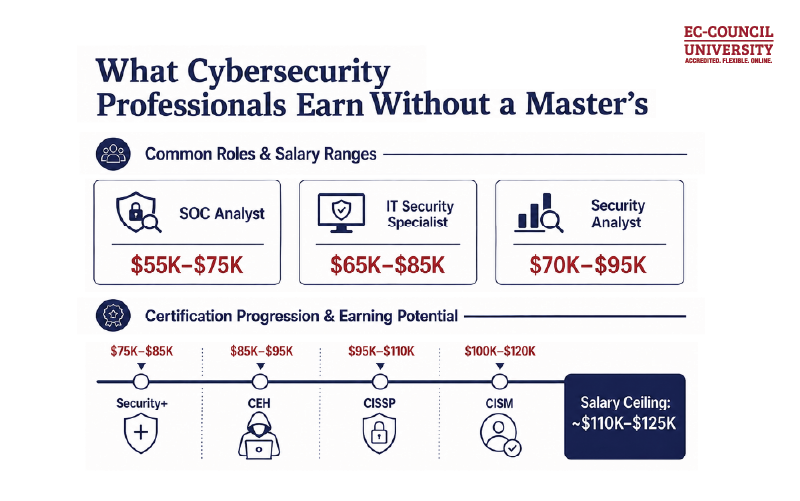
Here are the median salary ranges for common starting roles:
- SOC Analyst: $55,000 to $75,000
- IT Security Specialist: $65,000 to $85,000
- Security Analyst: $70,000 to $95,000
Entry-level professionals sit well below the field average. BLS puts the 2024 median at $124,910 for information security analysts. The gap reflects years of experience, certifications, and often a graduate degree.
The certification track and where it stalls
Certifications like Security+, CEH, and CISSP are genuine salary drivers. They can add 10 to 15 percent to a professional’s salary. CISM holders average between $140,000 and $167,000. Those are strong numbers.
But certifications validate technical competency. They rarely satisfy the criteria for senior leadership roles. In government contexts, they do not replace academic credentials for grade advancement. Without a graduate degree, mid-career professionals frequently stall around $110,000 to $125,000.
The Graduate Degree Premium: What the Data Shows
The salary lift from a bachelor’s to a master’s is real. The size of the gap depends on experience and role level.
Entry-level MS graduates typically earn between $85,000 and $95,000. That is roughly 15 to 25 percent more than peers with only a bachelor’s degree. At mid-career, master’s holders earn between $110,000 and $130,000. Bachelor’s-only professionals average $90,000 to $105,000. The gap widens as seniority increases.
Where the degree becomes non-negotiable
- Security Architect: Glassdoor puts the average Cyber Security Architect salary at $195,062 in the US. Many employers prefer candidates with master’s degrees for this role, and senior specialists regularly earn above $200,000.
- CISO: The C-suite track is where a master’s becomes close to mandatory. Many employers require CISOs to hold an advanced degree. Glassdoor places the average CISO salary at $262,245 in the US as of 2026. A bachelor’s-only CISO earns around $112,000 on average. One with a master’s earns closer to $145,000 at that same career stage.
- Federal and DoD roles: Government cybersecurity roles follow the General Schedule (GS) pay system. A master’s degree can qualify candidates for GS-11 entry points instead of GS-7. That means more money from day one. DoD’s Cyber Excepted Service, introduced in 2016, now allows defense agencies to pay closer to market rates, as outlined in OPM’s compensation guidance. Academic credentials still influence band placement.
Salary Ranges by Specialization: Which Track Pays the Most?
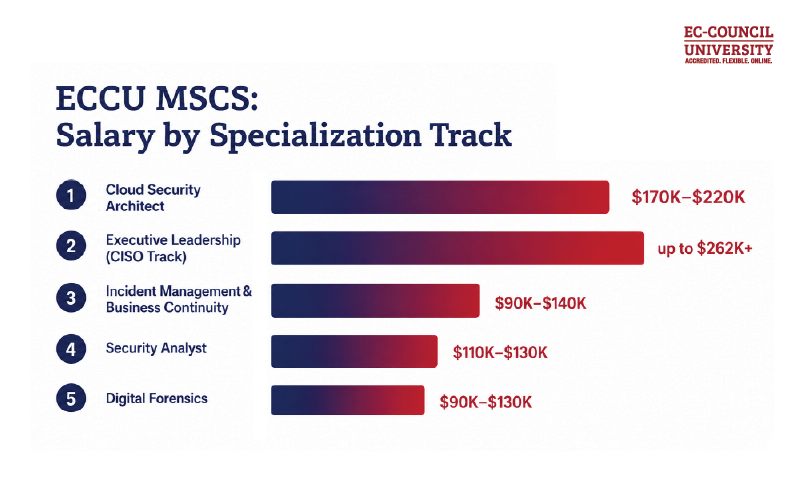
ECCU’s MSCS program offers five specialization tracks. Each maps to a distinct market salary band. Here is how they compare:
- Cloud Security Architect: Senior specialists earn $170,000 to $220,000. Highest ceiling of all tracks, driven by acute cloud expertise shortages.
- Executive Leadership in Information Assurance: This track leads toward CISO and director-level roles. Average CISO compensation sits at $262,245, with top earners well above that.
- Security Analyst: Mid-to-senior analysts with a master’s earn $110,000 to $130,000. A strong fit if you are already working in a SOC environment.
- Digital Forensics: Specialized forensic roles sit in the $90,000 to $130,000 range. Demand is rising as incident response becomes a boardroom-level concern.
- Incident Management and Cyber Operations: Incident response specialists earn $90,000 to $140,000. Consulting roles in this space pay a premium for highstakes experience.
Total Return Calculation: Degree Cost vs. Career Earnings
The ROI framework
Your return equals the salary lift multiplied by career years remaining. Subtract the degree cost and any opportunity cost during study. What is left is your net gain.
ECCU’s MSCS is priced at $19,440. That is less than one semester at many US research universities. A $15,000 annual lift recovers that cost in under 18 months. A $25,000 annual lift over 20 remaining career years returns over $480,000.
ECCU’s ROI breakdown shows a typical 20 to 40 percent salary lift. Individual results depend on role, location, and experience.
Funding options that change the equation
You may not pay full tuition at all. Three routes worth exploring:
- Employer tuition reimbursement: According to SHRM’s 2024 Employee Benefits Survey, 46 percent of US employers offer undergraduate or graduate tuition assistance. Cybersecurity is a field where employers actively want to upskill and retain staff. ECCU’s online, asynchronous format lets you stay employed throughout the program. That makes the employer conversation considerably easier.
- GI Bill benefits: Veterans can apply Post-9/11 GI Bill benefits toward ECCU’s MSCS. Private institution tuition is covered up to $29,920 per year for the 2025/26 academic year. ECCU’s tuition falls well within that cap.
Beyond Salary: Non-Financial Returns Worth Accounting For
- Job security and recession resilience: Cybersecurity is one of the few tech sectors that stayed above its pre-pandemic employment baseline. BLS projects 29 percent growth in analyst roles from 2024 to 2034. Budget cuts have hit hiring in some sectors. The underlying demand here continues to outpace supply.
- Remote work access: Cybersecurity is among the most remote-friendly technical fields. Threat analysis, incident response, and security architecture do not require physical presence. A master’s degree strengthens your case for senior remote roles. If you want to see what those roles look like today, this guide to remote cybersecurity jobs in 2026 breaks down the market. Those roles tend to pay competitively.
- Leadership credibility and promotion velocity: Promotions to management and C-suite roles happen faster with a graduate credential. The degree signals structured security thinking, not just hands-on skills. That distinction matters to hiring committees evaluating senior candidates.
Calculate your return. Explore ECCU’s MSCS program costs, financial aid options, and graduate outcomes, and see what a cybersecurity master’s could mean for your earning trajectory.
Frequently Asked Questions
Does a master's in cybersecurity really increase salary that significantly?
It depends on where you start and where you are headed. Entry-level MS graduates earn 15 to 25 percent more than bachelor’s-only peers. The gap compounds significantly at senior and leadership levels.
Which cybersecurity specialization has the highest earning potential?
Cloud Security Architecture commands the highest salaries. Senior specialists earn $170,000 to $220,000. The Executive Leadership track leads toward CISO roles. Total compensation regularly exceeds $250,000 at large organizations.
How does ECCU's MSCS tuition compare to competitor programs?
ECCU’s MSCS starts at $19,440. That is well below comparable programs at US research universities. The Fortune Top 10 ranking confirms quality is not traded for cost.
Can I get employer tuition assistance for ECCU's MSCS?
Many students do. SHRM’s 2024 survey found 46 percent of US employers offer tuition assistance. Cybersecurity qualifies as a high-priority skills area for most organizations. ECCU’s online format lets you stay employed throughout the program.
Are ECCU graduates actually earning six-figure salaries?
Half of ECCU’s graduates have achieved six-figure salaries. Two-thirds report significant career advancement. These are program-level outcomes. Individual results will vary by prior experience, specialization, and location.