Most online cybersecurity master’s degrees follow a predictable template. A core curriculum, a capstone project, a diploma. The problem is not that those programs are bad. The problem is that they were not built with a specific professional in mind. They were built for broad enrolment.
EC-Council University’s Master of Science in Cyber Security (MSCS) takes a different approach. ECCU sits at an unusual intersection: it is the academic arm of EC-Council, the body that created the Certified Ethical Hacker credential and has trained cybersecurity professionals across government and enterprise for over two decades. That structural position shapes everything about the MSCS, from how the curriculum is assembled to what a graduate walks away with.
This blog covers five structural features that set the ECCU MSCS apart from the typical online cybersecurity master’s. It also covers how to use those features as a filter when choosing the program that is right for your career stage and goals.
Key Takeaways
- The MSCS prepares you for up to four industry certifications without extra cost or separate study.
- Five specializations let you target a specific career outcome, not just a general credential.
- Curriculum is built around the NICE Framework and DoD 8140, not just academic preference.
- The program was designed for working professionals from the ground up.
- Transfer credits, including from existing EC-Council certifications, can shorten your path.
- EC-Council’s DoD 8140 recognition opens doors in federal and defense-sector hiring.
- Graduating with a degree and active certifications is a dual signal most programs cannot replicate.
1. EC-Council Certifications Are Embedded in the Degree
Most programs treat certifications and degrees as separate tracks. You study for a degree here, prepare for certifications on your own time, somewhere else. The financial and time cost of running both tracks in parallel is significant.
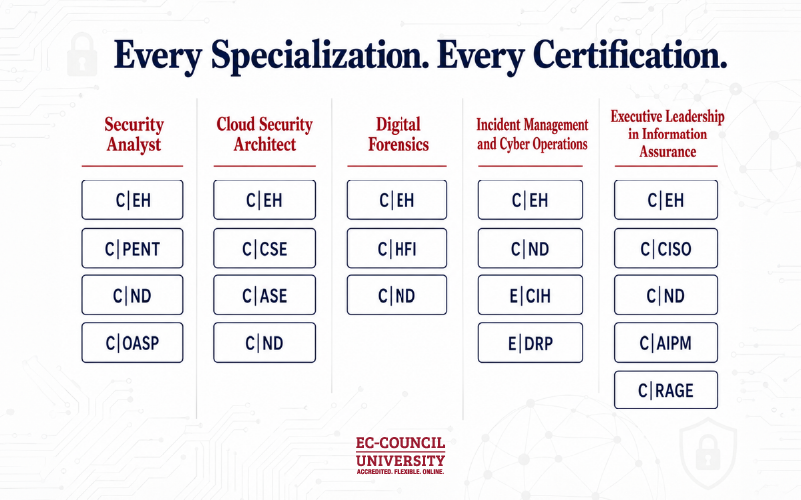
The ECCU MSCS works differently. The coursework is designed to directly cover the knowledge requirements for EC-Council certifications. Depending on your specialization, you become eligible to sit for up to five industry-recognized EC-Council certifications upon completing the program. These include credentials like the Certified Ethical Hacker (CEH), Computer Hacking Forensic Investigator (CHFI), Certified Network Defender (CND), and EC-Council Certified Incident Handler (ECIH). You are not paying for exam prep separately. The preparation is the degree.
This matters for career outcomes in a concrete way. EC-Council certifications are recognized under DoD 8140 across 31 critical roles in the DoD Cyberspace Workforce Framework. That covers roles in federal agencies, defense contractors, and national infrastructure positions where a certification on a resume is not optional. It is a baseline requirement. Graduating with both a master’s degree and active EC-Council credentials gives your profile a dual signal that generic academic-only programs simply cannot replicate.
2. Five Specializations, Not One Generic Cybersecurity Track
Here is the honest problem with most cybersecurity master’s degrees. They prepare you to work in cybersecurity generally. That sounds reasonable until you are sitting across from a hiring manager who needs a cloud security architect, and you have a degree in “cybersecurity.” The credential exists. The specificity does not.
ECCU solves this with five distinct specialization tracks, each mapped to defined job roles and real career outcomes:
- Security Analyst: Targets threat monitoring, vulnerability assessment, and SOC-level operations.
- Cloud Security Architect: Targets cloud infrastructure security across onpremise and cloud environments.
- Digital Forensics: Targets forensic investigation, evidence handling, and litigation support.
- Incident Management and Cyber Operations: Targets response planning, containment, and operational recovery.
- Executive Leadership in Information Assurance: Targets CISO-track and senior governance roles.
Each specialization has well-defined job prospects derived from the NICE Framework, published by the National Institute of Standards and Technology. You are not choosing a flavor of the same program. You are choosing a defined career direction and studying toward it. For a detailed breakdown of what each track covers and which roles it targets, see ECCU’s guide to cybersecurity master’s specializations.
How to pick the right one: If you are already working in a technical role and want to move into leadership, the Executive Leadership track is the logical path. If you are shifting from IT into a security function, Security Analyst or Cloud Security Architect gives you the specificity to compete. If your work already intersects with legal, compliance, or law enforcement, Digital Forensics or Incident Management is the stronger fit.
3. Curriculum Built and Reviewed by Active Industry Practitioners
Academic curriculum design has a well-known lag problem. Courses built without current operational input often cover threats and frameworks that the industry has already moved past. In cybersecurity, that gap is not a minor inconvenience. It is a career risk.
ECCU addresses this through its Industry Advisory Board, which keeps the curriculum aligned with current threat environments and employer expectations. The result is coursework that reflects what practitioners are actually dealing with at work, not what was documented two or three years ago in a textbook.
The alignment goes beyond internal review. The program maps to both the NICE Cybersecurity Workforce Framework and DoD 8140, the two most widely used federal standards for defining what cybersecurity professionals should know. When a hiring manager in a government or enterprise setting reviews your degree, NICE and DoD 8140 alignment tells them the curriculum has been benchmarked against a recognized external standard.
This is also where the broader ECCU ecosystem adds something most programs cannot offer. The curriculum now incorporates AI-specific content, including offensive AI security and AI governance, reflecting where the threat landscape is actually heading. If you want to understand how ECCU weaves AI into the MSCS specifically, this breakdown of AI integration in the ECCU master’s program covers it in full.
4. Designed for Working Professionals, Not Simply Adapted for Them
There is a difference between a program that is technically available online and one that was built from scratch for someone with a full-time job. Many programs fall into the first category. They offer recorded lectures and flexible deadlines, but the underlying structure still assumes you have large, uninterrupted blocks of study time.
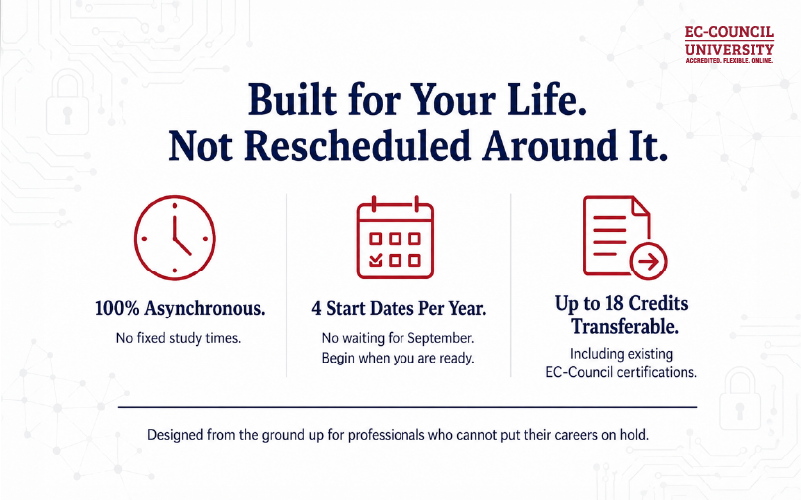
ECCU built the MSCS specifically for working professionals. The delivery is fully asynchronous with no fixed study times. The 36-credit, 12-course program runs across 10-week terms with four terms per year. Most students complete it in two years while working full-time.
The credit transfer policy extends this flexibility further. Students can transfer up to 18 graduate credit hours toward the MSCS. Of those, up to 9 can come from existing ECCouncil certifications, such as CEH, CND, or CHFI. If you have already invested in ECCouncil credentials, that investment converts directly into academic credit. It shortens your program, reduces your total cost, and recognizes the work you have already done.
To better align the education with your time availability, ECCU offers multiple start dates throughout the year, so you don’t have to wait for the September intake window. You start when you are ready. This resource can help you better understand how to finish your cybersecurity education faster.
5. The EC-Council Ecosystem: A Career Network, Not Just a Degree
Graduating from ECCU does not end your relationship with EC-Council. It extends it. As the academic arm of a global certification body with active presence across government, enterprise, and consulting sectors, ECCU connects graduates to a professional community that extends well beyond a traditional alumni list.
The non-degree course catalogue includes advanced topics like offensive AI security, red team operations, AI governance, and compliance management. Post-graduation, you can keep building credentials without re-enrolling in a degree program. The ecosystem accommodates professionals at different career stages and lets you continue investing as the threat landscape evolves.
The outcomes data reflects this. Within six months of completing the program, ECCU graduates report transitioning into new roles, earning promotions, or seeing salary progression. That timeline matters. A degree that takes two years to complete and then takes another two years to pay off in career terms is a different proposition from one where returns start arriving while the credential is still fresh. For a broader look at what distinguishes the ECCU approach overall, this piece on why cybersecurity professionals choose ECCU is worth reading alongside this one.
Explore ECCU’s MSCS and see why cybersecurity professionals who want more than a credential choose ECCU.
Frequently Asked Questions
How does ECCU's MSCS compare to programs at WGU or SNHU?
WGU and SNHU both offer solid online cybersecurity programs with flexible delivery. WGU embeds CompTIA and other certifications into its program, and SNHU offers broad topical coverage. What distinguishes the ECCU MSCS is the depth of EC-Council certification integration, five defined specialization tracks, and DoD 8140 recognition of the embedded credentials, which carries particular weight in federal and defense hiring contexts.
Are EC-Council certifications recognized by employers and the DoD?
Yes. CEH, CHFI, CND, and CCISO are approved by the US Department of Defense across 31 critical roles in the DoD Cyberspace Workforce Framework under Directive 8140. EC-Council is also an ANSI/ISO 17024-accredited organization, which is the international standard for personnel certification bodies. In enterprise hiring, CEH in particular is widely recognized as a practitioner-level signal across security teams.
Can I complete the MSCS while working full-time?
Yes, and most ECCU students do exactly that. The program is fully asynchronous with no scheduled study times. You study on your own schedule across 10-week terms, and the workload is structured to be manageable alongside full-time employment, though it does require consistent weekly commitment.
How long does the MSCS take to complete?
The standard completion timeline is two years, covering 36 credits across 12 courses. Students who transfer credits, including from existing EC-Council certifications, can shorten that timeline. The credit transfer policy allows up to 18 graduate credit hours to be applied toward the degree.
Does ECCU's MSCS qualify for employer tuition reimbursement?
It depends on your employer’s policy. ECCU is accredited by the Distance Education Accrediting Commission (DEAC), which is recognized by both the US Department of Education and the Council for Higher Education Accreditation (CHEA). Many employers with tuition reimbursement programs accept DEAC-accredited institutions. However, some corporate policies specifically require regional accreditation. Check your employer’s reimbursement policy directly before enrolling. ECCU also offers scholarships and flexible payment plans for students managing costs independently.