A master’s degree is a significant commitment. For working professionals, the first question is rarely “should I do this?” It is “can I actually fit this into my life?” The answer depends on more factors than most program pages will tell you. Study mode, course load, program structure, prior experience, and personal commitments all shape your timeline. So does choosing the right program from the start.
This breakdown covers how long a cybersecurity master’s degree takes, what shapes your
timeline, and how to move through it without putting your career on hold.
What Is a Cybersecurity Master's Degree?
A Master of Science in Cybersecurity is a graduate-level program. It builds advanced skills in areas like ethical hacking, risk management, and digital forensics. Most programs also build leadership capability alongside technical depth. That combination is what separates it from a certification track.
Standard Duration: What Most Programs Look Like
Most accredited cybersecurity master’s programs require 30 to 36 credit hours. At a standard pace, that translates to 18 months to 3 years of study.
Full-time students typically finish in 12 to 18 months. Part-time students balancing work and family often take 2 to 3 years. Some programs stretch further for students with heavier commitments.
Compare that to an MBA, which averages 18 to 24 months full-time. A cybersecurity master’s is
similar in length but far more specialized in outcome.
Factors That Influence How Long It Takes
No two students finish at the same pace. Here is what actually moves the timeline.
- Study mode: Full-time study significantly compresses your timeline. Part-time adds months, sometimes years. Neither is wrong. It is a trade-off between speed and sustainability.
- Prior experience and education: Some programs award credit for previous academic work or industry certifications. If you hold a CEH or a similar credential, that prior learning may reduce the coursework you need.
- Course load per term: Taking two courses per term versus one changes your graduation date considerably. Most working professionals manage one to two courses at a time without burning out.
- Program structure: Some programs run on fixed semester schedules. Others use shorter 8 or 10-week terms. The structure of your program matters as much as how hard you study.
- Personal commitments: A promotion, a newborn, a relocation: life does not pause for grad school. Flexible programs let you adjust your load when things get complicated. Rigid ones do not.
What happens if life interrupts?
This is the question most blogs skip. Choose a program that lets you reduce your course load without losing progress. For working professionals, that flexibility is not a luxury. It is essential.
Accelerated vs. Part-Time: What Should You Choose?
Both paths lead to the same degree. The difference is how much you can realistically give right now.
| Accelerated | Part-Time | |
|---|---|---|
| Typical duration | 12–18 months | 2–3 years |
| Weekly time commitment | High | Moderate |
| Best suited for | Career switchers, those between jobs, or professionals with employer support | Working professionals balancing jobs, family, or both |
| Pace | Intensive, compressed terms | Steady, sustainable |
| Burnout risk | Higher | Lower |
| Time to senior roles | Faster | Gradual |
| Flexibility if life changes | Limited | Higher |
Pro tip: When in doubt, start part-time. One term in, you will know if you can handle more. Overcommitting in the first term is one of the most common — and most avoidable — mistakes new graduate students make.
Online vs. Traditional Programs: Impact on Duration
Traditional universities offer structure. They also come with fixed semesters, limited flexibility, and longer timelines for working professionals.
Online programs remove most of those barriers. You study from anywhere. Progression is often faster because terms are shorter and scheduling is self-directed.
The quality gap between online and on-campus programs has narrowed considerably.
Employers today focus on what you know and what credentials you hold, not where you
attended class.
Can You Finish Faster? Tips to Reduce Completion Time
A few deliberate moves can shave months off your timeline.
| Strategy | Why It Works |
|---|---|
| Transfer credits early | Talk to your admissions advisor before you enroll. Know exactly what transfers and what does not. |
| Choose shorter-term cycles | Ten-week terms let you complete more courses per year than traditional 16-week semesters. |
| Stay consistent | Stopping and restarting costs more time than moving slowly but steadily. |
| Look for embedded certifications | Some programs build certification prep into the coursework. You earn credentials and degree credits simultaneously. |
None of these strategies requires you to study harder. They just require you to plan earlier. Most
students who finish ahead of schedule started making these decisions before their first class
began.
Is It Worth the Time Investment?
The data is direct. The median salary for information security analysts was $124,910 in May
2024. Senior and executive-level roles regularly push well beyond that.
The average cost of a cybersecurity master’s degree is approximately $35,639. Given that median salaries for degree-holders often exceed $110,000 annually, many graduates recoup that cost within 2 to 4 years. (Source: Programs)
Beyond salary, the degree opens doors that experience alone may not. Director-level and CISO-track roles increasingly expect advanced credentials. The degree signals both technical depth and leadership readiness.
Career Outcomes After Completion
A cybersecurity master’s degree prepares you for roles like Security Architect, Incident
Response Manager, Cybersecurity Consultant, and Chief Information Security Officer. US employers posted over 514,000 cybersecurity job openings in the past 12 months alone. The talent gap sits at roughly 265,000 qualified professionals. Demand is not the problem. Qualified
candidates are.
Why EC-Council University?
Many programs offer cybersecurity as one of several disciplines. ECCU is built entirely around it. That singular focus is why the program is ranked among Fortune’s Top 10 online cybersecurity master’s programs and why working professionals move through it faster and come out certification-ready.
The MSCS is a 36-credit, 12-course program running across 10-week terms, four terms per
year. Standard completion is two years. No fixed class times. No campus schedules. You study when your day allows it.
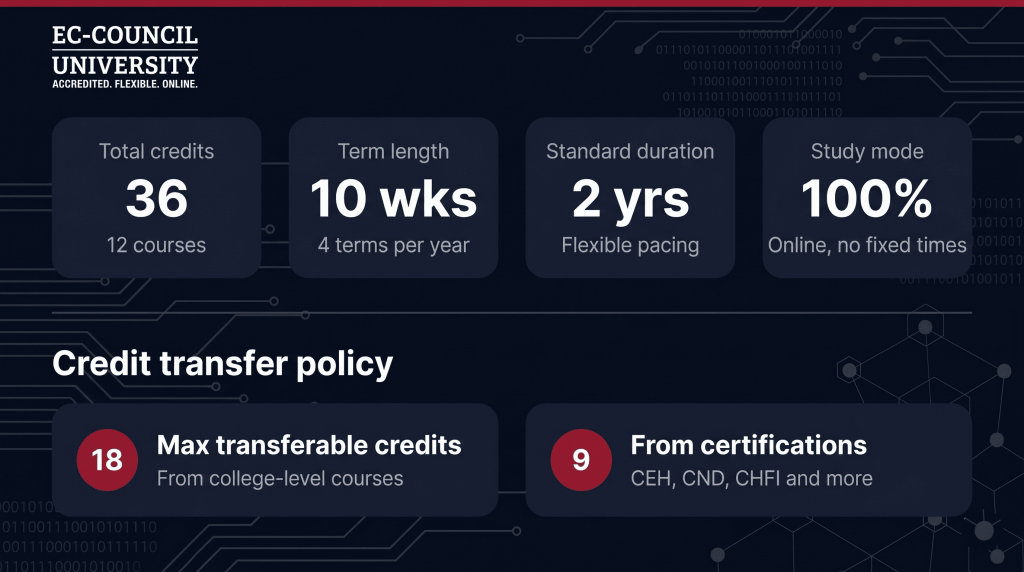
If you already hold industry credentials, the credit transfer policy shortens your path further. Up to 18 college-level credits transfer toward the degree. Of those, up to 9 can come from certifications like CEH, CND, or CHFI. Prior investment in EC-Council credentials counts toward your degree.
Conclusion
A cybersecurity master’s degree typically takes one to three years. Your timeline depends on your course load, your program’s structure, and how strategically you use credit transfers and embedded certifications.
Flexibility is not a compromise. For working professionals, it is what makes the degree achievable at all.
If you are ready to take the next step, EC-Council University’s Master of Science in Cybersecurity is worth a close look. It is designed for people already building careers who want to accelerate them without starting over.
Frequently Asked Questions
Yes. Many accredited programs are designed to accommodate professionals transitioning from non-technical fields. Curriculum typically covers foundational concepts like networking, risk management, and security architecture as part of the coursework. Roles in compliance, policy, and incident management often demand stronger analytical and leadership skills than coding ability. Your existing professional experience may count more than you expect. ECCU’s Executive Leadership in Information Assurance specialization is specifically built for professionals looking to lead security strategy without a purely technical entry point.
Certifications prove specific technical competency. A master’s degree proves breadth of knowledge, leadership readiness, and strategic thinking. For professionals targeting senior roles like Security Architect or CISO, a master’s degree is often the credential that separates candidates at the final stage of hiring. The two are not competing investments. They are complementary ones. See how ECCU aligns its MSCS program with EC-Council certifications to understand how both credentials work together in your career.
Most programs expect 15 to 20 hours of study per week per course. Taking one course per 10-week term is manageable alongside a full-time job. Two courses per term is achievable but demanding. The key variable is your program’s structure. Asynchronous, online programs with no fixed class times give working professionals the most control over when those hours happen. To understand how ECCU structures learning across its 10-week terms, check out the academic calendar before you enroll.
The degree itself does not expire. However, the field moves fast. Programs that integrate current threat landscapes, AI-driven security tools, and evolving compliance frameworks into their curriculum hold more value than those built on static content. This is one reason industry alignment matters when choosing a program. Pairing your degree with active certifications that require renewal keeps your credentials sharp after graduation. If you want to stay current without committing to a full degree, ECCU’s non-degree certification courses cover areas like ethical hacking, cloud security, and incident response as standalone modules.
Yes, and most students do. Online programs with self-paced, asynchronous learning are built specifically for working professionals. The standard advice is to start with one course per term and increase your load only after you understand how the program fits your schedule. Most working professionals complete their degree in two to three years without taking leave from their jobs. If you are not yet ready to commit to a full master’s program, ECCU’s graduate certificate programs let you build credentials in 3 to 9 months, with the option to transfer those credits toward a full degree later.