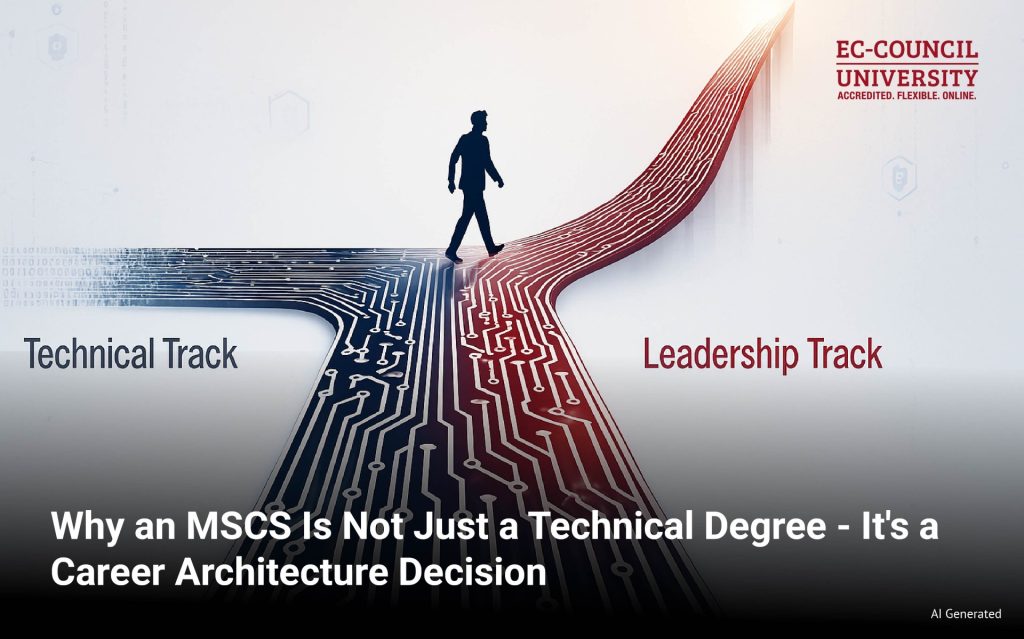
Most cybersecurity professionals treat a master’s degree as a knowledge upgrade. Those who reach the CISO, VP of Security, or Security Architect treat it as more as a strategic need. They treat it as a career move.
The decision to pursue a Master of Science in Cybersecurity (MSCS) is strategic, not purely academic. It is about choosing which career destination you are building toward and picking the right path to get there. We will cover the leadership ceiling that technical skills alone cannot break, what “career architecture” actually means in practice, how graduate credentials read differently on leadership-track resumes, and how ECCU’s MSCS specializations map to specific senior roles.
The Cybersecurity Career Ceiling Problem
Technical skills open doors. Past a certain level, they stop opening new ones.
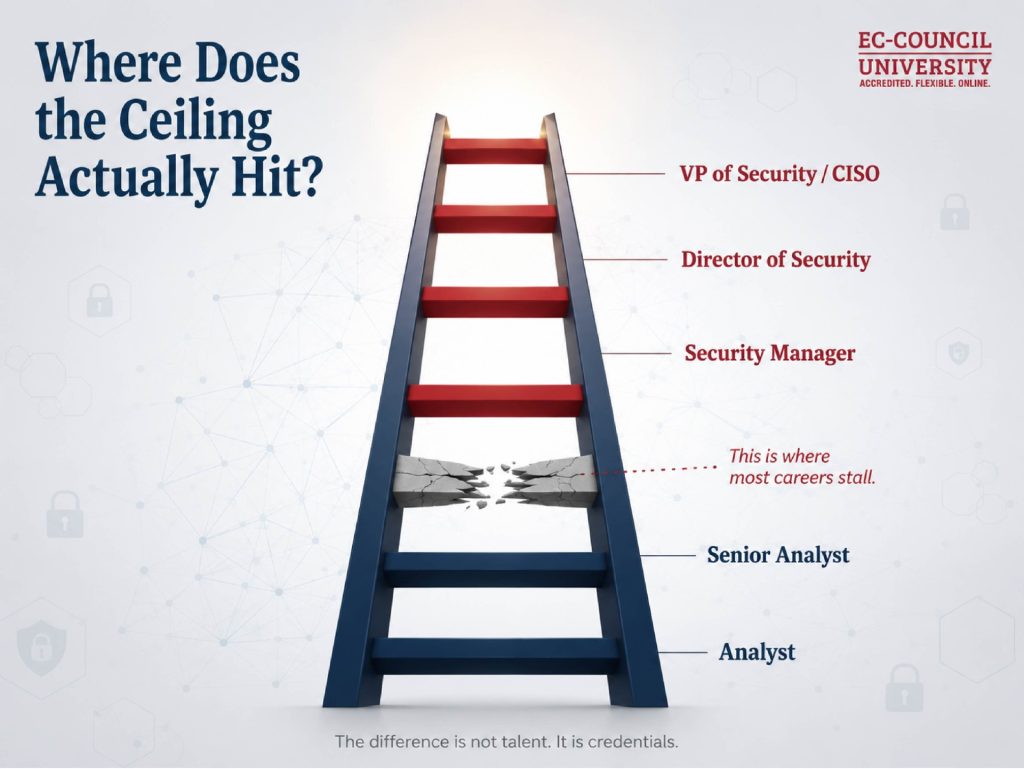
A Senior Security Analyst can monitor threats, manage incidents, and run complex investigations with precision. But when a Director of Security role opens, the hiring conversation shifts entirely. It stops being about tools. It starts being about judgment, risk communication, and organizational leadership.
A 2025 ScienceDirect study analyzing 250 CISO job postings across 27 nations found that current CISO requirements strongly emphasize strategic and business-facing skills over tactical or technical execution. “Doing security” and “leading security” are different jobs. The skills gap between them is real, and certifications alone do not close it.
Here is where technical credentials stop being enough:
Security Manager: People management, stakeholder communication, and budget ownership are non-negotiable here. Certifications cover governance concepts but fall short of developing the leadership depth to apply them within an organization.
Director of Security: This role involves cross-functional influence, policy development, and risk governance. No certification syllabus is designed to build institutional and strategic thinking at this level.
VP of Security / CISO: The job is enterprise risk strategy, board-level reporting, and organizational accountability. A Kaspersky Lab study found that 68% of sitting CISOs hold master’s degrees. A certification stack alone does not get you there.
What "Career Architecture" Actually Means
Career architecture is the deliberate sequencing of credentials, roles, and skills toward a defined destination. It is the opposite of accumulating qualifications reactively.
Most professionals build credentials in response to immediate job requirements. They earn Security+, then CEH, then CISSP as each role demands. That approach builds technical depth.
It does not build a career trajectory. At the master’s level, generalization loses its value. Specialization is what creates a clear, readable career signal to employers.
This is where the MSCS decision becomes strategic. Choosing a specialization is not just an academic preference. It is a declaration of where you are going. Each of ECCU’s five MSCS specialization tracks maps to a specific leadership destination.
| Career Goal | MSCS Specialization |
|---|---|
| Lead a SOC team or threat intelligence function | Security Analyst |
| Architect cloud defenses for enterprise environments | Cloud Security Architect |
| Conduct breach investigations and digital forensics | Digital Forensics |
| Lead crisis response and business continuity | Incident Management |
| Advance to CISO or board advisory roles | Executive Leadership in IA |
Choosing the right track matters as much as choosing the degree.
The Credential-to-Role Translation Layer
Hiring managers at the leadership level read credentials differently from technical leads do. Here is how the three most common credentials actually land on a senior hiring panel:
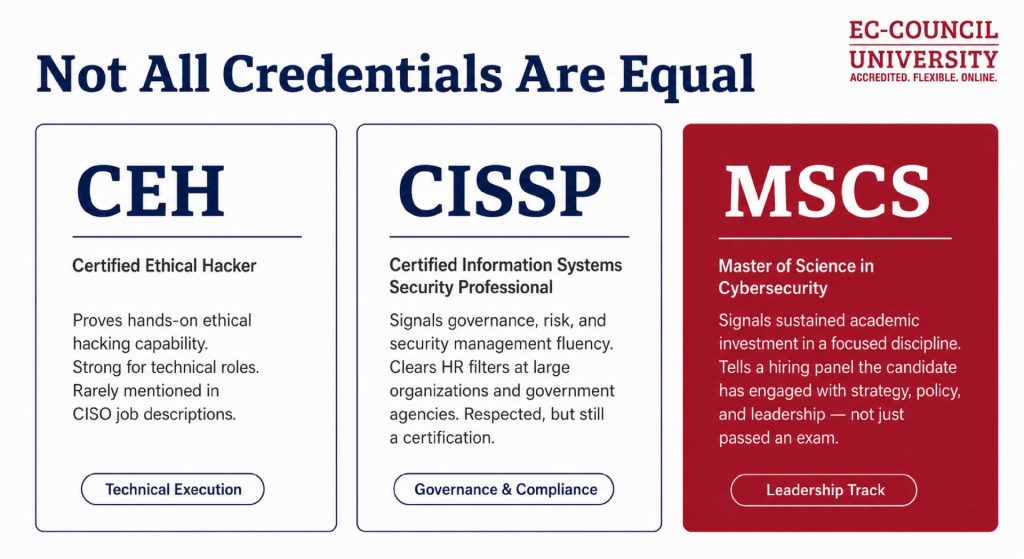
Certifications validate what you can do. A graduate degree signals how you think. For C-suite hiring decisions, that distinction carries real weight.
The salary data reflect this directly. Senior cybersecurity managers and architects with master’s degrees earn 20% to 35% more annually than their bachelor’s-educated peers in comparable roles. BLS data puts the median wage for computer and information systems managers at $171,200 as of May 2024, versus $124,910 for information security analysts. That $46,000 gap is where execution ends and leadership begins.
How ECCU's MSCS Prepares Students for This Career Architecture
EC-Council University’s MSCS is built around the same principle that runs through this entire piece: credentials should map to career destinations, not just skill inventories.
The program is fully online, which means working professionals can pursue it without interrupting their current roles. The curriculum integrates technical depth with governance, risk management, and strategic leadership, depending on which specialization track a student chooses. Each track is designed to serve a specific senior role, not a generic “advanced cybersecurity” outcome.
This matters because career architecture requires alignment, not just advancement. Earning any graduate degree moves the needle. Earning the right one, with the right specialization, creates a coherent story that employers can follow from where you are now to where you are heading.
The Architecture Mindset
Don’t just ask what you will learn. Start asking where it takes you. That shift in framing is the difference between academic thinking and career architecture thinking. Every credential decision has compounding effects. A CISSP compounds your technical credibility. An MSCS with the right specialization compounds your leadership trajectory.
The cybersecurity professionals who reach the C-suite are not always the most technically skilled people in the room. They are the ones who made deliberate choices about which credentials to earn, when to earn them, and what roles to use them to unlock. The MSCS decision is one of the most consequential of those choices. Make it with the outcome in mind.
Frequently Asked Questions
Yes, and the two serve different purposes. Certifications validate execution skills. A graduate degree builds the governance, risk, and leadership fluency that leadership roles actually require. The fact that 68% of sitting CISOs hold master’s degrees, despite most also holding senior certifications, shows these credentials are not interchangeable. They operate at different levels of your career.
ECCU’s MSCS is fully online and designed for working professionals. You set the pace without stepping away from your current role. Many students manage coursework alongside full-time security positions, which also means you can apply what you learn in real time.
The gap widens significantly as you move up. Senior cybersecurity professionals with master’s degrees earn 20% to 35% more than bachelor’s-educated peers in equivalent roles. The BLSreported jump from median pay for information security analysts to median pay for computer and information systems managers amounts to over $46,000 annually. Graduate credentials accelerate access to those higher-paying roles.
Most students complete the ECCU MSCS in 18 to 24 months, depending on pace and course load. The flexible online format lets you adjust your schedule each term without losing momentum toward graduation.