With governments, technology giants, and research institutions worldwide investing heavily in quantum computing innovation, cybersecurity leaders are preparing for one of the largest cryptographic transitions in modern history: Post-Quantum Cryptography (PQC).
The challenge is straightforward but serious. Today’s encryption systems, including RSA and Elliptic Curve Cryptography (ECC), protect everything from online banking and healthcare records to military communications and cloud infrastructure. However, sufficiently powerful quantum computers could eventually break many of these traditional cryptographic systems using algorithms such as Shor’s Algorithm. This grim possibility has accelerated the global push toward quantum-resistant cybersecurity practices, with Post-Quantum Cryptography the most prominent example.
What Is Post-Quantum Cryptography (PQC)?
Post-Quantum Cryptography (PQC) refers to cryptographic algorithms designed to remain secure even against attacks from future quantum computers. Importantly, PQC does not require quantum hardware and can run on existing systems, networks, and infrastructure.
The goal of PQC is to protect sensitive data before quantum computers can bypass today’s encryption standards.
The urgency to develop PCQ stems from a growing cybersecurity concern known as ‘Harvest Now, Decrypt Later’. In this attack strategy, adversaries steal encrypted data today and store it until future quantum computers become powerful enough to decrypt it. Sensitive information with long-term value, such as government secrets, healthcare records, intellectual property, and financial data, is especially vulnerable.
Why PQC Is One of the Most Strategic Cybersecurity Transitions Currently Underway
Cybersecurity experts increasingly view PQC migration as inevitable. In August 2024, the National Institute of Standards and Technology (NIST) officially finalized the world’s first post-quantum cryptography standards, signaling the beginning of large-scale industry adoption.
The following factors make this transition strategically critical:
- Quantum Computing Progress Is Accelerating: Major companies, including IBM, Google, and Microsoft, continue to advance quantum computing capabilities rapidly. IBM recently stated that fault-tolerant quantum computers could begin approaching “cryptographic relevance” before the end of the decade.
- Long-Term Sensitive Data Is Already at Risk: Organizations that store data requiring confidentiality for 10 to 30 years cannot afford to wait. If encrypted data is stolen today, future quantum systems may eventually decrypt it.
- Global Regulatory Pressure Is Increasing: Governments and regulatory bodies are in the early stages of mandating quantum-safe planning. Organizations are now expected to maintain inventories of cryptographic assets, develop crypto-agility strategies, begin phased PQC migration, and modernize PKI and certificate management systems.
- Migration Could Take Years: PQC migration is not a simple software patch. For it to be a successful endeavor, an enterprise must update its VPNs, TLS certificates, hardware security modules (HSMs), IoT devices, cloud infrastructure, identity systems, and more. Experts estimate full cryptographic transitions could take more than a decade.
NIST-Standardized Algorithms for PQC
NIST’s PQC standardization initiative represents one of the most important cryptographic projects in cybersecurity history. The first set of finalized standards includes:
| Standard | Purpose | Based On |
|---|---|---|
| FIPS 203 | Key establishment/encryption | ML-KEM (CRYSTALS-Kyber) |
| FIPS 204 | Digital signatures | ML-DSA (CRYSTALS-Dilithium) |
| FIPS 205 | Backup digital signatures | SLH-DSA (SPHINCS+) |
- ML-KEM (Kyber): ML-KEM is designed for secure key exchange and encryption. It is considered fast, efficient, and suitable for widespread deployment.
- ML-DSA (Dilithium): ML-DSA provides quantum-resistant digital signatures for verifying authenticity and integrity.
- SLH-DSA (SPHINCS+): SLH-DSA serves as a backup signature system that uses a different mathematical approach, thereby improving cryptographic diversity.
NIST also continues evaluating additional algorithms, such as:
- FN-DSA (Falcon)
- HQC (Hamming Quasi-Cyclic)
Where Is PQC Applicable?
Post-Quantum Cryptography has broad implications across nearly every industry that relies on encryption. These are the most notable examples:
- Cloud Security: Cloud providers are beginning to integrate quantum-safe TLS and key exchange mechanisms to secure future data transmission.
- Banking and Financial Services: Financial institutions require long-term confidentiality for transactions, payment systems, and customer records.
- Government and Defense: National security agencies are among the earliest adopters of quantum-safe encryption due to espionage concerns.
- Healthcare: Medical records often require decades-long privacy protection.
- Internet of Things (IoT): IoT devices with long operational lifespans are particularly vulnerable because many cannot easily receive cryptographic upgrades later.
- Telecommunications: Telecom providers must secure next-generation infrastructure, including 5G and future network architectures.
- Blockchain and Digital Identity: PQC may eventually reshape blockchain security models and digital signature systems.
Key Benefits of Post-Quantum Cryptography
The importance of PQC is gaining widespread attention because of:
- Protection Against Quantum Attacks: PQC algorithms are specifically engineered to resist attacks from future quantum computers.
- Long-Term Data Security: Organizations can protect sensitive data by imposing long-term confidentiality requirements.
- Improved Cyber Resilience: PQC strengthens future-proof cybersecurity architectures and reduces systemic cryptographic risk.
- Compatibility with Existing Infrastructure: Unlike quantum cryptography technologies such as Quantum Key Distribution (QKD), PQC can run on conventional hardware systems.
- Supports Cryptographic Agility: Modern PQC adoption encourages organizations to build flexible cryptographic infrastructures that can adapt to future threats.
Challenges and Limitations of PQC
Despite its promise, PQC also introduces several operational challenges.
- Larger Key Sizes: Many PQC algorithms require keys and signatures that are significantly larger than those for RSA or ECC.
- Performance Considerations: Some systems may experience increased bandwidth usage, higher processing overheads, and storage challenges
- Migration Complexity: Enterprises often lack visibility into where cryptography exists across their environments.
- Legacy Infrastructure: Older hardware and embedded systems may not support PQC upgrades.
These realities make cryptographic inventory management and crypto-agility essential components of modernization strategies.
How PQC Will Influence Future Cybersecurity Practices
Post-Quantum Cryptography will fundamentally redefine cybersecurity over the next decade. Future cybersecurity architectures will likely include:
- A hybrid of classical and PQC encryption
- Quantum-safe TLS
- Quantum-resistant PKI
- AI-driven cryptographic management
- Automated crypto-agility platforms
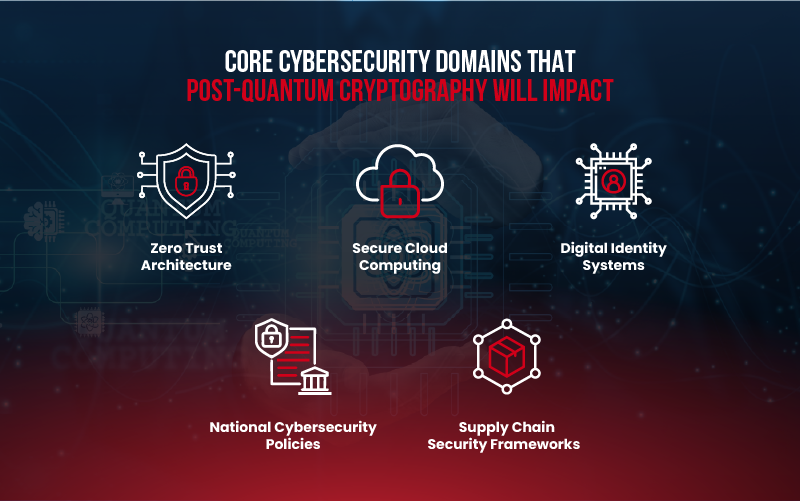
Many experts now compare the transition to PQC to the global migration from HTTP to HTTPS, though it is significantly larger and more complex.
What Cybersecurity Professionals Should Learn to Become PQC Experts
Demand for quantum-safe security expertise is rapidly gathering momentum. Cybersecurity professionals interested in PQC should focus on:
- Cryptography Fundamentals: Develop a strong understanding of RSA, ECC, hash functions, digital signatures, and PKI.
- Quantum Computing Basics: Gain familiarity with qubits, quantum algorithms, Shor’s Algorithm, and Grover’s Algorithm.
- NIST PQC Standards: Comprehend ML-KEM, ML-DSA, SLH-DSA, and hybrid cryptography.
- Secure Protocols: Learn how PQC integrates into TLS, VPNs, SSH, PKI, and identity systems.
- Programming and Implementation Security: Build expertise in side-channel attacks, secure coding, hardware acceleration, and performance optimization.
PQC: A Priority for Organizations and Cybersecurity Professionals Alike
Post-Quantum Cryptography (PQC) represents one of the most important cybersecurity evolutions of the modern era. Besides preparing for a future of quantum computing, this transition is driven by the need to protect today’s sensitive data from tomorrow’s threats. Organizations that begin planning now will be far better positioned to maintain regulatory compliance, preserve customer trust, reduce long-term cyber risk, and strengthen operational resilience.
For forward-thinking cybersecurity professionals, PQC also presents a major career opportunity. As quantum-safe migration accelerates, expertise in post-quantum cryptography will become increasingly valuable across most major industrial sectors. EC-Council University (ECCU) is where such professionals can acquire the skills and credentials to become PQC experts and position themselves perfectly for the impending boom in cybersecurity for quantum computing.
To know more about how ECCU prepares cybersecurity professionals for successful careers:
Frequently Asked Questions About Post-Quantum Cryptography (PQC)
PQC refers to cryptographic algorithms designed to resist attacks from future quantum computers.
PQC is important because quantum computers may eventually break traditional encryption methods such as RSA and ECC.
It refers to attackers stealing encrypted data today with plans to decrypt it once quantum computers become powerful enough.
The primary algorithms NIST has defined for PQC are ML-KEM, ML-DSA, and SLH-DSA.
No. Most organizations will use a combination of classical and PQC systems during the transition period.
Industrial sectors in which PQC will gain significant importance are banking and financial services, government, defense, healthcare, telecommunications, and cloud computing.
Yes. Major technology companies and governments have already begun integrating quantum-safe cryptographic solutions.
Post-Quantum Cryptography (PQC) uses advanced mathematical problems that are extremely difficult for both classical and quantum computers to solve. Unlike traditional encryption methods such as RSA or ECC, PQC algorithms are specifically designed to resist future quantum attacks while still running on today’s existing hardware and networks.
Experts do not yet know the exact timeline, but many researchers believe cryptographically relevant quantum computers could emerge within the next 10 to 20 years.
Quantum-safe encryption refers to cryptographic methods designed to remain secure even against attacks from quantum computers. This includes Post-Quantum Cryptography (PQC) algorithms that protect data, communications, and digital identities from future quantum-based threats.
Post-Quantum Cryptography (PQC) uses quantum-resistant mathematical algorithms that work on conventional computers and existing internet infrastructure. On the other hand, Quantum Cryptography, such as Quantum Key Distribution (QKD), uses principles of quantum physics to secure communications and often requires specialized quantum hardware.