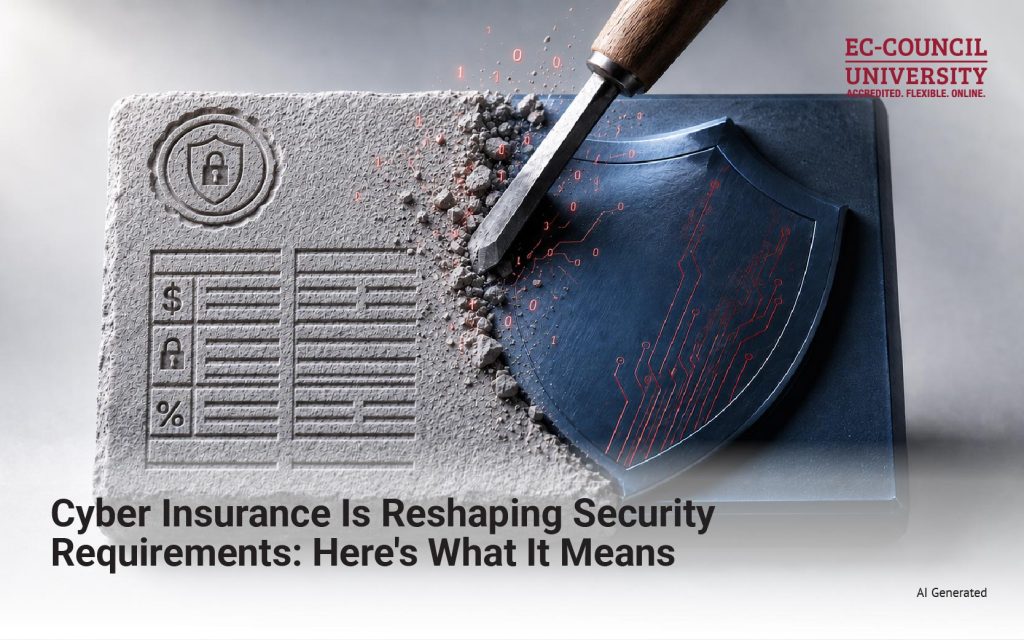
Cyber insurance used to sit quietly in the background of security planning. It was a financial safety net, not a design input. That has changed. Insurers now shape what controls organizations must build, what evidence they must keep, and how security teams justify their budgets. This shift is not about buying a policy anymore. It is about proving, in detail, that your defenses actually work. This blog looks at how insurers arrived at this role, what they expect from organizations today, how that expectation spreads into vendor contracts and compliance programs, and what it means for anyone building a career in security governance.
Key Takeaways
- Insurers now function as informal regulators of baseline security practice.
- Evidence of working controls matters as much as the controls themselves.
- MFA, EDR, and tested backups have moved from optional to mandatory.
- Insurance requirements are cascading into vendor contracts and audit expectations.
- Documentation and governance skills are becoming as valuable as technical ones.
- GRC roles are growing fastest where insurance and compliance overlap.
How Insurers Became Security Standard-Setters
Ransomware losses piled up fast between 2020 and 2022. Insurers absorbed the damage and responded the only way they could: tighter underwriting. Instead of trusting a signed application, carriers started asking for proof. That proof now decides who gets covered, what they pay, and what limits they receive.
The market has grown alongside this shift. Munich Re projects the global cyber insurance market will reach $16.3 billion in 2025-26. More capacity is available, but it favors organizations that can show strong, evidenced defenses. Weak applicants face higher premiums or outright denial. This is exactly the dynamic reshaping security budgets today, alongside the broader shift toward top cybersecurity threats in 2026 that carriers now factor into risk models.
What Insurers Now Require
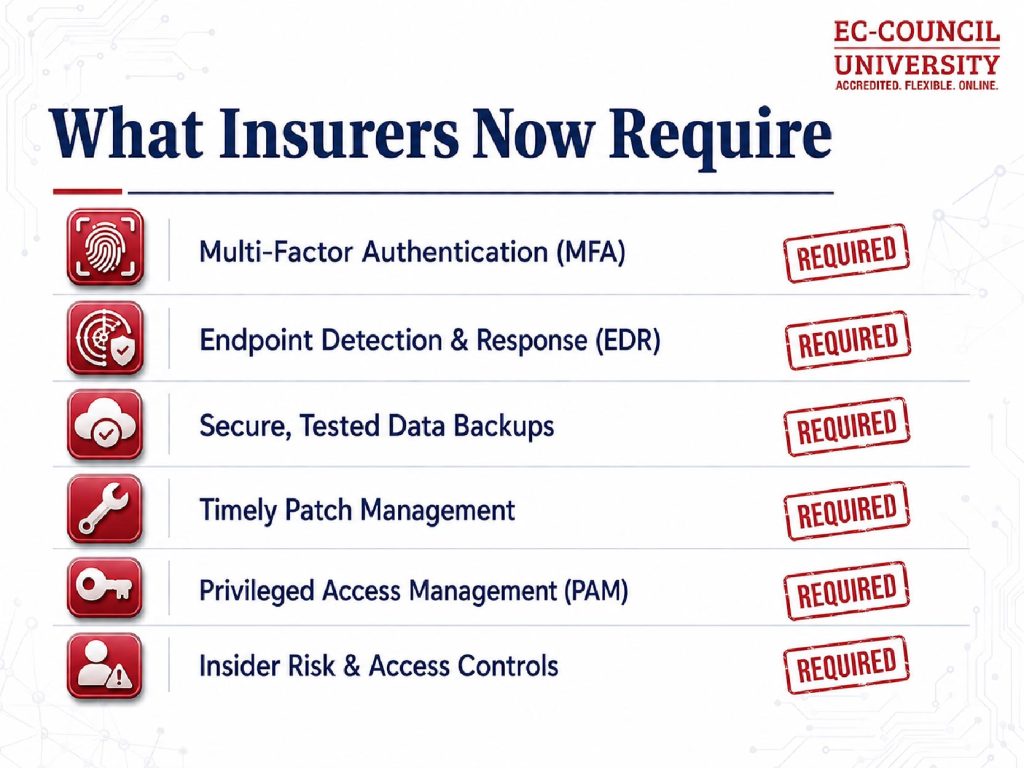
Underwriters are not asking for perfection anymore. They want clarity. What controls exist, who owns them, and how consistently are they applied? Coverage across most carriers now depends on the same handful of baseline controls.
- Multi-factor authentication enforced across email, remote access, and privileged accounts, with 100 percent coverage expected on email and remote access.
- Endpoint detection and response deployed on both workstations and servers, with coverage above 95 percent of endpoints. Legacy antivirus no longer satisfies this requirement.
- Immutable, tested backups, isolated from the main network and restored on a regular schedule.
- Patch management with defined service-level timelines for critical and highseverity vulnerabilities.
- Privileged access management for admin accounts, alongside network segmentation and centralized logging.
- Insider risk controls, since access misuse and account compromise remain common paths to a claim, a pattern covered in ECCU’s piece on insider threats in cybersecurity.
Why Documentation Matters as Much as the Control
A control that exists but cannot be proven is treated as if it does not exist. Underwriters want screenshots of enforcement policies, EDR coverage reports, and dated backuprestore logs. This is the real shift behind the outline above: cyber insurance stopped being a form and became something closer to a technical audit.
Continuous attestation is becoming the norm rather than the exception. Some carriers now run ongoing external scans against what an organization claims in its application. A gap between what was attested and what exists on the network is one of the fastest ways to see a claim disputed. Firms that walk into renewal with an organized evidence binder tend to keep premiums flat. Firms that scramble at the last minute often see steep increases, sometimes 50 to 200 percent higher.
The Business and Compliance Ripple Effects
Insurance requirements rarely stay confined to the policy itself. Once a carrier expects a control, that expectation tends to spread outward through the business.
Vendors get pulled into the same scrutiny, since a weak link in the supply chain can trigger a claim just as easily as an internal failure. Contracts increasingly include security clauses that mirror what underwriters ask for. Framework alignment, especially with NIST CSF or CIS Controls, has become a common reference point across both insurance applications and vendor questionnaires. What began as an underwriting checklist now functions as a shared compliance language across procurement, legal, and security teams.
What This Means for Security Careers
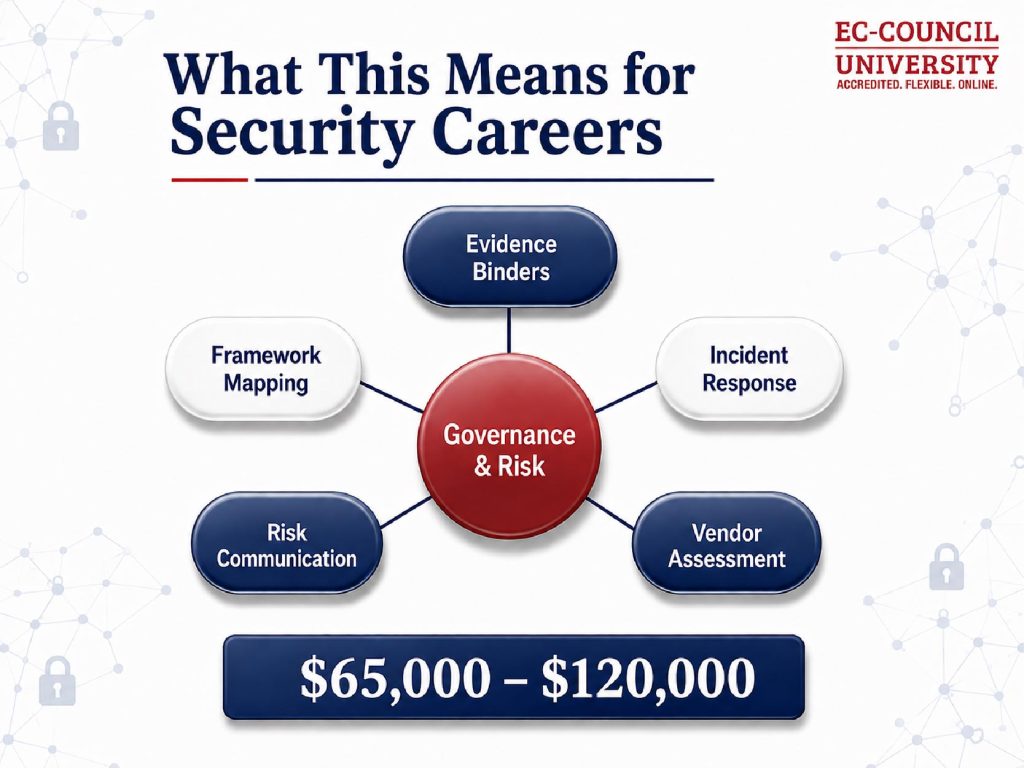
This shift is creating steady demand for people who can translate technical controls into language that underwriters, auditors, and boards actually understand. Pure technical depth is no longer enough on its own.
A few skills are becoming especially valuable in this environment:
- Building and maintaining a controls-evidence binder ahead of renewal cycles.
- Mapping internal controls to frameworks like NIST CSF or CIS Controls.
- Running incident response tabletop exercises and documenting the results.
- Communicating risk posture to non-technical stakeholders and executives.
- Understanding how vendor risk assessments connect to insurance requirements.
The NICE Workforce Framework already recognizes this shift through its Oversee and Govern category, which covers exactly this kind of work. Compensation reflects the demand too. GRC analyst roles currently pay between $65,000 and $120,000 depending on experience, and that range climbs quickly for professionals who can lead governance programs rather than simply support them.
Building the Skills to Lead in This Environment
Governance fluency is quickly becoming a career differentiator rather than a niche specialty. Professionals who can sit between a technical team and a boardroom, and speak both languages fluently, are the ones carriers, auditors, and executives increasingly turn to.
For anyone building toward this path, ECCU’s MBA in Cybersecurity Executive Leadership and Governance is built around exactly this intersection of business strategy and security governance. For a shorter, more targeted route, the Executive Leadership in Information Assurance graduate certificate builds the C-level governance skills this shift demands, without the full commitment of a degree program.
Conclusion
Cyber insurance is no longer a background financial product. It is actively shaping how organizations build, document, and prove their security programs. The controls it demands are not exotic. MFA, EDR, tested backups, and clear governance are the baseline now. What has changed is the burden of proof. Security teams that treat documentation and governance as core skills, not paperwork, will be the ones that keep their coverage, their premiums, and their leadership credibility intact.
Frequently Asked Questions
Most carriers require multi-factor authentication, endpoint detection and response, immutable backups, patch management, and privileged access controls. Documentation proving these controls work is just as important as having them in place.
Premiums have risen because insurers absorbed heavy ransomware losses between 2020 and 2022. Carriers now price risk based on evidenced security posture rather than self-reported answers on an application.
Security teams now need to maintain audit-ready evidence for their controls year-round. Renewal season has shifted from a form-filling exercise into something closer to a technical review.
Framework mapping, incident response documentation, vendor risk assessment, and clear communication with nontechnical stakeholders are all in high demand. These skills sit at the center of most GRC roles today.
The MBA in Cybersecurity Executive Leadership and Governance and the Executive Leadership in Information Assurance graduate certificate both build these skills, at different levels of time commitment.