You already know network security matters. What you might not know is how much the job has changed in the last two years.
Firewalls and VPNs used to be enough to call yourself a network defender. Not anymore. Zero trust architecture, cloud-native infrastructure, and OT-targeting ransomware have rewritten the job description. Employers are not just hiring for certificates anymore. They want people who can read traffic, spot what does not belong, and act before damage spreads.
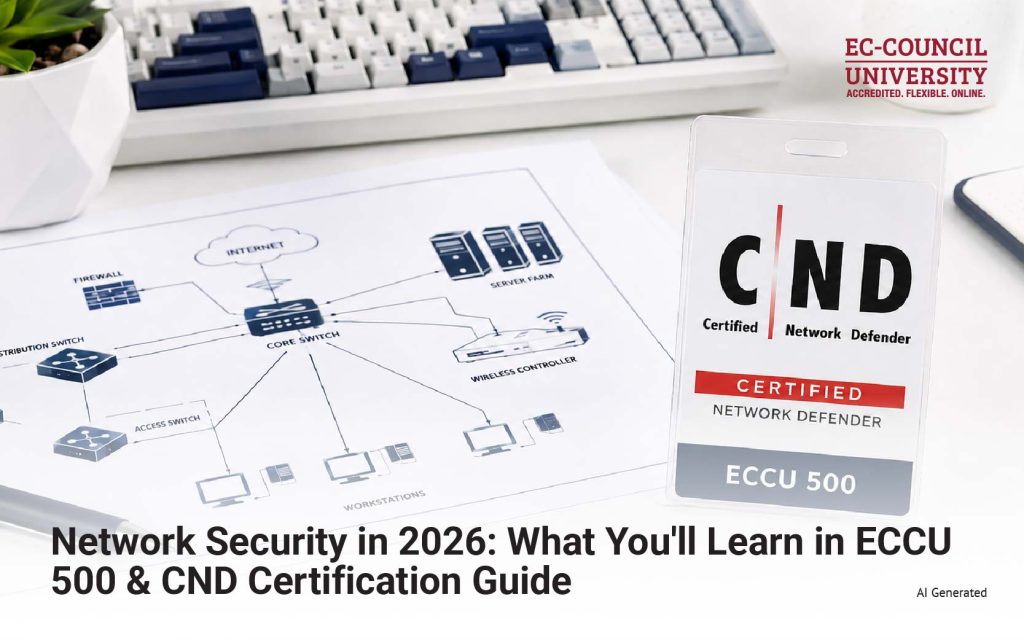
ECCU 500: Managing Secure Network Systems is a 10-week non-degree course built for that shift. It aligns with EC-Council’s Certified Network Defender (CND) certification and covers the tools, methods, and reasoning that network security roles demand right now. This guide breaks down what the course covers, what the CND credential is worth, how it stacks up against Security+ and Network+, who the course is for, and what comes after you finish.
Key Takeaways
- Zero trust depends on deep network knowledge to work, not replace it.
- Ransomware groups are actively moving from IT networks into OT environments.
- The cybersecurity workforce faces a skills gap, not just a headcount gap.
- CND is DoD 8140-approved, giving it real weight in federal and defense hiring.
- ECCU 500 earns academic credit that transfers directly into the full MSCS degree.
- Network Security Engineers in the U.S. earn between $92,000 and $172,000 annually.
What Is Network Security?
Network security is the set of practices, tools, and policies that protect a network and the data moving across it. It covers firewalls, intrusion detection, segmentation, encrypted traffic, and the people who monitor all of it around the clock. For a deeper walkthrough of the fundamentals, firewall types, and VPN basics, see ECCU’s guide on network security, firewalls, and VPNs. This post focuses on what that job looks like in 2026, and how ECCU 500 prepares you for it.
Types of Network Security Covered in ECCU 500
ECCU 500 builds around five core technology areas. Each one shows up repeatedly across the course, so it’s worth understanding what each does before we get into the module breakdown.
Firewalls and Next-Generation Firewalls (NGFW)
Traditional firewalls filter traffic by port and protocol. NGFWs add deep packet inspection, application awareness, and built-in intrusion prevention. ECCU 500 covers configuration and policy design for both, including common misconfiguration patterns that leave networks exposed.
Intrusion Detection and Prevention Systems (IDS/IPS)
IDS tools flag suspicious traffic for review. IPS tools block it in real time, automatically. Students learn to tune both, since a poorly tuned system either buries you in false positives or misses the alert that mattered.
Virtual Private Networks (VPN)
VPNs encrypt traffic between remote users and the network core. The course covers site-to-site and remote-access VPN design, along with the configuration mistakes that turn a VPN into an entry point rather than a defense.
Network Access Control (NAC)
NAC checks a device’s identity and security posture before granting network access. Students learn policy enforcement for both company-managed devices and BYOD environments, a growing gap in most enterprise networks.
Security Information and Event Management (SIEM)
SIEM platforms centralize logs from across the network and surface anomalies. ECCU 500 covers SIEM integration, alert tuning, and how to read an incident timeline from raw log data rather than a dashboard summary.
Network Security Threats in 2026: What Defenders Face
A common misconception is that zero trust architecture has made traditional network security knowledge obsolete. It has not. The opposite is closer to the truth.
Zero trust requires professionals who deeply understand network traffic. You cannot detect anomalies in packet flows or segment networks without understanding how protocols behave. 48% of businesses report difficulty integrating zero trust across hybrid environments. Their teams still lack foundational network fluency. Zero trust is the policy. Protocol knowledge makes it executable.
The threat landscape reinforces this point. Attacks on network infrastructure are growing more targeted, not less.
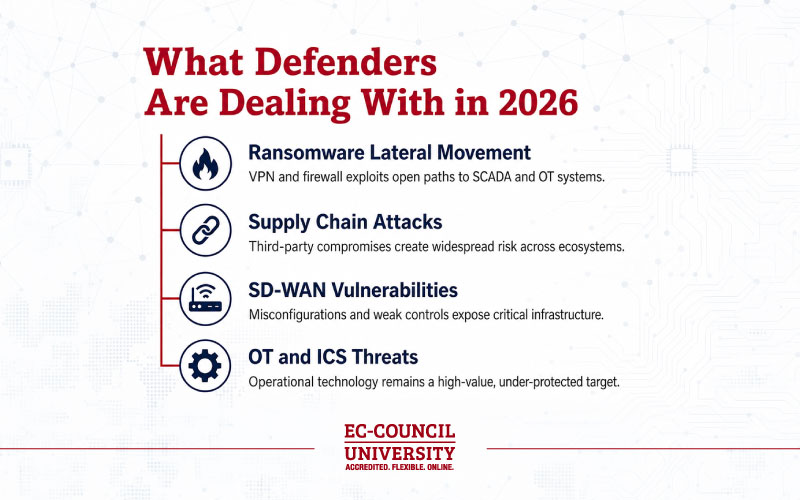
What defenders are dealing with in 2026:
- Ransomware with lateral movement: Groups like Qilin and Akira exploit VPN portals and firewall interfaces to get in. They then use RDP, SMB, and SSH to move toward SCADA systems and OT-support infrastructure. Over 60% of ICSrelated ransomware incidents now involve lateral movement from IT to OT networks.
- Supply chain attacks: Threat actors target MSPs and shared infrastructure to compromise multiple downstream networks in a single operation.
- SD-WAN vulnerabilities: Cisco Catalyst SD-WAN Manager has seen multiple actively exploited zero-days in 2026 alone. CISA has added related CVEs to its Known Exploited Vulnerabilities catalog. These are not theoretical risks.
- OT and ICS threats: 22% of organizations experienced an OT or ICS cyber incident in 2025.
The jobs picture tells the same story. The U.S. Bureau of Labor Statistics projects 29% employment growth for information security analysts from 2024 to 2034. That is roughly seven times the national average across all occupations. But volume is not the whole story. 52% of cybersecurity leaders say their primary hiring challenge is skill misalignment, not headcount. Network Security Engineers specifically earn between $92,000 and $172,000 in the U.S. market. These roles reward demonstrated technical depth over credentials alone.
Network Security Vulnerabilities You Will Learn to Defend
Most network breaches don’t start with a novel exploit. They start with something already known and already documented.
An unpatched CVE sitting on a public-facing device. A firewall rule left too permissive during a rushed migration. A cloud storage bucket configured for public read access by mistake. A segmentation gap between IT and OT networks that nobody closed after a merger. ECCU 500 trains you to find these before an attacker does, not to memorize a list of exploits. You’ll learn to read CVE severity scores, weigh patching urgency against operational risk, and audit configurations for the small, avoidable gaps that account for most real-world breaches.
AI Network Security: The 2026 Frontier
AI is changing both sides of network defense. Detection tools now use machine learning to baseline traffic and catch anomalies faster than static rule sets ever could. Attackers use the same technology to generate more convincing phishing infrastructure and probe networks faster than manual reconnaissance allows. ECCU 500 doesn’t teach AI engineering, but it builds the traffic-analysis foundation that AI-augmented security tools sit on top of. Analysts who understand what a model is actually looking at, not just what it flags, are the ones who catch what the tool misses.
What Is the CND Certification?
The Certified Network Defender (CND) is EC-Council’s practitioner-level credential for network defense. It is vendor-neutral, meaning it teaches principles that apply across Cisco, Palo Alto, AWS, Azure, and any other environment you land in, rather than tying you to one vendor’s tools.
The exam itself, code 312-38, is a 100-question multiple-choice test with a 4-hour time limit, delivered through the EC-Council Exam Portal. EC-Council uses a variable cut score depending on the exam form, typically landing somewhere between 60% and 85%. Students who complete an approved course like ECCU 500 can sit the exam directly, without the separate eligibility application that self-study candidates must file.
What makes CND worth knowing about for your career:
- It is approved by the U.S. Department of Defense under Directive 8570/8140, covering four workforce categories: IAT Level I, IAT Level II, IAM Level I, and CSSP Infrastructure Support.
- It is accredited by ANSI under ISO/IEC 17024 and mapped to NICE 2.0 work roles.
- It is recognized by the UK’s National Cyber Security Centre (NCSC) as meeting CyBOK requirements.
- The CND program includes 100+ hands-on labs on live target machines, more than any other globally recognized network security certification.
For roles that require government compliance or dedicated network defense operations, CND carries weight that broader, more generalist certifications do not.
Network Security Certifications: CND vs. Security+ vs. Network+
All three are respected, vendor-neutral credentials. They are not interchangeable, and each one solves a different problem depending on where you are in your career.
| CND | Security+ | Network+ | |
|---|---|---|---|
| Level | Practitioner, network defense | Broad security fundamentals | Baseline networking |
| Exam format | 100 questions, 4 hours | Up to 90 questions, 90 minutes | Up to 90 questions, 90 minutes |
| Passing score | Variable, roughly 60 to 85% | 750 out of 900 | 720 out of 900 |
| Hands-on labs | 100+ labs on live machines | Performance-based simulation questions | Performance-based simulation questions |
| DoD 8140 approved | Yes, four workforce categories | Yes, broad IT and security roles | Not directly, but often a prerequisite step |
| Best for | Practitioners defending live networks | Generalist entry into security | Foundational networking knowledge |
Security+ establishes broad cybersecurity fundamentals across a wide domain. It is often the first security certification people earn. Network+ tests baseline networking knowledge and usually comes before Security+ in a typical learning path. CND sits a level above both. It is a hands-on, practitioner-level network defense credential built for people who will actually configure firewalls, run packet captures, and respond to intrusions, not just understand security concepts in theory.
If you are new to IT, Network+ then Security+ is the standard on-ramp. If you already have networking or IT experience and want a credential that proves you can defend a live network, CND is the more direct path. Many professionals hold more than one of these credentials over the course of a career, since they stack rather than compete.
ECCU 500 Course Breakdown: 10 Modules Explained
- Network fundamentals and threat analysis: The course starts with hacking methodologies and how attackers approach network targets. Students learn TCP/IP, DNS, HTTP/S, and how encrypted protocols behave under analysis. Packet capture and traffic analysis give you a baseline for spotting what does not belong.
- Defense architecture: This includes firewall configuration, IDS/IPS deployment, SIEM integration, and network segmentation. Students work through DMZ design and apply defense-in-depth across real network topologies.
- Security management in virtualized and cloud environments: As networks shift to hybrid and cloud-native infrastructure, the attack surface changes. ECCU 500 covers VPC security, cloud-native firewall tools, and security management across AWS, Azure, and GCP.
- Threat detection and log analysis: Students learn traffic monitoring, log management, and anomaly detection. Establishing a network baseline is a core skill here. You cannot identify what is wrong if you do not know what normal looks like.
- Risk management and incident response: The final modules cover attack surface analysis, cyber threat intelligence, and incident response at the network layer, including containment, eradication, and recovery procedures. Business continuity and disaster recovery are also covered in the context of network operations.
Network Security Courses vs. Bootcamps: What Sets ECCU 500 Apart
Most network security bootcamps are fast and narrowly scoped. Many run 4 to 8 weeks, focus almost entirely on exam-pattern drilling, and end the moment the exam does.
ECCU 500 takes longer for a reason. It runs through EC-Council University, which is accredited by the Distance Education Accrediting Commission (DEAC) and recognized by CHEA, so the course carries real academic weight, not just exam prep. The three credit hours you earn apply directly toward the MSCS or BSCS if you decide to pursue a full degree later. You also get instructor access and structured weekly sessions instead of a self-paced video library, and lab time inside iLabs rather than a simulated sandbox built purely around exam questions.
The tradeoff is time and cost. A bootcamp gets you to the exam faster and usually cheaper. ECCU 500 is the better fit if you want a credential that also builds toward a degree, or if you’re targeting a federal or defense-adjacent role where structured, accredited coursework matters to the hiring process.
Skills You'll Learn in ECCU 500
By the end of the course, you should be able to:
- Read and interpret packet-level traffic to identify anomalies
- Configure firewalls, IDS/IPS, and segment a network using defense-in-depth principles
- Secure hybrid and multi-cloud environments across AWS, Azure, and GCP
- Build and monitor a network baseline to catch what falls outside it
- Run containment, eradication, and recovery procedures during a live incident
- Apply cyber threat intelligence to anticipate attacks before they land
These are the practical, demonstrable skills that separate a CND holder from someone who only has classroom exposure to security concepts.
Who ECCU 500 Is For
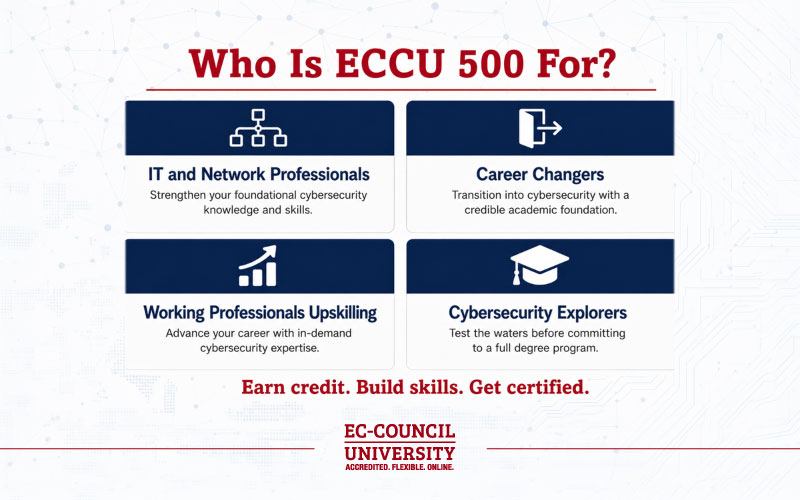
The course is built for people already working in IT or network administration who want to add security depth to their role. It also suits career changers entering cybersecurity and working professionals who want to upskill without committing to a full degree program. Students exploring the field can use it to test the waters before enrolling in the full MSCS.
Roles it is specifically designed for include:
- Network Administrator or Engineer
- Network Security Administrator, Engineer, or Analyst
- Cybersecurity Engineer
- Security Analyst
- Network Defense Technician
- Security Operator
The course also holds up well for small business IT professionals wearing multiple hats. In a smaller organization, one person often owns the firewall, the network, and incident response together. ECCU 500’s breadth across all five technology areas, rather than deep specialization in just one, matches that reality better than a narrowly scoped bootcamp would.
Is ECCU 500 Worth It?
The honest answer depends on what you are optimizing for. ECCU 500 is not the cheapest way to prepare for the CND exam, and it will not replace years of hands-on experience. What it offers is three things a lot of standalone bootcamps do not: academic credit that counts toward a real degree, DoD-recognized certification alignment, and structured lab time inside iLabs rather than a self-paced video library.
If your goal is the CND certification alone and you already have strong networking fundamentals, self-study plus the exam eligibility route may be faster and cheaper. If your goal is a credential that also builds toward an MSCS or BSCS, gives you instructor access, and proves structured coursework to an employer or a federal HR system, the course earns its cost. For a full breakdown of how a cybersecurity master’s affects salary and ROI over time, see ECCU’s guide on how much you can earn with a master’s in cybersecurity.
How Long Does ECCU 500 Take?
ECCU 500 runs over 10 weeks. Students should expect around 13.5 hours of work per week. The program runs fully online through ECCU’s LMS, with weekly live sessions and 24/7 access to recorded lectures, course materials, and virtual labs.
The credits are real. ECCU 500 earns three academic credit hours. Non-degree students can earn up to 12 credits across ECCU’s non-degree course offerings. Those credits apply toward the full Master of Science in Cyber Security (MSCS) or Bachelor of Science in Cyber Security (BSCS) if you later decide to pursue a degree.
ECCU 500 Requirements & Prerequisites
No formal prerequisite exists to enroll. Candidates must be 18 or older and hold a high school diploma, college degree, or relevant certification. A working familiarity with basic networking concepts helps you move through the material faster, but it is not required to start.
How to Prepare for the CND Exam
Completing ECCU 500 makes you exam-eligible and covers the full CND blueprint, but a few habits improve your odds on exam day:
- Work every iLabs exercise, not just the required ones. The exam leans on applied scenarios, not memorized definitions.
- Build your own network baseline in a home lab. Understanding what normal traffic looks like on a network you configured yourself sticks better than reading about it.
- Time yourself on practice questions. At 100 questions in 4 hours, pacing matters as much as knowledge.
- Review the eight CND domains against your weakest areas in the final two weeks, rather than re-studying everything evenly.
- Take the exam through the EC-Council Exam Portal once your course completion confirms your eligibility, so you skip the separate self-study application process.
Jobs You Can Get After ECCU 500
CND-aligned training opens doors to roles like Network Security Analyst, SOC Analyst, Incident Response Specialist, Network Defense Technician, and Security Consultant. For a broader look at cybersecurity career paths, salary ranges by role, and what different degrees and certifications unlock, see ECCU’s cybersecurity career guide and its guide to remote cybersecurity jobs in 2026.
Build the network security foundation your career needs. Enroll in ECCU 500, a nondegree course that earns academic credit and prepares you for the CND certification. Explore ECCU 500 and other non-degree courses here.
Frequently Asked Questions
No formal prerequisite exists. Candidates must be 18 or older and hold a high school diploma, college degree, or relevant certification. A working familiarity with basic networking concepts makes the material easier to absorb from the start.
No. Completing ECCU 500 makes you exam-eligible and prepares you for the CND exam, but certification requires passing the exam independently. Attending an ECCouncil-approved course lets you sit the exam without the separate application process.
Yes. Credits earned in non-degree status apply to the MSCS or BSCS programs upon admission. ECCU allows up to 18 graduate credit hours of transfer credit into the MSCS program.
Yes. The CND certification is DoD 8570/8140-approved across multiple workforce categories. If you are targeting federal agency or defense contractor roles that require a baseline certification, CND is one of the recognized credentials on that list.
Vendor-specific training gives you deep product knowledge tied to a single platform. ECCU 500 is vendor-neutral. It teaches network defense principles that apply across environments, and the CND credential is portable across employers and government agencies.
CND tests deeper, more applied network defense skills across 100 questions in a 4-hour window. Security+ covers broader security fundamentals in a shorter, 90-minute format. Most candidates with hands-on networking experience find CND more demanding in depth, though less broad in scope.
CND opens doors to roles like Network Security Analyst, SOC Analyst, Incident Response Specialist, Network Security Administrator, and Security Consultant, particularly in government, defense, and enterprise environments that value DoDapproved credentials.