
An Overview of Spyware in 2026
Spyware remains one of the most dangerous and underestimated forms of cybercrime in 2026. While ransomware and phishing often dominate headlines, spyware operates quietly in the background, stealing credentials, monitoring activity, capturing sensitive communications, and even activating microphones or cameras without a victim’s knowledge.
What makes modern spyware especially concerning is its sophistication. Today’s spyware is no longer limited to suspicious pop-ups or basic keyloggers. Advanced spyware campaigns now leverage AI, zero-click exploits, cloud synchronization abuse, deepfake social engineering, and stealthy persistence mechanisms that make detection significantly harder. For both individuals and organizations, the implications are enormous. Financial fraud, identity theft, corporate espionage, surveillance, and data extortion are all connected to the rise of modern spyware operations.
What Is Spyware?
Spyware is a category of malicious software that secretly gathers information from a device, user, or network without authorization. Unlike destructive malware that immediately disrupts systems, spyware focuses on surveillance, monitoring, and data exfiltration.
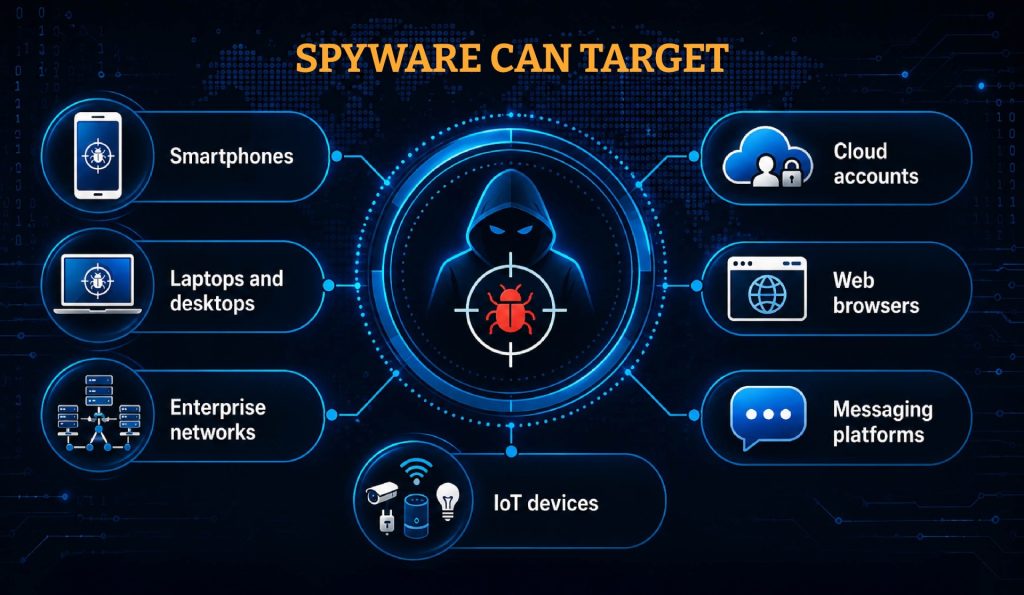
Depending on its purpose, spyware can record keystrokes, steal login credentials, monitor emails and chats, capture screenshots, track GPS locations, access microphones and cameras, harvest financial data, or exfiltrate sensitive business information. Modern spyware often operates silently for weeks or months before discovery.
Is Spyware Still Prevalent in 2026?
Absolutely. In fact, spyware activity has become more sophisticated, more targeted, and more commercially accessible than ever before. According to KELA’s 2026 cybercrime report, cybercriminals stole approximately 2.86 billion credentials in 2025, highlighting the growing role of surveillance spyware and credential theft operations.
Mobile devices remain a major target. Kaspersky data shows that there were 29% more attacks targeting smartphone users in the first half of 2025 than in the first half of 2024.
The spyware ecosystem itself has also expanded dramatically. The U.K. National Cyber Security Centre recently warned that roughly 100 countries now possess commercial spyware capabilities capable of compromising smartphones and computers.
Recent Real-World Spyware Incidents
Several major spyware-related events have made headlines recently:
- WhatsApp disclosed that approximately 200 users were tricked into downloading fake applications embedded with spyware in a targeted campaign allegedly linked to an Italian surveillance company. (Source)
- Google Threat Intelligence researchers reported that spyware vendors and Chinese state-backed actors dominated zero-day exploit activity in 2025, demonstrating how advanced spyware increasingly relies on undisclosed software vulnerabilities. (Source)
- Courts continued to scrutinize commercial spyware vendors such as NSO Group, whose Pegasus spyware has been associated with surveillance campaigns targeting journalists, activists, and political figures worldwide.
These incidents highlight the fact that spyware is now a mainstream cybersecurity challenge affecting governments, enterprises, high-profile individuals, and ordinary civilians alike.
What Modern-Day Spyware Looks Like: Then vs. Now
| Aspect | Traditional Spyware | Modern Spyware in 2026 |
|---|---|---|
| Infection Method | Suspicious downloads | Zero-click exploits, AI phishing, fake apps |
| Targets | Primarily PCs | Smartphones, cloud accounts, IoT, enterprise systems |
| Detection | Often visible symptoms | Highly stealthy and fileless |
| Persistence | Registry modifications | Kernel-level persistence, firmware abuse |
| Delivery | Email attachments | Messaging apps, QR codes, supply chains |
| Objectives | Ad fraud, credential theft | Espionage, surveillance, extortion, and nation-state intelligence |
| Technical Sophistication | Moderate | Extremely advanced and AI-assisted |
| Operators | Individual cybercriminals | Organized crime groups and nation-state actors |
Key Takeaway: Modern spyware behaves more like an advanced persistent threat (APT) than traditional malware.
Hallmarks of Spyware in 2026
Current spyware bears the following characteristics:
- Zero-Click Exploits: Spyware is increasingly using zero-click vulnerabilities, meaning victims do not need to click links or open files to become infected. This is made possible by attackers exploiting flaws in messaging platforms, VoIP applications, mobile operating systems, and browser rendering engines. The result is that even cautious users are vulnerable to spyware these days.
- AI-Driven Social Engineering: Artificial intelligence has radically transformed the methods of spyware delivery. Attackers are now using AI to generate convincing phishing messages, clone voices for social engineering, create personalized malware lures, automate reconnaissance, and bypass traditional detection tools. AI is enabling cybercriminals to scale operations while making attacks appear highly authentic.
- Fileless and Memory-Resident Techniques: Many spyware strains now avoid writing files to disk entirely. Instead, they operate in memory, abuse legitimate system tools, leverage PowerShell or scripting frameworks, or hide inside trusted applications. This reduces forensic evidence and complicates incident response.
- Cross-Platform Surveillance: Modern spyware targets all major operating systems, such as Windows, macOS, Linux, Android, iOS, and Cloud collaboration tools. Attackers are focusing on identity compromise rather than simply infecting a single device.
- Commercial Spyware-as-a-Service: The commercialization of spyware has lowered the barrier to entry. Today, advanced surveillance tools are marketed to governments, private investigators, criminal groups, and corporate espionage actors. This industrialization of spyware is one of the most concerning cybersecurity trends of the decade.
How AI Is Changing Spyware
AI has amplified spyware capabilities in several ways:
- Smarter Evasion: AI-powered malware can dynamically adapt its behavior to avoid triggering endpoint detection systems.
- Automated Target Profiling: Attackers use AI to analyze victims’ social media, communication habits, and business relationships before launching attacks.
- Faster Vulnerability Discovery: Machine learning accelerates the discovery of exploitable software flaws.
- Deepfake-Enhanced Spy Operations: Deepfake voice and video impersonation can trick victims into installing spyware or revealing credentials.
The combination of spyware and AI creates highly personalized, difficult-to-detect attack campaigns.
How to Detect Spyware
| Warning Signs on Personal Devices | What Organizations Should Monitor |
|---|---|
| Rapid battery drain | Unusual outbound traffic |
| Overheating devices | Unauthorized credential use |
| Increased data usage | Beaconing activity |
| Unknown applications | Suspicious PowerShell execution |
| Random microphone or camera activation | Endpoint anomalies |
| Slower performance | Unexpected privilege escalation |
| Unexpected pop-ups | Data exfiltration patterns |
| Unusual permissions requests |
It’s important to keep in mind that advanced spyware often produces no obvious symptoms.
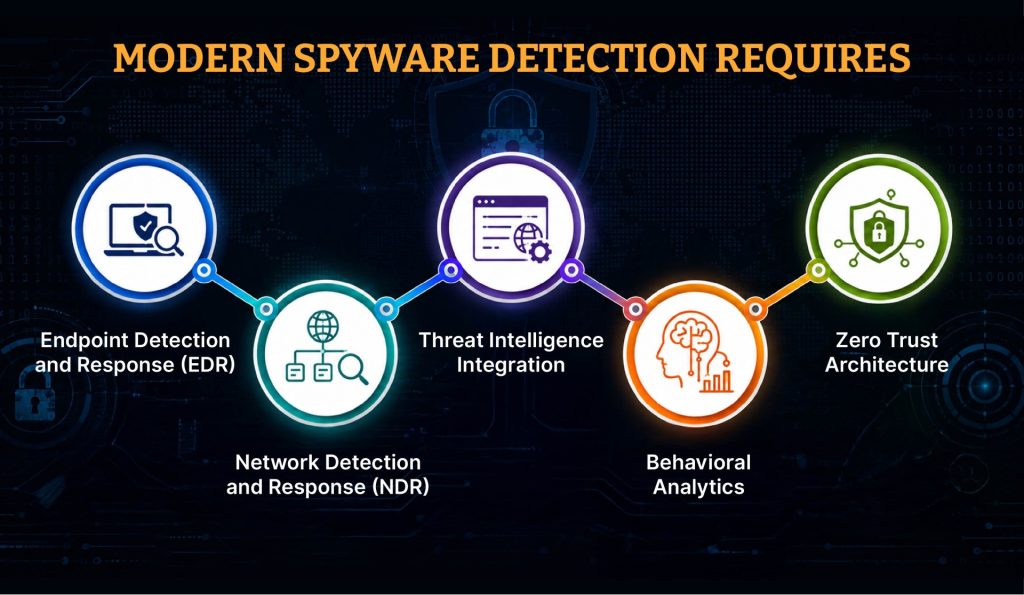
Tips to Help You Avoid Being a Victim of Spyware
- Keep Software Updated: Patch operating systems, browsers, mobile apps, and firmware promptly.
- Use Multi-Factor Authentication (MFA): Even if credentials are stolen, MFA can reduce the risk of unauthorized access.
- Avoid Untrusted Apps: Download applications only from official app stores and verified vendors.
- Limit App Permissions: Review your device’s microphone, camera, location, and accessibility permissions regularly.
- Deploy Endpoint Security Tools: Use reputable antivirus, EDR, and mobile threat defense solutions.
- Train Employees Continuously: Security awareness training remains one of the strongest defenses against spyware delivery methods.
- Watch for Phishing Attempts: Modern phishing campaigns are highly personalized and AI-enhanced.
- Encrypt Sensitive Data: Encryption reduces exposure in the event of surveillance or interception.
- Implement Zero Trust Security: Never automatically trust users, devices, or applications.
The Dangers and Harmful Consequences of Spyware in 2026
Spyware can have devastating consequences for both individuals and organizations.
- Personal Risks: Include identity theft, financial fraud, privacy invasion, blackmail, extortion, and reputation damage.
- Business Risks: Include intellectual property theft, regulatory fines and penalties, data breaches and theft, operational disruption, corporate espionage, loss of customer trust, and harm to brand image.
- National Security Risks: State-sponsored spyware campaigns can influence geopolitics, conduct espionage, monitor dissidents, and target critical infrastructure.
Why Cybersecurity Awareness Matters More Than Ever
Relying solely on technology to stop spyware is insufficient, as human behavior remains a primary vector of exploitation. This is why cybersecurity awareness is crucial.
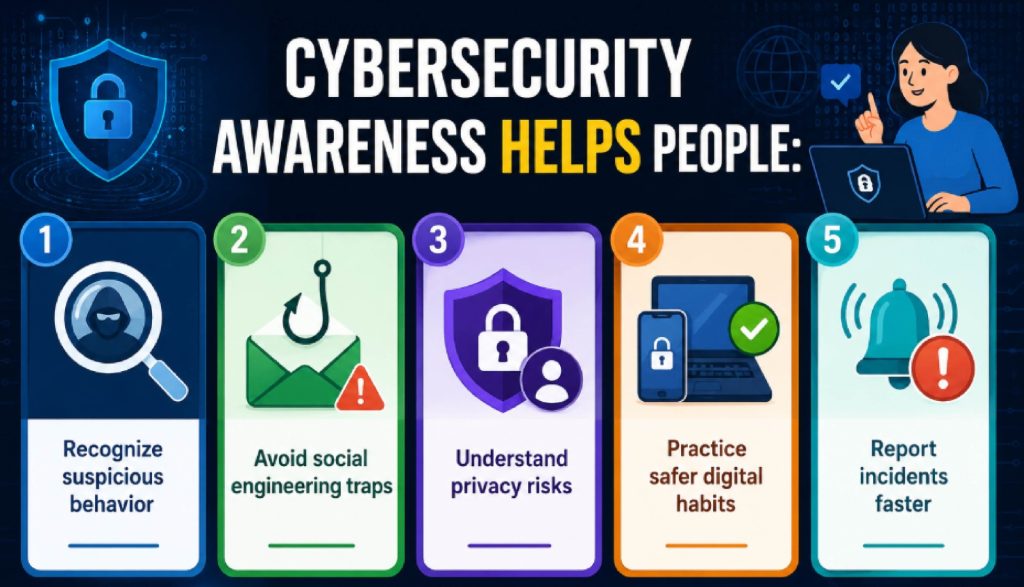
Organizations that prioritize cyber awareness training consistently experience fewer successful attacks, emphasizing the value of embracing a cybersecurity-oriented business culture.
In Summary
Spyware has evolved from simple nuisance software into a sophisticated cyber weapon capable of enabling espionage, surveillance, credential theft, and large-scale data compromise. The rise of AI-powered attacks, zero-click exploits, and commercial spyware marketplaces has made the threat landscape all the more difficult to navigate.
But while spyware is becoming more advanced, defenders are not powerless. Strong cyber hygiene, continuous security awareness, proactive monitoring, and modern threat detection technologies can significantly reduce risk. The most effective defense against spyware in 2026 is a combination of technology, vigilance, and education.
When it comes to cybersecurity education, EC-Council University (ECCU) leads the way by offering world-class online degrees and certification courses designed to empower technical and non-technical professionals alike with cybersecurity know-how. Discover how ECCU can help you become cybersecurity-savvy:
Frequently Asked Questions About Spyware in 2026
Spyware is malicious software designed to monitor user activity and steal their information covertly.
Yes. Modern spyware heavily targets Android and iPhone devices using advanced techniques such as zero-click exploits and malicious applications.
Warning signs that your device is infected by spyware may include unusual battery drain, overheating, slow performance, unknown apps, or abnormal data usage.
Zero-click spyware infects devices without requiring the victim to click links, open attachments, or interact with content.
Yes. Some governments use commercial spyware platforms for surveillance and intelligence gathering. However, these tools have also been linked to abuse and unauthorized monitoring.
Many security solutions can detect common spyware, but highly advanced spyware can evade traditional or basic antivirus tools.
Businesses should adopt EDR solutions, MFA, Zero Trust security, employee awareness training, and continuous monitoring to prevent spyware infiltration.
AI enables attackers to automate phishing, personalize attacks, evade detection, and accelerate vulnerability discovery.