Ethical hacking has always been a game of knowing what attackers know. That game changed significantly when AI entered the picture. Attackers now automate reconnaissance, generate exploits faster, and launch phishing campaigns at machine scale. Defenders who rely on manual methods alone are falling behind. ECCU 501, ECCouncil University’s credit-bearing course tied to the Certified Ethical Hacker (CEH v13) certification, reflects this shift. The updated CEH curriculum now weaves AI into every stage of the ethical hacking lifecycle, not as a standalone module, but as a redefined approach to the entire discipline. This blog covers what that means in practice, what you actually learn in ECCU 501, what the CEH certification tests, and where this credential takes your career.
Key Takeaways
- AI has fundamentally changed how attackers operate, and defenders must keep pace.
- CEH v13 integrates AI across the full ethical hacking lifecycle, not just one module.
- ECCU 501 is the credit-bearing course that maps directly to CEH v13 certification.
- The CEH holds DoD 8140 recognition, making it valuable for government and cleared-contractor roles.
- CEH is strongest for compliance-aligned and breadth-focused career paths.
- Stacking CEH with CPENT and LPT builds a complete offensive security profile.
- ECCU 501 fits within the Graduate Certificate Program and the broader MSCS pathway.
The Threat Landscape Has Changed
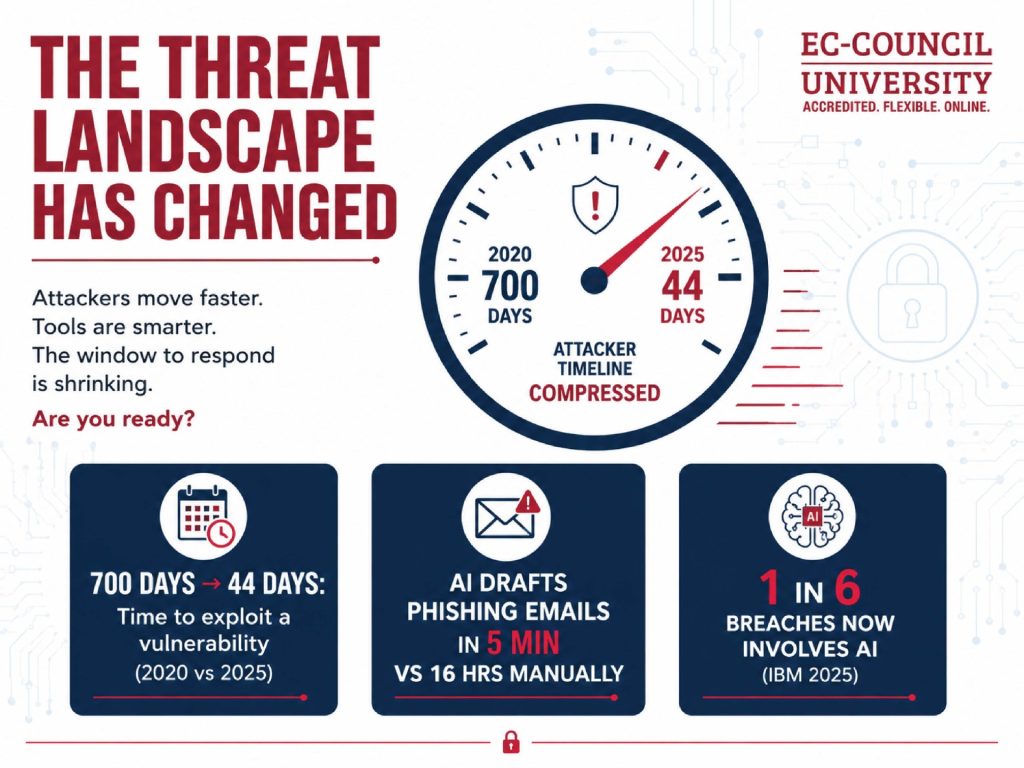
Attackers are not waiting for defenders to catch up. Time to exploit a known vulnerability dropped from over 700 days in 2020 to just 44 days in 2025. IBM X-Force research found AI can draft a convincing phishing email in five minutes versus sixteen hours for a skilled human operator. ENISA’s 2025 Threat Landscape report confirmed that AIsupported social engineering made up more than 80% of observed phishing activity worldwide. IBM’s Cost of a Data Breach Report 2025 put it plainly: 1 in 6 breaches now involves an attacker using AI.
Beyond phishing, AI compresses the exploit development cycle. Tools like WormGPT and FraudGPT automate vulnerability scanning, payload mutation, and reconnaissance at a scale that manual methods cannot match. Adversarial attacks on ML-based security models are also gaining ground.
Ethical hackers are adapting. AI assists OSINT, automates repetitive pen testing phases, and speeds up payload generation. The question is whether your training reflects this reality.
What ECCU 501 Covers
ECCU 501 is an AI-centric course at EC-Council University. It is the academic vehicle through which students engage with the CEH v13 curriculum. The course covers the full ethical hacking methodology: footprinting and reconnaissance, scanning and enumeration, vulnerability analysis, system hacking, social engineering, session hijacking, web application attacks, wireless security, denial-of-service, and cryptography.
What makes the current version different is what CEH v13 brought in. EC-Council did not simply add an AI module. AI was woven into every phase of the ethical hacking lifecycle, a curriculum redesign, not a cosmetic update. Students learn to use tools like ShellGPT for AI-assisted reconnaissance and scripting, understand how adversarial ML attacks work against security systems, and engage with prompt injection and LLM security testing as real attack surfaces.
Hands-on lab access is central to the ECCU experience. The course uses the ECCouncil iLab platform, a cloud-based environment where students:
- Launch pre-configured target machines with real vulnerabilities
- Practice scanning, exploitation, web application attacks, and malware analysis
- Work through enumeration, session hijacking, and IoT/OT hacking scenarios
- Run real-world simulations, not sanitized demos
The iLab environment matters because CEH v13 includes a practical exam component alongside the theory test, and hands-on preparation is where most candidates underperform.
What the CEH Exam Tests
The CEH v13 exam consists of 125 multiple-choice questions over four hours. The passing threshold ranges from 60% to 85%, depending on the question set, with the practical exam requiring the same 60% to 85% pass. The exam spans 20 domains, from reconnaissance and system hacking through to cloud security, IoT, and AI-driven attack and defense techniques.
CEH’s standing comes partly from its compliance value. The certification is formally recognized under DoD 8140, the U.S. Department of Defense Cyber Workforce Framework, making it a baseline requirement for many federal and cleared-contractor cybersecurity roles. CEH v13 also maps to 49 cybersecurity job roles, up from roughly 20 in the previous version.
Where does it sit relative to other certifications? CEH is not OSCP. OSCP demands a 24-hour live exploitation exam and remains the stronger signal for pure penetration testing roles. PenTest+ serves as a solid entry point for those new to offensive security. CEH sits between the two: broader than OSCP in scope, more rigorous than PenTest+, and uniquely strong in compliance-driven environments and government contexts. If your path leads toward federal agencies, regulated industries, or a structured corporate security career, CEH is often the required checkbox, not just an optional add-on.
Who Should Take ECCU 501
ECCU 501 is well-suited for several career profiles:
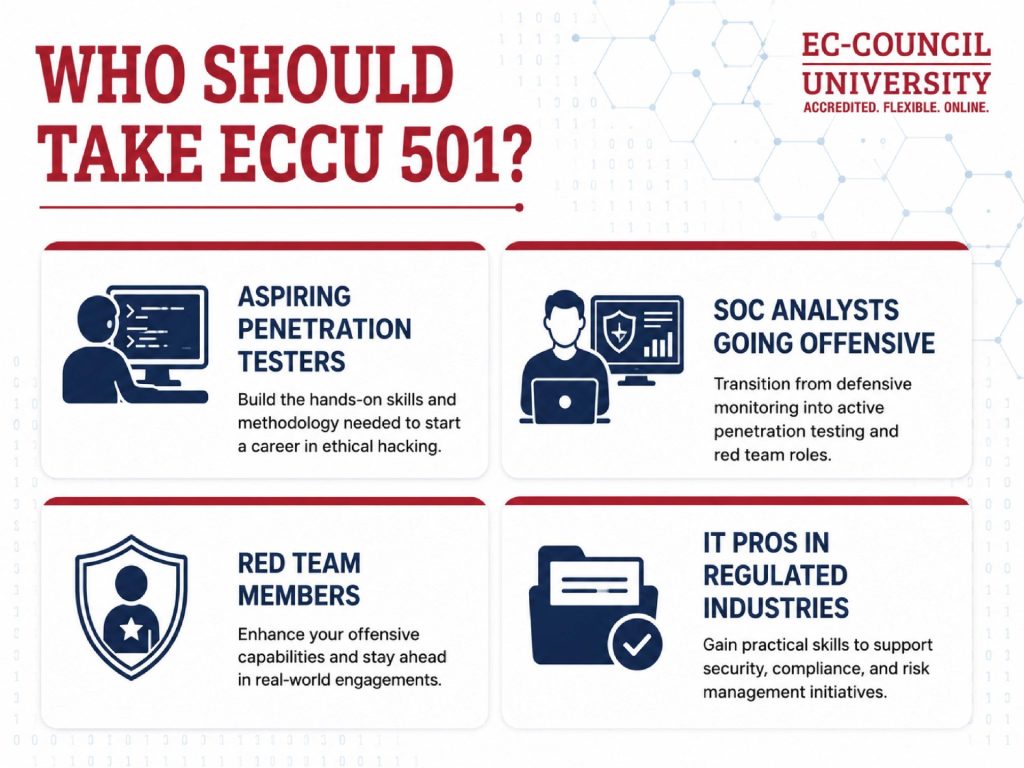
- Aspiring penetration testers building toward their first professional credential
- SOC analysts moving from defensive to offensive security work
- Red team members who need formal certification to back their skills
- IT professionals in compliance-heavy sectors where CEH is a hiring requirement A basic networking and security foundation is expected. You do not need a prior cybersecurity degree. Non-degree students can enroll in ECCU 501 directly through ECCU’s non-degree pathway and later convert those credits toward a full MSCS if they choose to continue.
Where CEH Takes Your Career
CEH holders work across penetration testing, vulnerability assessment, SOC operations, red team consulting, and security architecture. Average total compensation for U.S. CEH professionals sits around $126,547 annually, with Glassdoor reporting an average of $139,516 and top earners reaching $232,850. Foote Partners found CEH holders earn a 10% salary premium over peers without the certification.
For those building a full offensive security profile, the natural path runs CEH to CPENT to LPT. CEH gives you the methodology. CPENT sharpens technical execution. LPT validates you at an advanced practitioner level. Together they build a credential stack that serious offensive security hiring managers recognize.
Build the Skills Behind the Certification
Ethical hacking is not slowing down, and neither is the threat landscape it responds to. ECCU 501 gives you the structured, credit-bearing path to a credential that governments and enterprises actually require. Advance your ethical hacking skills with the course behind one of cybersecurity’s most respected certifications. Also, explore ECCU 501 within the Graduate Certificate Program and see how it integrates with the full MSCS pathway.
Frequently Asked Questions
Is ECCU 501 only for students in the Graduate Certificate Program?
No. ECCU 501 is available as a standalone non-degree course. Students who complete it can later apply those credits toward the Graduate Certificate Program or the MSCS pathway if they want to continue.
How does the CEH exam in 2026 differ from earlier versions?
CEH v13 integrates AI throughout the curriculum rather than treating it as an add-on. The exam now includes AI-assisted attack and defense techniques, and the certification maps to 49 cybersecurity job roles compared to roughly 20 in v12.
Is CEH recognized for DoD 8140/DCWF roles?
Yes. CEH is formally approved under the DoD 8140 Cyber Workforce Qualification Program and maps to multiple DCWF work roles across basic, intermediate, and advanced proficiency levels.
Can I take ECCU 501 without a cybersecurity background?
A basic understanding of networking and IT fundamentals is expected. A cybersecurity degree is not required. ECCU’s enrollment advisors can help you assess readiness before you apply.
Does ECCU provide exam vouchers for the CEH certification exam?
ECCU’s course materials indicate the CEH v13 certification is included as part of the program. Contact ECCU’s enrollment team directly to confirm current voucher terms, as these can vary by enrollment pathway.