
People ask whether a cybersecurity degree actually pays off. It is a fair question. Tuition costs money. Time costs more. Bootcamp ads push the idea that certifications alone land six-figure jobs. This blog does not make empty promises. It covers what graduates earn in year one and where they land. Where a bachelor’s degree creates advantages, shorter paths simply cannot compete. Weighing a BSCS against other options? This is the comparison you need.
Key Takeaways
- Entry-level cybersecurity roles pay $65,000 to $85,000 nationally in year one.
- Degree holders earn roughly 15% more than bootcamp graduates at the start.
- Federal and DoD roles almost always require a bachelor’s as a baseline.
- ECCU’s BSCS includes six EC-Council certifications at no additional cost.
- Over 514,000 US cybersecurity roles were open in the latest CyberSeek reporting period.
- A BSCS is the direct route into an MSCS and higher-paying senior roles.
The First-Year Reality: What Cybersecurity Graduates Actually Earn
Let’s put the median number in context. The BLS reports a $124,910 median for information security analysts. That is the May 2024 figure. It spans the full career, not just year one. Year one looks different.
Entry-level roles pay less. That is how every technical profession works. What matters is where you start and how fast you move.
Glassdoor places the average entry-level security analyst salary at $73,927 nationally. Tier 1 SOC analyst roles cluster between $65,000 and $90,000. Employer size, geography, and shift requirements all shift within that range. High-cost markets like Washington DC, California, and Massachusetts push figures higher. Salary.com puts the DC average for SOC analysts at $85,814.
How does cybersecurity compare to other STEM bachelor’s degrees? PayScale puts the BS in Cybersecurity median at $78,000. That is well above the national median for all bachelor’s degree holders. The field rewards entry faster than most.
ECCU reports a 93% employment rate for ECCU graduates within six months. Starting salary range runs $75,000 to $90,000 for entry-level roles. These figures come from ECCU’s own graduate outcome surveys. They are consistent with market data. Individual results vary by role, location, and prior experience.
What Roles Are Available to BSCS Graduates Immediately After Graduation?
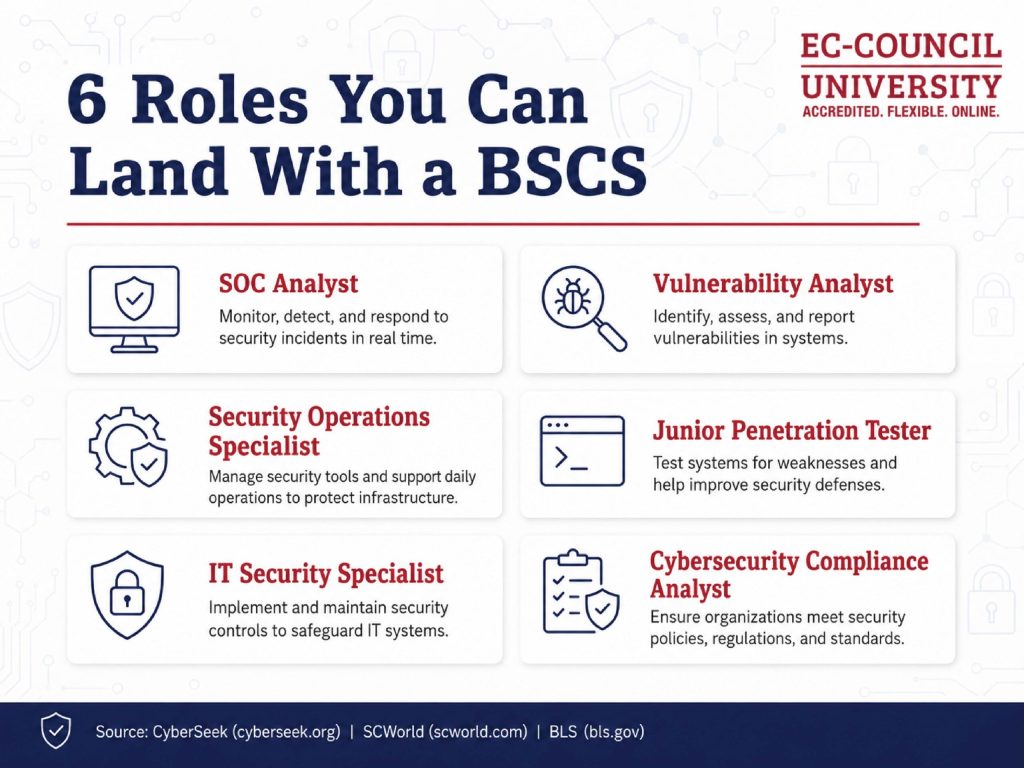
A BSCS does not lock you into one title. The roles available in year one are varied:
- SOC Analyst (Tier 1 and Tier 2): real-time threat monitoring and incident response.
- Vulnerability Analyst: identifying and prioritizing security weaknesses in systems.
- Security Operations Specialist: supporting larger security programs and frameworks.
- Junior Penetration Tester: especially relevant with a CEH certification embedded in the degree.
- IT Security Specialist: a broad role common in mid-market companies.
- Cybersecurity Compliance Analyst: GRC-focused roles that grew 40% in job postings in 2024.
Some of these roles do not strictly require a four-year degree. At a smaller MSP, Security+ and a portfolio might be enough. That works at some companies. But a bachelor’s functions as a hiring filter at large enterprises. Financial institutions, healthcare systems, and government agencies screen for degree credentials first. Automated tracking systems screen for the degree before a recruiter even looks.
Government and defense roles are the clearest examples. Federal civilian positions follow the General Schedule pay system. A bachelor’s degree qualifies candidates for GS-9 entry instead of GS-7. Most DoD contractor postings list a bachelor’s as the standard baseline. The DoD 8140 framework governs cybersecurity personnel qualifications across all branches. Certifications matter within that framework. But a degree consistently strengthens a candidate’s profile for cleared roles. If a federal career is the goal, a BSCS is not optional. ECCU’s breakdown of five key roles shows what a BSCS opens up.
What the BSCS Teaches That Self-Study and Bootcamps Don't
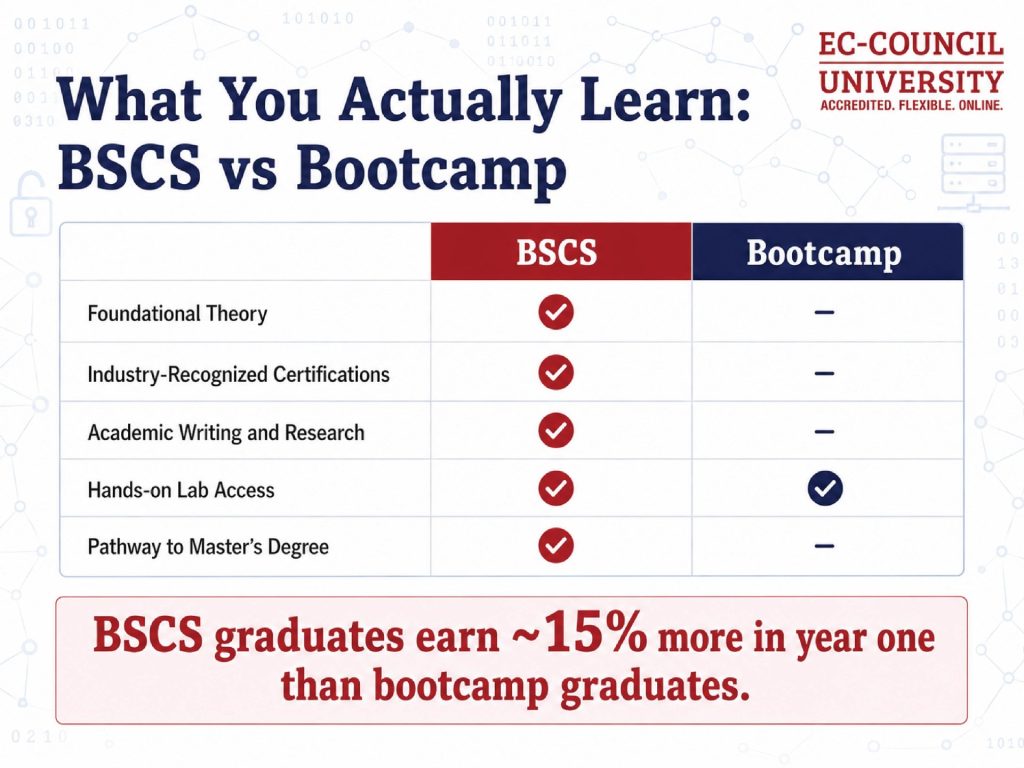
Bootcamps move fast. That is their selling point. The tradeoff is depth. A 20-week program covers tools and procedures. That theoretical substrate is what keeps analysts adaptable when tools change.
ECCU’s BSCS builds from the ground up. Networking fundamentals, operating systems, cryptography, and programming logic are not electives. They are the foundation every advanced course builds on. Security tooling is being reshaped by AI. Analysts who understand what sits underneath the tool can adapt. Those who only know the tool are exposed when it changes.
Academic skills matter too. Research, structured writing, and critical analysis are part of every graduate program. The MSCS and senior advisory roles require these skills. A bootcamp does not teach them. A degree does.
Then there is the certification layer. ECCU’s BSCS includes six industry-recognized ECCouncil certifications embedded directly in the curriculum:
- Certified Network Defender (CND)
- Certified Ethical Hacker (CEH)
- Certified Hacking Forensic Investigator (CHFI)
- Certified Threat Intelligence Analyst (CTIA)
- Certified SOC Analyst (CSA)
- Artificial Intelligence Essentials (AIE)
Each maps to a specific course. Exam vouchers are included at no extra cost. The standalone market value of these certifications runs into thousands of dollars. Graduates leave with a degree and a working certification portfolio.
Does an online format change the degree’s value? That is worth answering before you enroll.
Alternative Paths and Comparison
Cybersecurity bootcamps are real. Some graduates land jobs directly. Research.com’s analysis puts bootcamp starting salaries at $55,000 to $70,000. That is typically at startups or smaller firms. Practical skills outweigh credentials there. It is also roughly 15% below degree-holder starting salaries. Over a career, that gap compounds.
Self-study with certifications is cheaper still. The ceiling is real, though. Certifications prove you passed an exam. They do not prove you can reason through a novel threat. Managing a security program requires more than that. Large employers know this. The path to senior roles closes earlier without a degree credential.
An associate degree is a reasonable bridge for career changers. Prior IT experience makes it work. The associate’s median salary sits at $56,000, well below the BSCS median. ECCU’s BSCS completion program accepts transfer credits from a community college. The path from an associate’s to a bachelor’s here is fast.
For those thinking further ahead, the BSCS-to-MSCS pathway at ECCU is direct. Graduates who continue to the MSCS report a 20-40% salary increase. Whether a bachelor’s alone is enough for an IT job is context-dependent. For many entry-level positions, yes. For anything above that, the master’s accelerates significantly.
Market Resilience: Why Cybersecurity Is an Unusually Safe Career Bet
CyberSeek tracked 514,359 open US cybersecurity roles in its latest reporting window. The BLS projects 29% growth for information security analyst roles through 2034. That is more than five times the national average.
One honest caveat: the field is not recession-proof. ISC2’s 2024 and 2025 workforce studies documented hiring freezes and layoffs. Budget cuts hit security teams too. But the comparative picture is still strong. Indeed Hiring Lab tracks four major tech sectors. Cybersecurity stands alone among them. It is the only one still above pre-pandemic posting levels. Software development sits at roughly 71% of its February 2020 baseline. Security sits at around 113%. More resilient is not the same as immune. It is still the stronger bet.
Remote-eligible roles exist, though less commonly than in general software development. Where remote work is available, geography stops limiting your salary options.
Conclusion
A BSCS is not a guarantee. No degree is. It opens the full hiring market. It builds a technical and academic foundation shorter paths skip. It includes job-ready certifications. It connects directly to a master’s pathway. The first-year numbers support the investment. The long-term trajectory supports it more.
Start your cybersecurity career on the strongest possible foundation. Explore ECCU’s Bachelor of Science in Cybersecurity. Built to get you job-ready from day one.
Frequently Asked Questions
Can I get a cybersecurity job without a degree if I have certifications?
Yes, for some roles. Certifications like CEH can get you through the door at smaller companies and managed service providers. But at large enterprises, government agencies, and DoD contractors, a bachelor’s degree is typically a hard requirement that certifications alone cannot replace. The degree also meaningfully increases your starting salary and long-term advancement ceiling.
How long does ECCU's BSCS take to complete?
ECCU’s BSCS is a two-year online completion program consisting of 20 courses. It is designed for students entering with prior college credits, and transfer credits from certifications or an associate degree can reduce both the cost and the time to completion.
Does ECCU's BSCS accept transfer credits from community college?
Yes. ECCU accepts transfer credits from accredited community colleges, which can meaningfully reduce both the cost and the time to finish. Prospective students should contact ECCU’s admissions team to assess which credits apply to their situation.
What is the pathway from ECCU's BSCS to the MSCS?
The BSCS is built as a direct foundation for ECCU’s Master of Science in Cybersecurity. Graduates who continue to the MSCS typically see a 20 to 40% increase in earning potential. The academic rigor of the BSCS curriculum prepares students for the research and analytical demands of graduate-level study.
Is a bachelor's in cybersecurity better than a bachelor's in computer science for security roles?
For roles specifically in cybersecurity, a BSCS is more directly aligned. A computer science degree covers broader ground across software engineering, data science, and systems. The BSCS goes deeper into threat analysis, network defense, ethical hacking, and security operations. For someone certain they want a cybersecurity career, the BSCS is the more efficient path.