
Open ten IT job postings right now, for network roles, cloud roles, even help desk roles, and count how many mention security skills. Most of them will. Cybersecurity has moved from a specialist add-on to a baseline expectation across IT hiring, and that shift is exactly why more students are choosing cybersecurity degrees over general IT ones.
It also raises a real question, one that matters more than the marketing around it suggests: does the degree alone get you hired?
Here’s the honest answer, backed by the numbers. A bachelor’s in cybersecurity puts you ahead of most other entry points into IT. It does not, on its own, close the experience gap that shows up in almost every “entry-level” posting asking for two to three years of hands-on work. That gap, and how to close it, is what the rest of this comes down to.
What Is a Bachelor's Degree in Cybersecurity?
A Bachelor of Science in Cybersecurity (BSCS) is a four-year undergraduate degree, or a two-year completion program for students entering with prior college credit, that combines core IT fundamentals with dedicated security coursework. Students typically study networking, operating systems, and scripting alongside security-specific subjects such as vulnerability assessment, incident response, digital forensics, and secure architecture. It differs from a general IT or computer science degree by treating security as the organizing principle of the curriculum rather than one elective among many.
How the IT and Cybersecurity Job Market Is Changing
A decade ago, security was handled by a specialist team. Today, security fundamentals show up inside almost every IT role:
- A network technician needs to understand firewall rules.
- A cloud administrator needs to understand IAM and access control.
- A help desk technician needs to recognize social engineering attempts.
Three things are driving this:
Threats are outpacing hiring. Organizations are dealing with daily phishing attempts, ransomware campaigns, and data leaks, which has pushed companies to hire IT staff who can secure systems from day one, not just set them up.
Demand keeps outrunning supply. The U.S. Bureau of Labor Statistics projects 29% employment growth for information security analysts from 2024 to 2034, nearly ten times the average growth rate across all occupations, with about 16,000 openings projected annually. CyberSeek’s most recent data tracks over 514,000 open cybersecurity positions across the U.S., and ISC2’s 2024 Workforce Study estimates a global workforce gap of roughly 4.8 million professionals. That gap is exactly why cybersecurity-literate IT graduates are landing offers faster than generalists.
Employers want prevention, not just repair. Companies increasingly hire for a security-first mindset: candidates who understand risk and vulnerabilities rather than just fixing what already broke.
Why Your Cybersecurity Degree Matters More Than You Think
A BSCS already works in your favor in a few concrete ways:
- It proves technical fundamentals. You are not walking in with zero grounding in networking, operating systems, or scripting.
- It signals commitment in a field that needs talent. The BLS reports a 2024 median annual wage of $124,910 for information security analysts, well above the median for all occupations, though entry-level pay starts lower and builds from there.
- It teaches risk, threat modeling, and security frameworks, knowledge that sets you apart even in a support or networking role at the same level.
- It’s the standard entry credential. BLS lists a bachelor’s degree as the typical entry-level education for this field.
None of that guarantees a job by itself. The degree is the credential. What gets you hired is what you can point to beyond it.
Is a Bachelor's in Cybersecurity Enough Without Experience?
This is where most graduates hit a wall. “Entry-level” postings routinely ask for two to three years of hands-on experience, which feels contradictory until you understand why: employers are not doubting your classroom knowledge, they are checking whether you can apply it under pressure, on a live system, without guidance.
That gap exists because most degree programs, cybersecurity included, are built around theory first. Concepts like log monitoring, vulnerability scanning, and incident response are taught, but not always practiced against realistic, messy scenarios. A degree from a program that builds in labs, simulations, and case studies closes more of that gap than one that doesn’t. This is one of the reasons the specific program you choose matters as much as the degree title.
Realistically, a BSCS alone is enough for some entry-level paths (help desk, junior SOC analyst tier 1, IT support with a security focus) and not quite enough for others (compliance-heavy or cleared roles that specifically weight applied experience). The honest framing: the degree opens the interview. What you’ve built, documented, and can talk through in that interview is what closes it.
How to Get IT Experience With a Bachelor's in Cybersecurity
The good news is that this gap is buildable while you’re still in school or shortly after graduating. The most credible ways to do it, roughly in order of how much weight they tend to carry with hiring managers:
- Build a home lab. Set up a small virtualized network, practice hardening a server, and document what you did. This is the single most commonly cited proof point in entry-level cybersecurity hiring.
- Run vulnerability scans on your own lab environment using free or opensource tools, then write up findings the way an analyst would.
- Take on an internship, even an unpaid or short-term one. It’s the fastest way to get “real environment” experience on a resume.
- Participate in Capture-the-Flag competitions or cyber ranges. These are increasingly recognized by hiring managers as evidence of applied problemsolving.
- Earn a certification that requires a practical exam, not just multiple choice. Exams with hands-on components (like performance-based labs) demonstrate skills employers can verify.
- Document everything in a portfolio. Screenshots, write-ups, and GitHub repos of your lab work function as proof in a way a resume line alone cannot.
Employers want to know you can troubleshoot a broken network, harden a server, monitor logs, respond to an incident, or run a vulnerability scan. Programs that build labs, simulations, and case studies directly into coursework, rather than leaving practical exposure entirely up to the student, give graduates a real head start here.
What a Bachelor's in Cybersecurity Really Teaches You
A cybersecurity degree is not only about hacking or defense tools. It shapes an IT professional who understands how systems work and how they break.
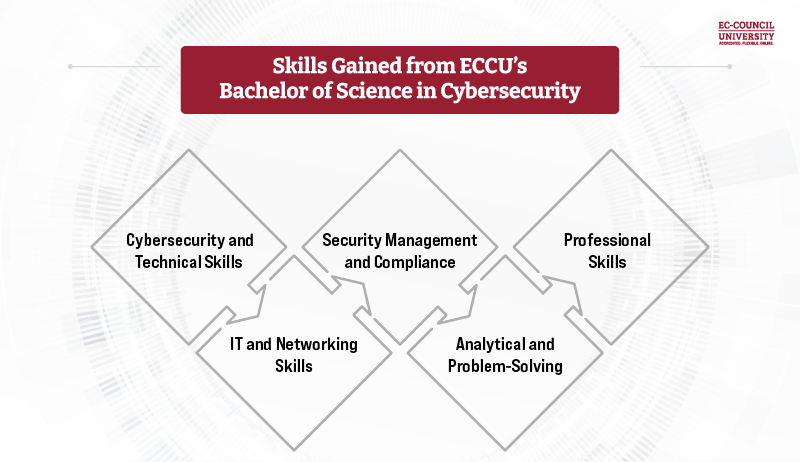
You gain core IT foundations:
- Networking
- Operating systems
- Cloud basics
- Scripting and automation
Alongside essential security disciplines:
- Security monitoring
- Vulnerability assessment
- Access management
- Cyber risk fundamentals
- Incident response
- Digital forensics
- Secure architecture principles
This combination is what makes cybersecurity graduates versatile for both entry-level cybersecurity roles and IT jobs that expect a security-first mindset.
ECCU’s Bachelor of Science in Cybersecurity (BSCS) builds these fundamentals through an industry-driven curriculum, with real labs, hands-on exercises, simulations, and case studies rather than theory alone. The program also embeds EC-Council certification opportunities directly into coursework, so graduates leave with a working certification portfolio alongside the degree.
See how ECCU alumnus Christopher Banda’s cybersecurity degree helped him advance his career here.
Bachelor's in Cybersecurity vs. IT Degree
Both degrees teach you how systems work. A cybersecurity degree specifically teaches you how to build and defend them, and that difference shows up in both curriculum and pay ceiling.
| Bachelor’s in Cybersecurity | General IT Degree | |
|---|---|---|
| Core focus | Security-first: threat modeling, risk, defense | Systems, infrastructure, and support-first |
| Typical entry roles | SOC Analyst, IT Security Specialist, Compliance Technician | Help Desk, Network Technician, Systems Support |
| Median pay reference (BLS, 2024) | Information Security Analyst: $124,910 | Network & Computer Systems Administrator: $96,800; Computer Support Specialist: $61,550 |
| Certification alignment | Directly maps to CEH, CND, CSA, and similar credentials | Maps more to CompTIA A+/Network+ style credentials |
| Best fit for | Candidates certain they want a security-focused career | Candidates who want broader systems exposure before specializing |
Neither path is objectively better. A general IT degree gives you a wider entry point into more roles early on. A cybersecurity degree narrows that entry point but positions you for the higher end of the IT pay scale sooner, and gives you a head start if security is the direction you already know you want.
Jobs You Can Get With a Bachelor's in Cybersecurity
Despite the name, a cybersecurity degree prepares you for more than security-titled roles. Many BSCS graduates begin in broader IT positions to build foundational experience.
Entry-level roles:
- IT Support Specialist
- Network Technician
- Junior Systems Administrator
- SOC Analyst (Tier 1)
- Junior Cybersecurity Analyst
- IT Helpdesk Technician
- Incident Response Assistant
- IT/Compliance Technician
Mid-level roles to grow into:
- Cybersecurity Analyst
- Network Security Engineer
- Application Security Analyst
- Threat Intelligence Analyst
- Cloud Security Specialist
- Digital Forensics Investigator
- Penetration Tester (starting at junior level)
These entry roles don’t just provide a first job. They provide the real-world experience that everything in the section above depends on.
How Long Does a Bachelor's in Cybersecurity Take?
A traditional, start-from-scratch BSCS runs about four years. ECCU’s BSCS is structured as a completion program: 20 courses, with 60 credit hours required at the 300/400 (upper-division) level and 120 or more total semester credit hours once transfer credit is applied. For students entering with an associate degree, prior college credit, or qualifying certifications, that typically compresses the timeline to roughly two years. A minimum cumulative GPA of 2.0 is required to graduate.
Should You Add Certifications?
Certifications aren’t mandatory, but they give your resume something concrete to point to alongside the degree. Early-career credentials worth prioritizing include CEH, CND, and CPENT, all of which have hands-on, performance-based exam components rather than multiple choice alone. ECCU’s BSCS aligns naturally with several of these, since certification prep is built into the coursework rather than treated as a separate track. For a deeper look at how certifications affect salary and hiring, see our cybersecurity certifications guide.
Why ECCU Graduates Stand Out
What makes ECCU students distinct in the job market:
- A curriculum shaped by cybersecurity practitioners
- A degree that includes industry-recognized certification opportunities
- Hands-on labs and real-world cyber range simulations
- Exposure to modern security tools and frameworks
- Pathways to advanced certifications and graduate-level study
If you’re weighing the BSCS against a graduate degree, our breakdown of what a master’s adds in salary and role access covers that comparison directly. And if you want the full first-year salary picture for BSCS graduates, our salary guide for cybersecurity bachelor’s graduates has the current numbers.
So, Is a Bachelor's in Cybersecurity Enough to Get You an IT Job?
Yes, when paired with real, demonstrable experience. A bachelor’s in cybersecurity gives you a strong academic foundation, a security-first mindset employers value, and access to roles that a general IT background reaches more slowly. It doesn’t replace the need to show you can do the work. Labs, certifications with hands-on components, internships, and a documented portfolio are what turn “I have the degree” into “I can start Monday.”
Whether you step into IT support, networking, cloud, or a junior analyst role, the path forward is open, provided you build the proof alongside the credential.
Frequently Asked Questions
It’s enough to qualify for and compete seriously for entry-level IT and junior security roles, especially when paired with a home lab, an internship, or hands-on certifications. For roles that explicitly require 2-3 years of experience, the degree gets you the interview; demonstrated project work gets you the offer.
A four-year undergraduate degree (or two-year completion program for students with prior credits) combining core IT fundamentals like networking and operating systems with security-specific coursework such as threat analysis, incident response, and digital forensics.
Traditionally four years from scratch. Completion programs, including ECCU’s BSCS, typically take about two years for students entering with an associate degree, transfer credits, or qualifying certifications.
Common entry points include
IT Support Specialist, Network Technician, SOC Analyst (Tier 1), and Junior Cybersecurity Analyst, with growth paths into Cybersecurity Analyst, Cloud Security Specialist, and Penetration Tester roles as you gain experience.
It’s enough for some entry-level paths and not quite enough for others, particularly compliance-heavy or cleared roles. Building a home lab, portfolio, or internship experience alongside the degree materially improves your odds across the board.
Build a home lab and document it, pursue an internship (even unpaid or shortterm), compete in Capture-the-Flag events, and pursue certifications with hands-on, performance-based exam components rather than multiple choice only.
Practical, demonstrable skills: troubleshooting a broken network, hardening a server, monitoring logs, responding to an incident, deploying cloud infrastructure, and running vulnerability scans.