
The label “soft skills” is genuinely misleading. There is nothing soft about persuading a skeptical board. Nothing soft about leading a team through an active breach. Nothing soft about shifting how an entire organization thinks about risk.
Technical skills get you noticed. Certifications prove competence. Tooling expertise opens doors. But the skills that actually keep security leaders in their roles are something else. They require communication, patience, influence, and composure under pressure.
This blog covers what those skills are, why technically strong engineers often struggle after promotion, what 2026 data says about the widening leadership skills gap, and how to build these capabilities before they become your gap.
Key Takeaways
- Technical excellence earns the promotion. Leadership skill keeps you in the role.
- Most CISO struggles trace back to communication failures, not technical ones.
- Translating security risk into business language is a learnable, practicable skill.
- Security culture shifts over years. Leaders who lose patience rarely see programs mature.
- Personal liability for cyber failures is now legally real, not just reputational.
- AI is elevating judgment, communication, and business alignment above traditional technical skill, not replacing the need for either.
- Deliberate skill-building beats waiting for experience alone to close the gap.
The Myth of the Technical Leader
Promoting the best security engineer into leadership is a natural instinct. It rarely plays out as organizations expect.
Engineering and leadership are different cognitive tasks. Strong individual contributors solve contained, defined problems. Leaders manage ambiguity, sustain relationships, and communicate across competing interests. One skill set does not prepare you for the other.
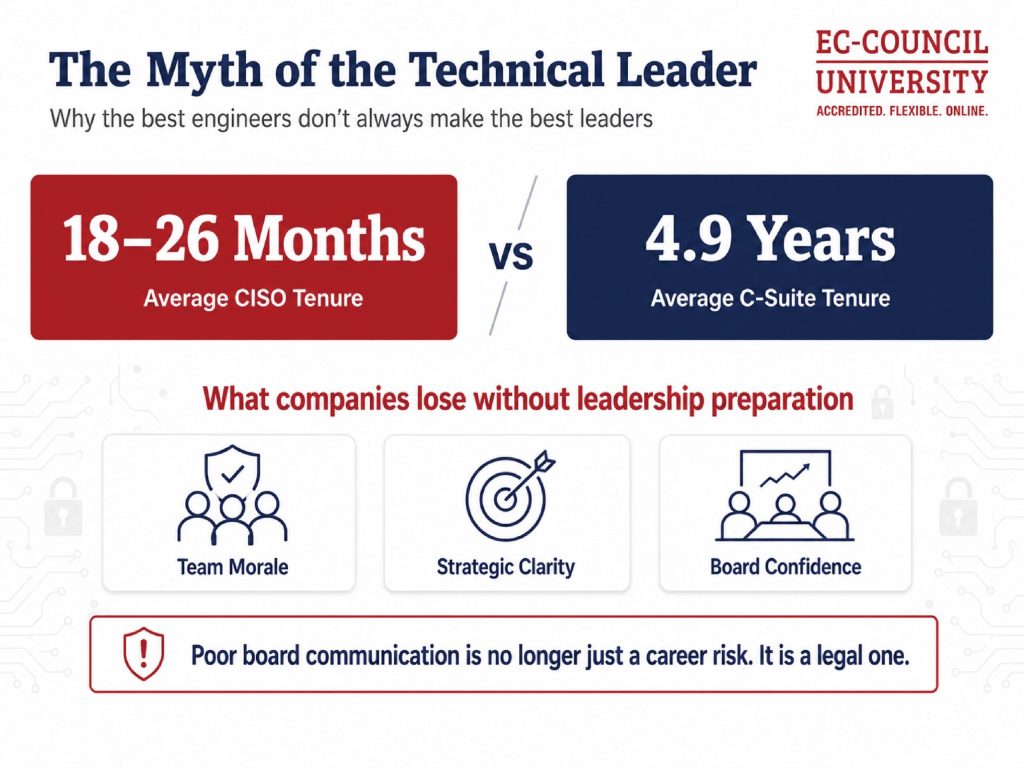
When organizations promote on technical merit alone, the costs are real. Team morale erodes when a manager cannot develop people. Strategic clarity gets lost when security planning stays inside a technical frame. Board confidence disappears when a CISO cannot hold a non-technical room.
The CISO Crisis: Why Leaders Fail Without Soft Skills
The tenure data makes the gap visible. The average CISO stays in post for just 18 to 26 months1. Other C-suite roles average 4.9 years. That difference does not come from threat complexity alone. It reflects a leadership preparation gap, not a technical one.
The pressure has intensified further in 2026. New workforce research from Seemplicity found nearly half of security leaders are working eleven or more extra hours a week, with one in five logging sixteen-plus. The same report describes AI as fundamentally reshaping what cybersecurity leadership requires: elevating judgment, communication, and business alignment above pure technical skill. The role is not getting easier to hold. It is getting harder to hold without the leadership skills this blog covers.
There is also a legal dimension now. SEC disclosure rules have created personal liability for security leaders. The cases against CISOs at SolarWinds and Uber set a clear precedent. Poor board communication is no longer just a career risk. It is a legal one.
Hard Skills vs. Soft Skills: What Actually Drives CISO Success
Neither skill set replaces the other. The distinction matters because most security careers are built entirely around one of them.
| Hard Skills | Soft Skills | |
|---|---|---|
| What they cover | Firewalls, penetration testing, cloud security, incident response, compliance frameworks | Communication, influence, empathy, conflict resolution, strategic patience |
| How they’re built | Certifications, labs, hands-on tooling experience | Deliberate practice, mentorship, structured leadership education |
| What they get you | Hired and promoted into technical and management roles | Trusted and retained in executive and board-facing roles |
| Where they fail you | Rarely explain why a technically excellent CISO gets pushed out | Rarely the reason someone gets the CISO title in the first place |
Hard skills open the door to a leadership role. Soft skills determine whether you stay in the room once you’re there. Most security curricula are built almost entirely around the left column of that table, which is exactly the gap this blog addresses.
The Soft Skills That Actually Shape Security Leadership
Some of these skills are more unexpected than most security professionals anticipate. Research and practitioners consistently point to the same core set.
Why Communication Is the #1 Leadership Skill
Boards do not want a technical briefing. They want to understand business exposure. 67%2 of CISOs report difficulty winning C-suite support for their security strategies. The gap is rarely knowledge. It is language. Leaders who frame threats as financial and operational risk get funded. Those who don’t, struggle.
CISO-board sessions often run just 30 minutes per quarter3. Every word has to land.
Communication comes up more consistently than any other soft skill in both research and practitioner accounts, largely because every other leadership skill on this list depends on it. Influence, conflict resolution, and executive presence all collapse without it.
How to Translate Cyber Risk for the C-Suite and Board
Translating risk is a specific, learnable skill, not an innate talent. A few habits separate leaders who hold the room from those who lose it:
- Lead with business impact, not technical severity. A board doesn’t need to know a vulnerability is “critical severity.” It needs to know what it costs, how fast, and to whom.
- Quantify exposure in dollars and downtime, not CVSS scores or MITRE ATT&CK stages.
- Bring one ask per session. Boards fund clear decisions faster than they fund broad awareness.
- Rehearse the non-technical version out loud before the meeting, ideally with someone outside security who can flag jargon.
Recruiters in the executive search market describe this specifically as “board fluency,” and treat it as one of the rarest, most compensated traits in a CISO candidate pool, distinct from and harder to find than technical depth alone.
Influence Without Authority: Leading Across Departments
Security programs need buy-in from IT, finance, legal, HR, and operations. The CISO controls none of those teams directly. Influence here is built on trust and relationship capital over time. Professionals who master this move security culture forward. Those who rely on authority alone stall.
Cross-functional influence is not a personality trait some leaders happen to have. It is built through repeated, small interactions: showing up to a finance team’s planning meeting before you need something from them, learning what legal actually worries about before you ask them to sign off on a policy, understanding what operations is measured on before you ask them to change a process.
Emotional Intelligence & Empathy in Security Teams
Post-incident environments are pressure cookers. Blame spreads. Teams fracture. 76%4 of cybersecurity professionals reported burnout in 2024. Leaders who address tension directly and protect their teams retain good people. Those who don’t, lose them.
Only 11%5 of organizations view empathy as an essential soft skill. Yet burnout keeps accelerating. That contradiction sits at the heart of the cybersecurity retention crisis. Emotional intelligence is what lets a leader recognize burnout before a resignation letter does, and what lets a team trust a leader enough to say something is wrong before it becomes a breach.
Strategic Patience and Change Management
Security culture does not shift in a quarter. It shifts over years, sometimes many years. Leaders who lose patience during slow progress rarely see programs mature. The leaders who last treat culture change as a multi-year program with milestones, not a campaign with a launch date.
AI Is Making Soft Skills More Valuable, Not Less
The assumption that AI will make human leadership skills less important gets the direction backward. As AI absorbs more routine technical work, the skills machines cannot replicate are becoming the differentiator, not a nice-to-have.
LinkedIn’s 2026 skills data shows soft skills account for seven of the ten fastest-growing skills globally. In cybersecurity specifically, 51%6 of security professionals say nontechnical skills matter more with AI in the picture. That is not a future concern. It is a present one.
Seemplicity’s 2026 State of the Cybersecurity Workforce Report reaches the same conclusion from a different angle: AI is reshaping cybersecurity leadership by elevating judgment, communication, and business alignment above traditional technical skill, even as it adds to leaders’ overall workload. The technical floor is rising because AI raises baseline capability across a team. The leadership ceiling is what still separates a functioning security program from a struggling one.
What Most Security Curricula Get Wrong
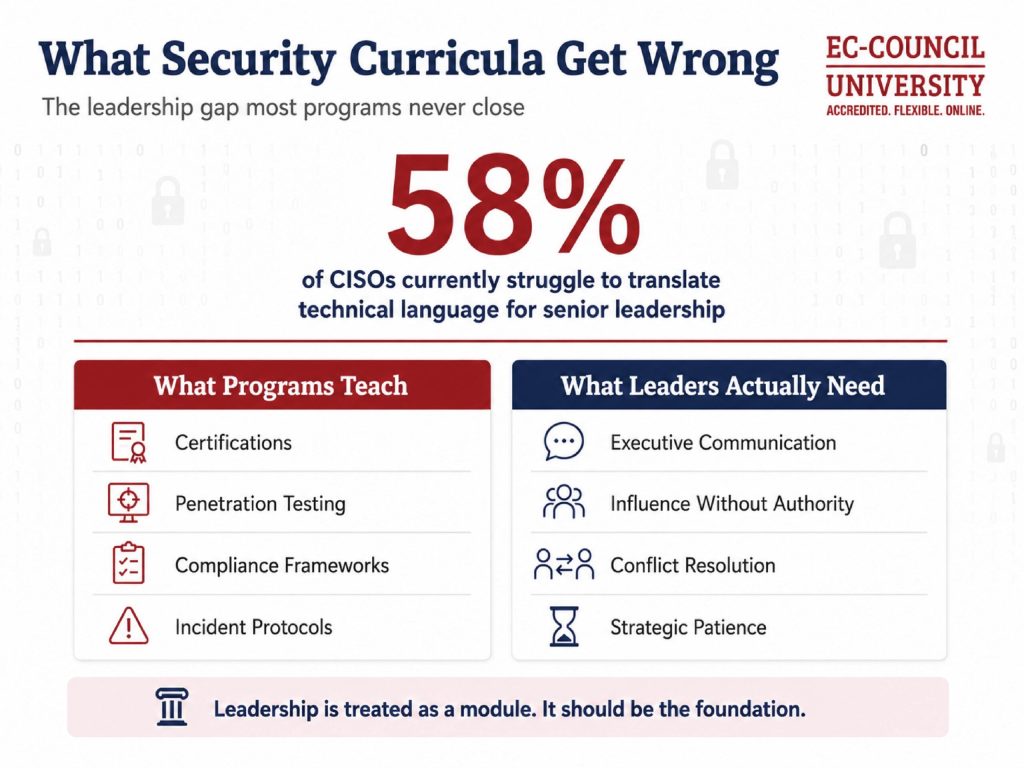
Most security training is built around certification. Firewalls. Penetration testing. Compliance frameworks. Incident protocols. That makes complete sense for technical roles.
For leadership roles, it is a real problem.
Leadership development gets treated as an afterthought in most security programs. When it appears, it is a module, not a foundation. Most professionals learn leadership entirely on the job, in environments that rarely allow for reflection or growth.
The outcome is predictable. 58%7 of CISOs currently struggle to translate technical language for senior leadership. That number exists because most programs never teach them how. The cybersecurity skills shaping 2026 make clear how far the field’s expectations have moved beyond technical competence.
ECCU addresses this gap directly. The Executive Leadership in Information Assurance Graduate Certificate puts leadership at its core. It covers global business leadership, executive governance and management, and IT security project management. None of these are electives. They are the foundation of the program. Completing it earns the CCISO certification, one of the most recognized executive credentials in security.
The 9 graduate credits also count toward a future ECCU degree, for professionals who want to keep building. The premise throughout is the same: you cannot lead what you cannot articulate.
Common Leadership Mistakes New CISOs Make
Most first-time security leaders make some version of the same errors. Recognizing them early is cheaper than learning them on the job:
- Leading with technical detail in the wrong room. What lands with an engineering team buries a board.
- Treating influence as a byproduct of authority. Title does not create buy-in from teams that don’t report to you.
- Avoiding conflict after an incident. Unaddressed post-incident tension is what actually drives good people out, not the incident itself.
- Expecting culture change to move on a project timeline. Security culture shifts over years, not sprints.
- Under-investing in the relationship before you need it. By the time you need finance or legal’s buy-in, it’s too late to start building that trust.
Soft Skills Checklist for Aspiring Cyber Leaders
Use this as a working self-assessment, not a one-time test:
- Can you explain your team’s biggest current risk in under two minutes, with no jargon, to someone outside security?
- Do you have a working relationship with at least one leader each in finance, legal, and operations, independent of an active request?
- Have you had a direct, uncomfortable conversation with a team member in the last quarter, rather than letting tension sit?
- Can you name one instance where you changed your communication style for a specific audience, deliberately, this year?
- Do you have a mentor or peer who has sat in front of a board, who you can ask before a high-stakes meeting?
- Are you tracking your own burnout signals with the same discipline you’d expect from your team?
Industries Where Soft Skills Matter Most
Board scrutiny and regulatory exposure are not distributed evenly across sectors, and that changes how much leadership skill a CISO role actually demands:
- Financial services and banking: Heavy regulatory oversight (SEC, FINRA, statelevel rules) means CISOs face frequent, formal board and audit-committee reporting, where communication failures carry direct legal exposure.
- Healthcare: HIPAA obligations and high ransomware exposure put CISOs in regular conversations with clinical and executive leadership who have no security background, making risk translation a daily requirement rather than a quarterly one.
- Publicly traded technology companies: Investor scrutiny and public disclosure rules mean board communication is tied directly to shareholder confidence, not just internal risk management.
- Government and defense contracting: Cross-agency coordination and clearance-driven hierarchies make influence without authority a core, constant skill rather than an occasional one.
In every one of these sectors, the CISOs who struggle tend to struggle for the same reason: strong technical judgment, but no reliable way to make that judgment land with the people who control budget and policy.
Building Soft Skills Deliberately
Soft skills do not arrive through experience alone. They require the same intentional investment that technical skills get. A few paths that actually work:
- Seek cross-functional exposure early: Volunteer for projects with finance, legal, or operations teams. Learn their language. Understand their priorities. Knowing what they care about helps you reach them.
- Build executive presence deliberately: Public speaking, clear written communication, and meeting facilitation are learnable. Treat them like any other skill. Build a practice plan.
- Find a mentor who has been in the room: Experienced leaders who have navigated boards and budget fights compress your learning curve. Study the most in–demand leadership skills in the field. Then build a deliberate plan around them.
- Use structured graduate education: These programs give you frameworks and vocabulary that informal experience rarely delivers. 51% of security professionals say non-technical skills matter more with AI. That is not a future concern. It is a present one.
Conclusion
Security leadership is ultimately a human discipline. Threats evolve. Regulations shift.
What stays constant is who can communicate clearly and build trust under pressure. Leaders who hold their teams together through sustained difficulty are the ones who last. Security professionals who build these skills now will be ahead when it counts.
Technical skill gets you in the room. Leadership keeps you there.
Explore ECCU’s Executive Leadership in Information Assurance specialization, where strategic capability is built alongside technical depth.
Frequently Asked Questions
Technical skills are learned through structured training, certifications, and repeatable practice. Soft skills like influence, patience, and executive communication develop through years of high-stakes, ambiguous situations that most security professionals never get formal preparation for. That’s what makes them harder to build, not less important to have.
Executive communication comes up most consistently in research and practitioner accounts. A CISO who cannot translate security risk into business language will struggle. Budget approvals and board support both depend on this skill. Influence without authority, emotional intelligence, and strategic patience follow closely, since each supports the ability to actually execute on what communication makes possible.
Start by rehearsing technical updates in front of a non-technical colleague before delivering them to a board or executive audience. Focus on framing risk in terms of cost, timeline, and business impact rather than technical severity. Public speaking practice, written communication review, and structured graduate coursework all accelerate this in ways that on-the-job experience alone often doesn’t.
Lead with what a risk costs and how fast it could happen, not its technical classification. Quantify exposure in dollars and downtime instead of CVSS scores. Bring one clear decision to ask the board for per session rather than a broad status update, and rehearse the non-jargon version out loud beforehand.
Yes, but not through technical skill alone. Deep technical credibility earns a CISO respect from their own team, which matters. But board confidence, cross-departmental buy-in, and team retention depend on skills that have to be built deliberately alongside the technical foundation, not assumed to follow from it automatically.
That’s the average CISO tenure, well below the 4.9-year average for other C-suite roles. The gap isn’t primarily about threat complexity. It traces back to a leadership preparation gap: CISOs promoted for technical strength often lack the board communication, influence, and change-management skills the role actually requires.
It’s the ability to get buy-in from teams the CISO doesn’t directly manage, like IT, finance, legal, HR, and operations, without relying on positional power. It’s built through sustained trust and relationship capital rather than a single ask, and it’s essential because most of what a CISO needs to accomplish depends on other departments’ cooperation.
It helps leaders recognize burnout and team tension before it turns into resignations or breakdowns in post-incident environments, where blame and stress run high. With burnout affecting a majority of security professionals, leaders who address tension directly and protect their teams retain talent that leaders without that skill lose.
Yes. As AI absorbs more routine technical work, the skills that remain distinctly human, judgment, communication, and business alignment, are becoming more valuable, not less. Recent workforce data shows soft skills among the fastest-growing skill categories globally, and a majority of security professionals now say non-technical skills matter more because of AI, not despite it.
The most frequent ones include leading with technical detail in front of a non-technical audience, assuming title alone will generate cross-departmental buy-in, avoiding difficult conversations after incidents, expecting culture change to happen on a project timeline, and waiting until a relationship is needed to start building it.
Structured programs give security professionals frameworks and vocabulary for organizational dynamics that informal, on-the-job experience rarely provides in a compressed timeframe. ECCU’s Executive Leadership in Information Assurance Graduate Certificate, for example, covers global business leadership, executive governance, and IT security project management, and completing it earns the CCISO certification.
Financial services, healthcare, publicly traded technology companies, and government or defense contracting all place unusually heavy demands on CISO communication and influence, due to regulatory reporting requirements, cross-functional complexity, or public accountability that make technical skill alone insufficient.
Treat it as a learnable skill rather than an innate trait. Build a deliberate practice plan around public speaking, clear written communication, and meeting facilitation. Find a mentor who has already navigated boards and budget fights, and study what specifically works in their approach rather than trying to develop executive presence through trial and error alone.