Many students hesitate before starting a cybersecurity degree. They fear losing years and money they cannot get back. That fear is common, and it quietly stops good candidates from applying. The truth is simpler than the fear suggests. Prior learning rarely goes to waste. An associate degree can shorten your path. So can transferable credits or a certification you already hold. This piece walks through both routes and shows how they connect. It also explains how ECCU treats prior learning as forward progress. That progress moves you toward your Bachelor of Science in Cyber Security.
Key Takeaways
- An associate degree can satisfy general education requirements outright.
- Transfer credits and certifications both count toward your bachelor’s degree.
- Combining both paths cuts tuition and completion time together.
- ECCU evaluates every transcript individually, so nothing is assumed.
- Certifications you already hold can replace entire courses.
- A clear transfer plan prevents wasted credits and wasted terms.
Why the Path to a Bachelor's Isn't Always Four Years
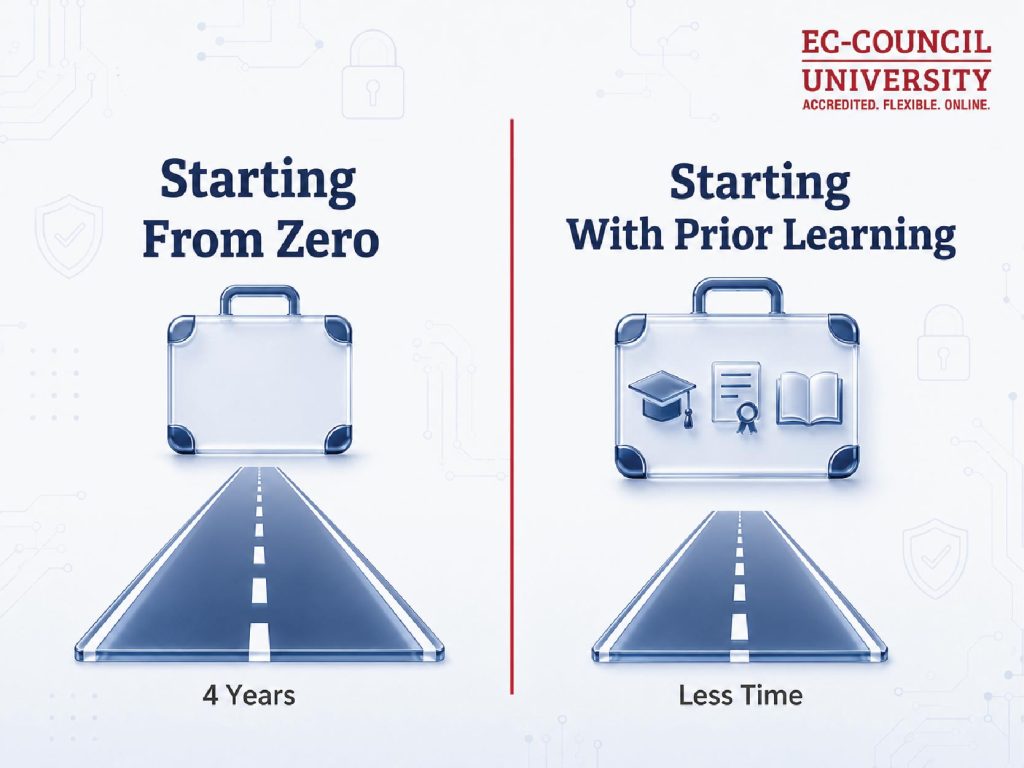
A four-year timeline assumes you start from zero. Most working adults do not start from zero. They carry an associate degree, unfinished coursework, or hard-earned certifications. Each piece can count toward a bachelor’s degree. ECCU built its Bachelor of Science in Cyber Security around that reality. The program runs as a completion degree, not a start-from-scratch one. You need a foundation before enrolling, then ECCU builds on it. That foundation is worth real money once it gets recognized. Cost matters here too. Among organizations with insufficient resilience, 85% cite missing skills and people. That gap makes trained graduates valuable fast. Even so, some ask if a degree still matters. We explore whether a bachelor’s in cybersecurity is enough elsewhere.
Option 1: The Associate Degree Route
An associate degree is often the fastest on-ramp. It typically satisfies general education and foundational requirements outright. ECCU requires 60 transferred credits or an earned associate degree for admission. At least 25% of those credits must be general education coursework. That rule protects the value of your prior degree. It also keeps the bachelor’s meaningful to employers.
Making the Associate Degree Count
A few habits make your associate degree work harder:
- Choose coursework that maps to information systems, security, or IT.
- Keep official transcripts ready before you apply.
- Ask whether your college has an articulation history with ECCU.
- Apply for the U.S. Community College Scholarship if you qualify.
Eligible students receive a 30% tuition reduction. Eligibility needs an associate degree or 60 transferable credits in IT.
Option 2: Transfer Credits and Prior Learning
Not every student holds an associate degree, and that is fine. ECCU accepts credit from accredited college coursework directly. It also accepts credit from relevant industry certifications. Certifications like CEH, CND, and CHFI can convert into course credit. Up to 90 of the 120 total credits can come from transfer. No more than 15 of those can come from certifications alone. The rest must come from real college coursework.
What Typically Transfers
- Accredited college credit earned within the last ten years.
- Eligible EC-Council certifications tied directly to program courses.
- Military training and documented work experience, evaluated case by case.
- Credit recommendations from ACE or NCCRS, where applicable.
A transfer credit evaluation confirms exactly what applies. Send transcripts early so evaluation does not delay your start. Good training also shapes your cybersecurity training and career path directly.
Combining Both for Maximum Speed
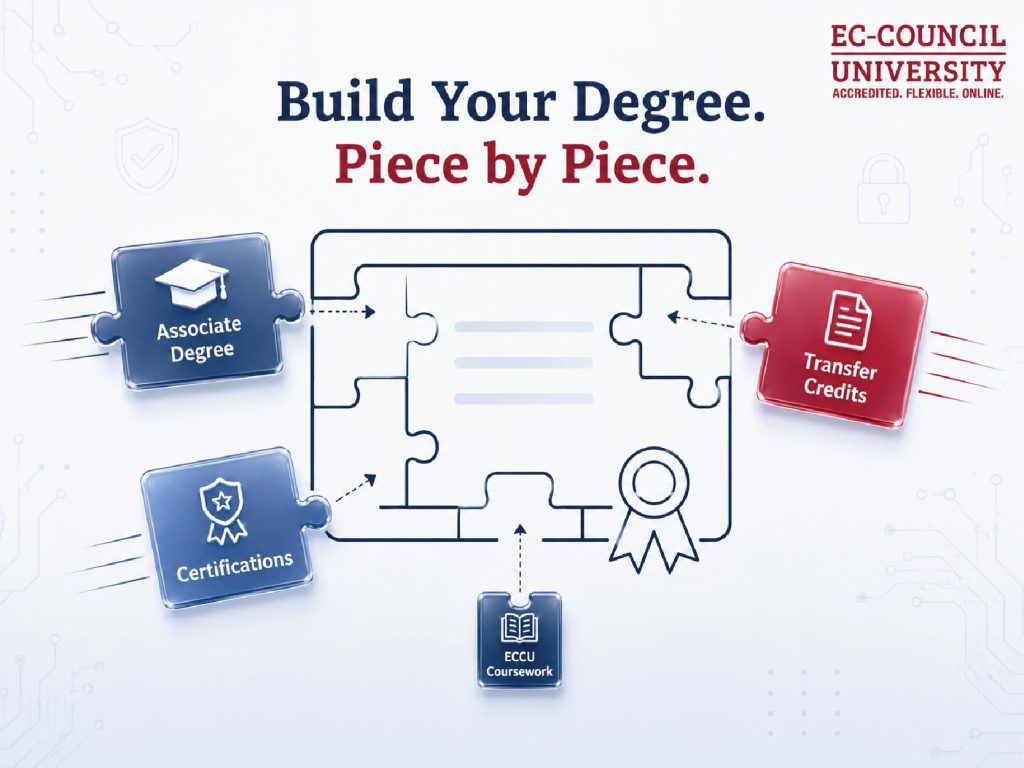
An associate degree and extra transfer credits can stack together. Together they push your total transfer credit even higher. That means fewer courses left to complete at ECCU. Fewer courses means a shorter timeline and lower tuition. Plan your term load around your job, not around guesswork. Working professionals often take one or two courses per term. That pace protects your career while you finish your degree.
Building Your Fast-Track Plan
Start by gathering every transcript you have. Request an official transfer credit evaluation as soon as you apply. ECCU reviews accredited coursework and eligible certifications side by side. You will get a clear count of credits accepted. From there, map out which courses remain. The BSCS runs fully online, built around live weekly sessions. That format lets you keep working while you study. See how online vs oncampus cybersecurity bachelor’s formats compare. Most students finish in about two years once enrolled. Transfer credit can shorten that timeline further, depending on your evaluation.
Ready to Fast-Track Your Degree
Your prior learning already has value. An associate degree, transfer credits, or a certification can move you forward. The fastest path usually combines more than one of these. Explore ECCU’s Bachelor of Science in Cyber Security page for details. Then visit the transferring credit page to see what applies to you. Check your eligibility for the Community College Scholarship as well. Starting a transfer evaluation costs nothing and takes little time. It could be the fastest step toward your degree.
Frequently Asked Questions
Yes, an associate degree often satisfies general education requirements outright. It typically covers the 60-credit admission requirement in full. ECCU still reviews your transcript to confirm course equivalencies.
Yes, several EC-Council certifications convert directly into course credit. CEH, CND, and CHFI are common examples. Certifications must align with a specific ECCU course to qualify. Certification-based credit is capped at 15 credits total.
Apply to your chosen ECCU program first. Then send official transcripts for review. ECCU’s admissions team evaluates each course individually. You get written confirmation of which credits transfer.
Timelines depend entirely on how many credits transfer in. Some students finish faster than the standard two-year pace. Others complete it closer to two years. An evaluation early in the process gives you a real estimate.