Every time I walk into a government office, I hand over a piece of myself.
My name. My national ID number. My home address, my phone number, sometimes my medical history. I hand it over because I have no choice. And I trust that someone on the other side keeps it safe.
That trust is fragile.
In my work, I see the same pattern behind almost every data leak. Attackers rarely need a clever, movie-style hack. They walk through doors we leave open. A staff account with far too much access. A partner connection nobody watches. A backup file in the wrong place.
These are not exotic risks. They are everyday gaps inside systems that hold millions of citizen records.
This post explores one question. How do we keep citizen data safe, even when something goes wrong?
Why citizen data is different
Customers can walk away from a bank they no longer trust. Citizens cannot walk away from their government.
If a retailer leaks your card details, you shop somewhere else. If the tax office leaks your records, you still file your taxes there next year. You have no alternative.
That makes public-sector data a special kind of responsibility. A tax record. A health registry entry. A welfare file. A vehicle license. Each one ties back to a real person who cannot opt out.
And when that data leaks, the harm spreads quickly. Identity theft follows. Fraudsters open loans in other people’s names. Scammers use real details to sound convincing. Over time, people lose faith in digital government itself. That last cost is the hardest to repair.
So why do government databases keep leaking?
In my experience, the cause is rarely one dramatic failure. It is usually a set of quiet habits.
Too many people see too much. A clerk who only needs a phone number often sees the entire record. Multiply that by thousands of staff, and the exposure becomes enormous.
Systems connect directly to each other. One agency’s database plugs straight into another’s. Nobody reviews what flows across that link, or why.
Sensitive data piles up in one place. Names, ID numbers, addresses and service history sit together in one table. Breach that table, and you breach everything.
None of these is purely a technology problem. Each one is a design choice. And design choices can change.
Why I stopped trusting the perimeter
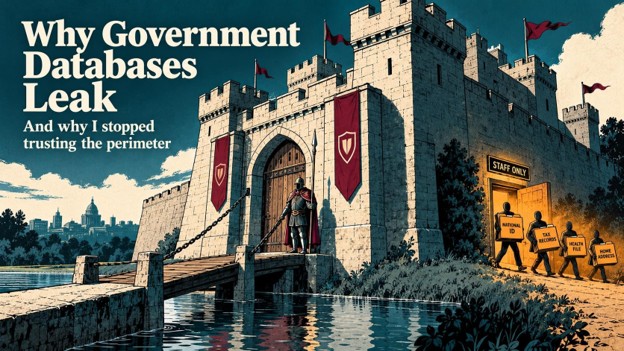
Traditional security works like a castle. You build a strong wall and a deep moat. The castle trusts anyone inside the wall.
The flaw is obvious once you say it out loud. Attackers get inside. Insiders make honest mistakes. A stolen password looks exactly like a real one. And once someone is inside the castle, the old model lets them wander freely.
Zero trust flips that thinking. It treats every user, device and connection as unverified until proven otherwise. The system checks every request for sensitive data. Every single time.
Before my design shares anything, it asks a few questions:
- Who are you, and can you prove it with more than a password?
- Is this a device we recognize and trust?
- What is your role, and which case are you working on?
- Why do you need this data right now?
Device checks matter more than people expect. A valid password on an infected laptop still spells trouble.
If the answers don’t add up, the request stops there. It does not matter whether it comes from inside the office. Location no longer equals trust.
This sounds strict, and it is. But for most staff, the checks run quietly in the background. They log in once with multi-factor authentication. The system handles the rest. Friction only appears when someone asks for something unusual. That is exactly when friction should appear.
Mask by default, and close the side doors
Here is something every auditor learns fast. Most staff do not need full personal data to do their jobs.
Picture a social welfare officer reviewing a benefit application. She needs to confirm the applicant exists and qualifies. She rarely needs the full national ID number on her screen. So in my design, she sees masked values by default. Something like ****-****-4821.
The full value appears only when her task truly requires it. Even then, she selects an approved purpose and verifies her identity again. The system logs every step. I unpack that process in my next post.
The second rule is just as firm. Nobody connects directly to the database. Not staff. Not partner agencies. Not analysts building reports.
Every request goes through a controlled gateway instead. Think of it as a front desk with a very strict receptionist. It checks your ID, confirms your appointment and records your visit. Then it hands over only what your request allows. Nothing more.
Analysts get a different arrangement. They work with de-identified or aggregated data. They can spot trends across a million citizens without seeing a single name.
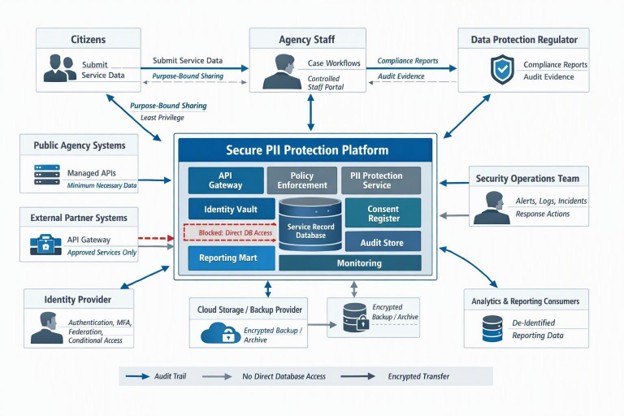
Everyone reaches the data through controlled channels. Nobody gets a direct line into the database.
The same logic covers the places people forget. Developers test with synthetic data, not real citizen records. Backups leave the building only in encrypted form. Their keys live somewhere else entirely.
Never keep the whole person in one place
This idea sits at the heart of my design.
Most systems store a citizen’s full profile together. Name, ID number, address and service history, all in one place. It is convenient. It is also dangerous.
So I split that profile apart.
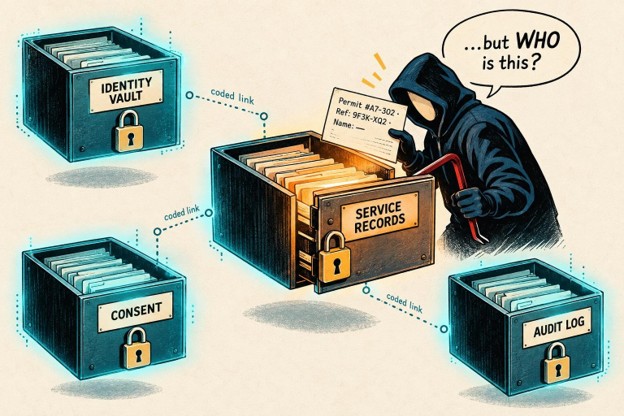
Direct identifiers, like a name and a national ID, live in a secure identity vault. Service records, like a building permit or a tax filing, live in a separate database. Consent records and audit logs each get their own store. A protected linkage service connects them using coded references, never raw identifiers.
I also encrypt each sensitive field separately. The keys sit in separate domains. One stolen key unlocks one piece, not the whole record.
Now imagine an attacker breaches the service database. They find permit numbers, dates and coded keys. They find no names. No ID numbers. The stolen data tells them almost nothing about who anyone is.
To rebuild a complete citizen profile, they must break several systems at once. Each system has separate keys, separate access rules and separate monitoring. That turns one easy win into a long, noisy campaign. Good monitoring catches noisy campaigns.
I want to be honest about the trade-off. The linkage service becomes a high-value target. So it gets the strongest protection in the entire platform. Even its metadata counts as sensitive.
Good security is a leadership decision
The law points the same way. Ghana’s Data Protection Act, 2012 (Act 843) expects strong safeguards for personal data. Similar laws now exist across Africa, Europe, Asia and the Americas. Global frameworks like ISO 27001 and the NIST Cybersecurity Framework support the same principles.
This approach also does not depend on one vendor or one database. It works across different agencies, older systems and mixed technology stacks. A vehicle licensing office and a public health registry can follow the same blueprint.
But technology only takes us so far.
Protecting citizen data is a leadership decision before it is a technical one. Someone has to insist that masking by default is non-negotiable. Someone has to say no to the convenient direct connection. Someone has to fund the unglamorous work of mapping where personal data lives. You cannot protect data you cannot find.
That realization shapes my own learning path. My MBA studies at EC-Council University push me to think beyond tools. The hardest security problems I face involve people, priorities and governance.
Citizens hand us their data because they have to. Our job is to make that trust well placed.
In my next post, I walk through the specific design choices that make this work. Write-only kiosks. Locked-down access to full records. And AI that knows when to ask a human.