

U.S. Cybersecurity Regulations Are Evolving Alongside Technological Advancements
Cybersecurity regulations in the United States don’t remain static. They shift and expand in lockstep with technological developments, requiring organizations to adapt or face accountability for non-compliance. In 2026, several regulatory developments are changing how businesses collect personal information, secure digital infrastructure, manage vulnerabilities, and respond to cyber incidents.
Unlike the European Union’s GDPR, the U.S. does not have a single, comprehensive national data privacy law. Instead, organizations must navigate a combination of federal regulations, industry-specific requirements, and state-level privacy and cybersecurity legislation.
For businesses operating across multiple states or serving customers internationally, understanding these requirements is essential to maintaining compliance and strengthening organizational resilience.
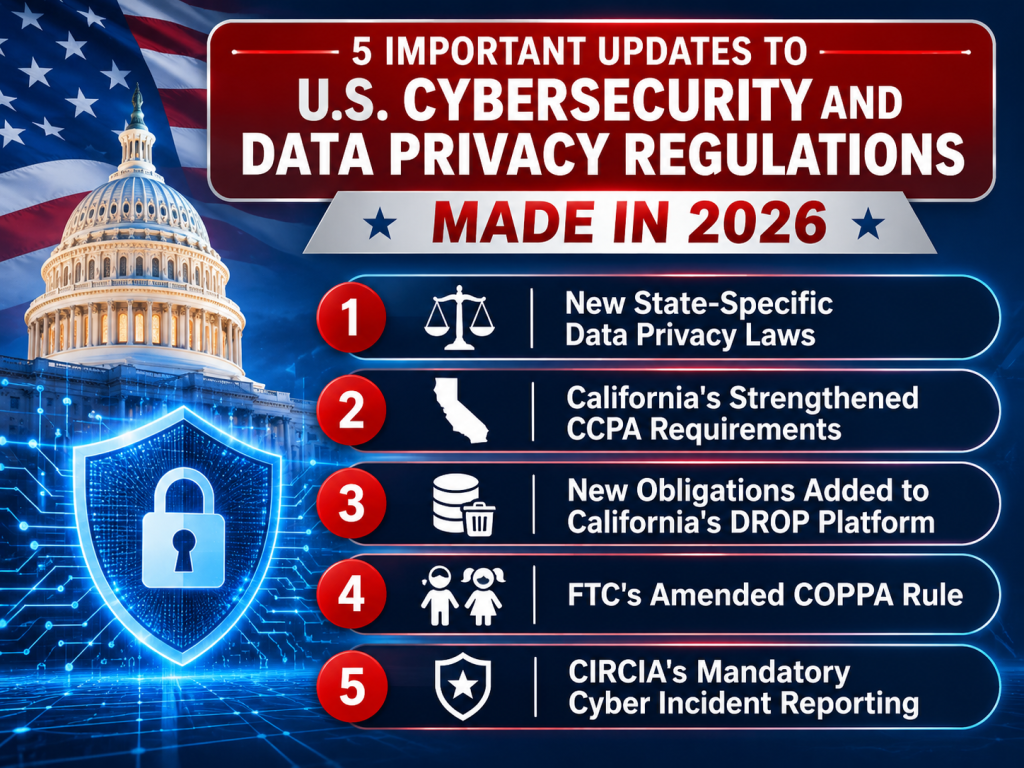
5 Important U.S. Cybersecurity and Data Privacy Regulatory Updates Organizations Should Know About in 2026
Businesses operating in the U.S. must be aware of all 5 regulatory updates listed below:
1. New State Privacy Laws Expand Data Protection Responsibilities
(Effective January 1, 2026)
Three additional comprehensive state privacy laws took effect in 2026:
- Indiana Consumer Data Protection Act (INCDPA) (1)
- Kentucky Consumer Data Protection Act (KYCDPA) (2)
- Rhode Island Data Transparency and Privacy Protection Act (RIDTPPA) (3)
These laws expand the regulatory landscape for organizations that collect, process, or sell the personal information of residents in these states. Although their coverage thresholds and individual provisions differ, the laws establish requirements around consumer privacy rights, transparent data processing, and appropriate security safeguards.
Key compliance responsibilities include:
- Providing clear privacy notices explaining how personal information is collected and used.
- Establishing mechanisms for consumers to access, correct, and delete their personal information.
- Supporting applicable opt-out rights concerning targeted advertising and personal data sales.
- Conducting data protection assessments for specified high-risk processing activities.
- Implementing reasonable administrative, technical, and physical data security safeguards.
Connecticut also introduced significant amendments to its Data Privacy Act (4), effective July 1, 2026. These amendments include stronger data minimization requirements, expanded protections against certain automated decisions, and additional transparency obligations concerning the use of personal data for training large language models.
What organizations should do:
Review their privacy policies, data processing agreements, consent mechanisms, and data protection assessment procedures. Businesses operating across multiple states should also evaluate whether their existing privacy programs address jurisdiction-specific requirements.
2. California Strengthens CCPA Requirements for Risk Assessments and Cybersecurity Audits
(Effective January 1, 2026, with phased compliance deadlines)
California has introduced significant regulatory changes under the California Consumer Privacy Act (CCPA) (5), including requirements concerning cybersecurity audits, privacy risk assessments, and automated decision-making technology (ADMT).
The updated regulations, approved in September 2025, became effective January 1, 2026. Some of the most important requirements include:
- Privacy risk assessments: Covered businesses must assess certain high-risk data processing activities, including the sale or sharing of personal information, processing sensitive personal information, and specified uses of automated decision-making technology.
- Cybersecurity audits: Businesses meeting applicable thresholds must undergo independent cybersecurity audits. Initial certification deadlines are phased based on annual revenue, with the earliest deadline on April 1, 2028, for businesses earning more than $100 million.
- Automated decision-making: Additional consumer rights and business obligations for certain significant decisions made using ADMT are due to be enforced from January 1, 2027, onward.
These changes reinforce the importance of documenting privacy risks, evaluating information security controls, and demonstrating accountability for how personal information is processed.
What organizations should do:
Establish documented risk assessment procedures, evaluate existing cybersecurity controls, and, where applicable, prepare for independent audits. Organizations using automated decision-making should also review their data governance and transparency practices.
3. California's DROP Platform Introduces New Data Deletion Obligations
(Operational requirements began August 1, 2026)
California’s Delete Act has introduced another important development through its Delete Request and Opt-out Platform (DROP) (6). Launched in January 2026, DROP allows California residents to submit a single request asking registered data brokers to delete their personal information held across multiple data brokerage operations.
As of August 1, 2026, registered data brokers have been required to access DROP at least once every 45 days and process applicable deletion requests. This includes deleting matched personal information and associated inferences, subject to applicable legal exemptions. Data brokers must also report request outcomes through the platform.
The requirements impose important operational responsibilities on businesses that gather and sell information on consumers with whom they may not have a direct relationship.
What organizations should do:
Determine whether their activities meet California's definition of a data broker. Covered businesses should establish processes for identifying consumer records, validating deletion requests, coordinating with service providers, and maintaining records demonstrating compliance.
4. FTC's Amended COPPA Rule Strengthens Children's Online Privacy Protection
(Compliance deadline: April 22, 2026)
The Federal Trade Commission (FTC) has strengthened the Children’s Online Privacy Protection Rule (COPPA) (7), introducing additional requirements for organizations collecting personal information from children under 13. Although the amendments were finalized in 2025, the April 22, 2026, compliance deadline makes them an important regulatory milestone this year.
Key changes include:
- Stronger parental consent: Separate verifiable parental consent is required before disclosing children’s personal information to third parties for targeted advertising or other purposes.
- Expanded information protection: The definition of personal information includes additional categories, such as biometric identifiers.
- Written security programs: Covered organizations must establish and maintain a written information security program.
- Data retention restrictions: Organizations must establish retention policies and delete children’s personal information when it is no longer reasonably necessary.
- Greater accountability: Additional transparency and reporting requirements apply to FTC-approved COPPA Safe Harbor programs.
These requirements are particularly relevant to educational technology providers, gaming platforms, children’s websites, and online services directed toward children.
What organizations should do:
Review parental consent mechanisms, third-party data-sharing arrangements, information security programs, and data retention policies. Organizations should also evaluate whether their services collect children's information, even when those services are not specifically designed for children.
5. CIRCIA Moves Closer to Mandatory Cyber Incident Reporting
(Final rule under federal review as of November 2026)
The Cyber Incident Reporting for Critical Infrastructure Act of 2022 (CIRCIA) (8) is an important federal cybersecurity initiative that establishes standardized requirements for reporting cyber incidents and ransomware payments by covered critical infrastructure organizations.
The Cybersecurity and Infrastructure Security Agency (CISA) published its proposed implementing rule in April 2024. In October 2026, CISA submitted its draft final rule to the White House Office of Information and Regulatory Affairs for review. The proposed framework includes two major reporting requirements:
- 72-hour reporting: Covered entities would report qualifying substantial cyber incidents to CISA within 72 hours of reasonably believing an incident has occurred.
- 24-hour reporting: Covered entities would report ransomware payments within 24 hours of making them.
As of November 12, 2026, the final rule remained under review. Therefore, these proposed reporting deadlines should not be treated as universally effective requirements. Nevertheless, the legislation signals a move toward more standardized federal visibility into cyber incidents affecting critical infrastructure.
What organizations should do:
Covered critical infrastructure entities should monitor the final rulemaking, evaluate existing reporting obligations, and strengthen incident detection, escalation, documentation, and response procedures.
Preparing for the Evolving U.S. Cybersecurity Regulatory Landscape
The 2026 cybersecurity regulatory developments in the U.S. demonstrate that compliance and governance are becoming crucial components of organizational cyber risk management. Businesses must move beyond traditional perimeter defenses and adopt a more comprehensive approach to protecting sensitive information, managing vulnerabilities, and maintaining operational resilience.
Key priorities include:
- Strengthening cybersecurity governance: Establish clear security responsibilities, policies, and accountability structures.
- Improving data protection: Implement appropriate safeguards, access controls, encryption, and data retention practices.
- Enhancing risk management: Conduct regular security assessments, vulnerability testing, and third-party vendor risk evaluations.
- Building incident response capabilities: Develop and test procedures for detecting, documenting, reporting, and recovering from cyber incidents.
- Developing regulatory expertise: Ensure cybersecurity teams understand applicable federal, state, and industry-specific compliance requirements.
Importantly, regulatory compliance is not a one-time exercise. Organizations must continuously evaluate their security programs as new laws, enforcement priorities, and compliance deadlines come into effect.
Stay Up to Date with the Latest U.S. Cybersecurity Regulations
As cyber threats become more complex and digital regulations continue to evolve, organizations need cybersecurity professionals who complement their technical expertise with an understanding of governance, risk management, data protection, and regulatory compliance.
EC-Council University (ECCU) is committed to delivering world-class cybersecurity education that evolves alongside the changing threat landscape and emerging government regulations and compliance mandates. Through our specialized online programs, industry-aligned curriculum, and focus on developing practical cybersecurity knowledge, ECCU helps learners build the advanced capabilities needed to address modern organizational security challenges. For aspiring and experienced cybersecurity professionals, staying current with regulatory developments is not simply a compliance responsibility. It is an essential part of becoming an effective cybersecurity leader.
For more information on how ECCU can help you transform into a cybersecurity governance expert:
Frequently Asked Questions (FAQs) About U.S. Cybersecurity Regulations[
What are the major U.S. cybersecurity regulatory changes in 2026?
Important developments include new state privacy laws in Indiana, Kentucky, and Rhode Island; updated California CCPA requirements; California’s DROP platform obligations; the FTC’s amended COPPA Rule; and the ongoing federal CIRCIA rulemaking.
Does the U.S. have a federal data privacy law?
The United States does not currently have a single comprehensive federal consumer data privacy law equivalent to the EU’s GDPR. Instead, it relies on sector-specific federal laws and state-level privacy legislation.
What are the new state privacy laws effective in 2026?
The Indiana Consumer Data Protection Act, Kentucky Consumer Data Protection Act, and Rhode Island Data Transparency and Privacy Protection Act became effective on January 1, 2026.
What is CIRCIA, and how does it affect organizations?
CIRCIA is a federal law that establishes mandatory reporting requirements for cyber incidents and ransomware payments by covered critical infrastructure entities. Its proposed reporting deadlines are 72 hours for qualifying cyber incidents and 24 hours for ransomware payments. The implementing final rule remained under review as of November 2026.
What does the amended COPPA Rule require?
The amended COPPA Rule strengthens parental consent, children’s data security, third-party disclosure, and data retention requirements. Covered organizations were required to comply with the amendments by April 22, 2026.
What is California's DROP platform?
The Delete Request and Opt-out Platform (DROP) permits Californians to submit a single request to data brokers to delete their personal information. Registered data brokers must access the platform at least once every 45 days and process applicable requests.
Why is cybersecurity regulatory compliance important for organizations?
Regulatory compliance helps organizations protect sensitive information, manage cyber risks, strengthen incident response, maintain accountability, and reduce exposure to regulatory enforcement and financial penalties.
What skills do cybersecurity professionals need to manage regulatory compliance?
Important skills include cybersecurity governance, risk and compliance (GRC), data privacy, security auditing, vulnerability management, incident response, digital forensics, and third-party risk management.
References & Sources:
- https://privacyrights.org/resources-tools/law-overviews/indiana-consumer-data-protection-act
- https://www.ag.ky.gov/about/Office-Divisions/ODP/KCDPA/Pages/default.aspx
- https://pirg.org/edfund/resources/what-the-rhode-island-data-transparency-and-privacy-protection-act-means-for-you/
- https://portal.ct.gov/ag/sections/privacy/the-connecticut-data-privacy-act
- https://oag.ca.gov/privacy/ccpa
- https://privacy.ca.gov/drop/
- https://www.ftc.gov/legal-library/browse/rules/childrens-online-privacy-protection-rule-coppa
- https://www.cisa.gov/topics/cyber-threats-and-advisories/information-sharing/cyber-incident-reporting-critical-infrastructure-act-2022-circia