Children Are Increasingly Spending Their Time Online
For better or worse, the internet has become an essential part of childhood. Children use connected devices to learn, communicate, play games, watch videos, socialize, and explore the world. But that access also exposes them to incredibly harmful cyber threats that parents and caregivers cannot always anticipate.
For families, the challenge is no longer simply deciding how much internet access a child should have, but teaching children how to navigate an increasingly complex digital environment safely. According to the Pew Research Center(1), 97% of U.S. teens use the internet daily, while 4 in 10 say they are online almost constantly. Nearly all teens also have access to a smartphone, with 95% reporting access to one at home. It’s a level of connectivity that makes online child safety a family, school, technology, and cybersecurity issue.
Why Unsupervised Internet Access is Dangerous for Kids
The internet provides enormous educational and social benefits, but young children lack the experience or judgment to recognize manipulation, scams, inappropriate content, or dangerous people. Major risks include:
- Online grooming and exploitation: Predators can establish relationships with children through social media, messaging platforms, gaming communities, and chat services.
- Sextortion: Criminals may trick or pressure minors into sharing intimate images and then threaten to distribute them unless the victim complies with demands.
- Cyberbullying: Digital harassment can follow children beyond school and into their homes.
- Privacy loss: Children may unknowingly disclose names, locations, photographs, school information, passwords, or other sensitive data.
- Scams and phishing: Uninformed young users can be duped through fake giveaways, messages, gaming offers, and malicious links.
- Inappropriate or harmful content: Recommendation algorithms can expose children to material that is inappropriate for their age or developmental stage.
- Excessive screen use: Constant connectivity can harmfully impact sleep, personal and physical development, relationships, performance in school, and offline activities.
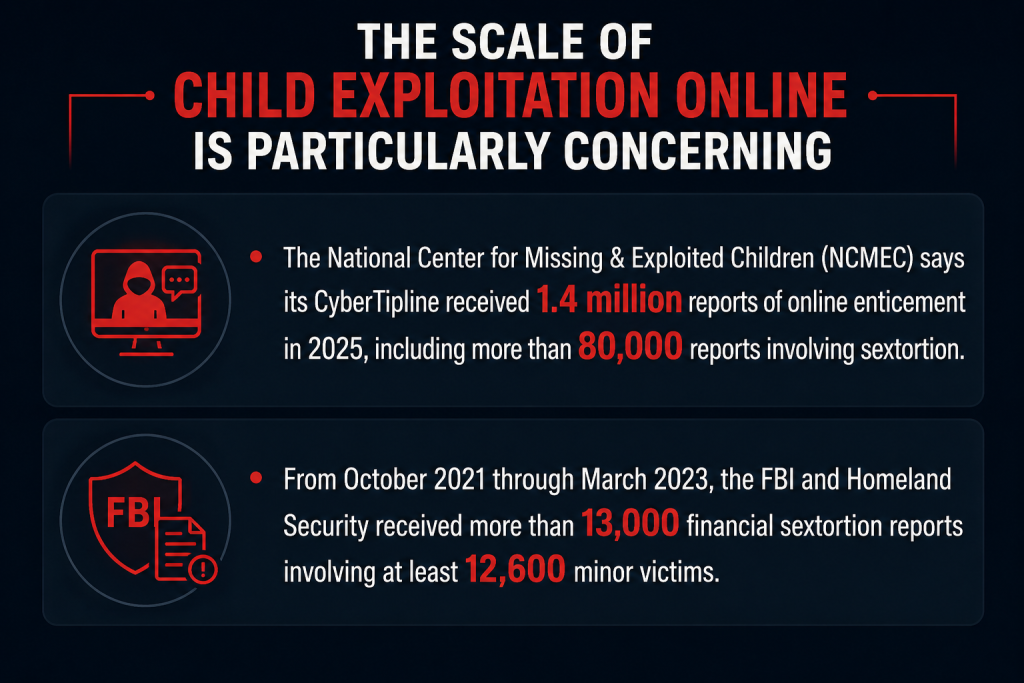
The numbers depicted above show why online safety education for children must not be an afterthought.
How Should We Educate Children About Internet Safety?
The most effective approach is education rather than fear. Telling children that “the internet is dangerous” is unlikely to prepare them for real-world situations. Instead, parents and educators should teach practical decision-making skills. Children should understand that:
- Not everyone online is who they claim to be. An account that appears to be another child may actually be an adult or someone deliberately attempting to manipulate them.
- Personal information has value. Children should learn to never share passwords, home addresses, school locations, phone numbers, financial information, or private photographs without appropriate permission.
- They should never feel pressured to keep an online secret from a trusted adult. Grooming often relies on secrecy and emotional manipulation.
- They should stop and ask before responding to suspicious messages. A child should know that they can show a parent, teacher, or another trusted adult anything that makes them uncomfortable.
- Children need to know that getting into trouble is never a reason to hide an online incident. If something goes wrong, adults should focus first on protecting the child, not punishing them.
The American Psychological Association(2) recommends internet usage monitoring and coaching for most young adolescents, while gradually increasing independence as children develop digital literacy and maturity.
What Can Parents Do to Protect Children Online?
More than anyone else, parents play the most important role in protecting their children from online dangers. If you have a young child who’s exploring the internet regularly, these tips can minimize the harm they could encounter:
- Use parental controls: Enable age-appropriate content filters, privacy settings, app restrictions, screen-time controls, and purchasing restrictions on devices and platforms.
- Keep devices in appropriate spaces: For children under 13, consider keeping internet-connected devices in shared family spaces rather than allowing unrestricted private access.
- Establish family technology rules: Set clear expectations covering acceptable apps, social media, gaming, messaging, passwords, screen time, and sharing of photographs.
- Teach strong cybersecurity habits: Children should know to use unique passwords, enable multifactor authentication (MFA) where appropriate, avoid suspicious links, and keep devices and applications updated.
- Talk regularly, not just after something goes wrong: Online safety should be an ongoing conversation. Ask children what platforms they use, whom they interact with, and what they enjoy about being online.
- Respect privacy while maintaining appropriate oversight: Safety does not require parents to treat children as suspects. Monitoring should be age-appropriate and transparent, with greater independence introduced as children demonstrate responsible behavior.
Privacy matters legally, too. Under the Federal Trade Commission’s (FTC) Children’s Online Privacy Protection Act (COPPA)(3), covered services generally must obtain verifiable parental consent before collecting personal information from children under 13. In 2025, the FTC finalized amendments strengthening protections for children’s data, including a requirement for parental opt-in for certain disclosures to third parties.
Does AI Make the Internet More Dangerous for Children?
It can, but AI is not inherently the enemy. Generative AI introduces new risks because it can create convincing text, images, audio, and video at unprecedented speed. Children may encounter AI-generated misinformation, manipulated photographs, impersonation, harmful advice, inappropriate chatbot interactions, and increasingly sophisticated scams.
Perhaps most disturbingly, AI can facilitate the creation of sexually exploitative material involving children. UNICEF’s 2026 research(4) estimates that AI was used to create fake sexual images or videos of at least 1.2 million children across 11 surveyed countries in a single year.
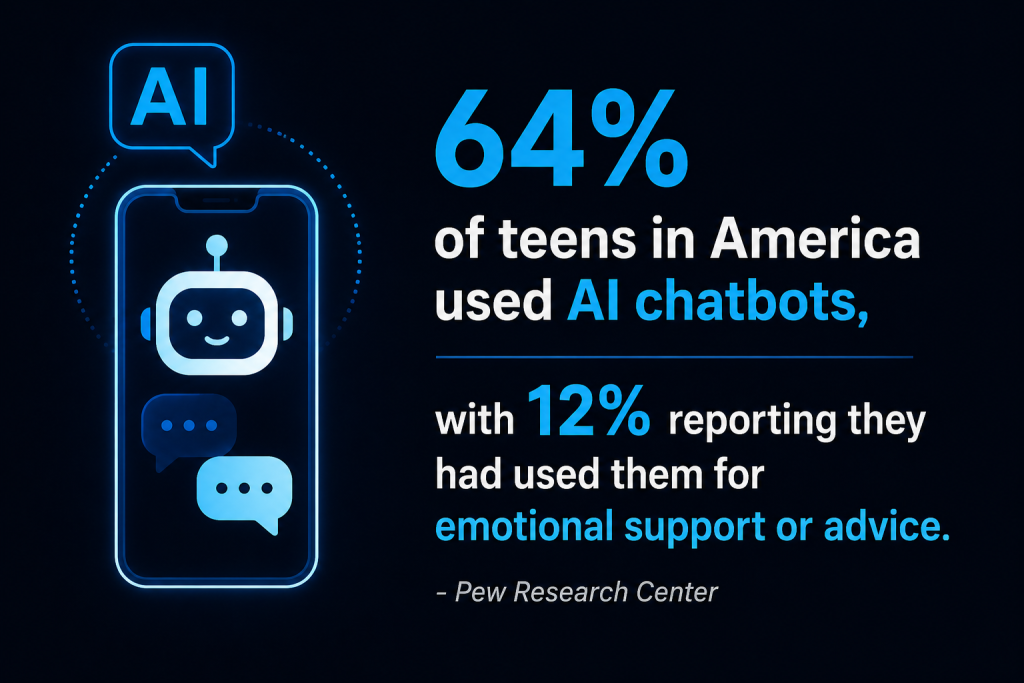
AI-powered chatbots also create a different type of risk. Some children treat conversational AI as a friend, advisor, or confidant. This raises important questions about privacy, emotional dependence, misinformation, and whether children can distinguish trustworthy human guidance from machine-generated responses.
AI Can Also Reinforce Child Safety Online
The same technology that creates new risks can also improve children’s safety. AI can help online platforms:
- Detect grooming and suspicious conversations
- Identify potentially exploitative imagery
- Flag cyberbullying and abusive behavior
- Detect scams and phishing attempts
- Identify malicious accounts and coordinated attacks
- Provide age-appropriate safety warnings
- Help parents identify emerging risks
- Support cybersecurity monitoring and threat detection
The goal, therefore, should not be to keep children away from AI but to teach them how to use it safely.
The Future of Child Online Safety Is a Shared Responsibility
Parents cannot solve this problem alone. Schools need age-appropriate digital citizenship and cybersecurity education. Tech companies need stronger safety-by-design practices. Policymakers need to implement adaptive regulations that keep pace with emerging technologies. Law enforcement agencies need cyber resources to investigate child exploitation online. And children themselves need the knowledge and confidence to recognize danger and seek help before it’s too late. Collectively, we should strive to nurture a generation of digitally literate, cybersecurity-aware, and AI-savvy youth who understand that the internet is powerful, useful, and sometimes dangerous.
Young children should be free to explore the digital world, but they should never have to navigate it without adult guidance and supervision.
Frequently Asked Questions About Child Online Safety
There is no universal age that works for every child. Parents should consider developmental maturity, the purpose of internet use, the child’s ability to recognize risky situations, and the level of adult supervision available.
There is no single biggest threat. Online exploitation, grooming, sextortion, cyberbullying, inappropriate content, privacy violations, scams, and excessive technology use all present serious risks.
For younger children, active supervision is strongly advisable. As they mature and demonstrate responsible behavior, parents can gradually increase independence while maintaining open communication.
The child should not send it, should stop communicating with the person, and should immediately tell a trusted adult. If an image has already been shared, the child should not feel ashamed or threatened into complying with further demands.
Yes. AI can be misused to create manipulated or sexually exploitative images involving minors. UNICEF identifies AI-generated child sexual abuse material and non-consensual intimate imagery as emerging concerns requiring stronger safeguards.
AI tools can provide educational and creative benefits, but children should use them in accordance with age-appropriate guidelines and with adult guidance. They should understand that AI can produce inaccurate, biased, or inappropriate information and should not be used to replace trusted adults for serious personal problems.
The Children’s Online Privacy Protection Act is a U.S. law that gives parents control over the collection of personal information from children under 13 by covered websites and online services.
Teach children that they can always come to a trusted adult when something online makes them uncomfortable, scared, or confused. Creating that sense of trust may be more valuable than any single parental-control feature.
References & Sources:
- https://www.pewresearch.org/internet/2025/12/09/teens-social-media-and-ai-chatbots-2025/
- https://www.apa.org/monitor/2023/09/protecting-teens-on-social-media
- https://www.ftc.gov/news-events/topics/protecting-consumer-privacy-security/kids-privacy-coppa
- https://www.unicef.org/innocenti/generative-ai-risks-and-opportunities-children