
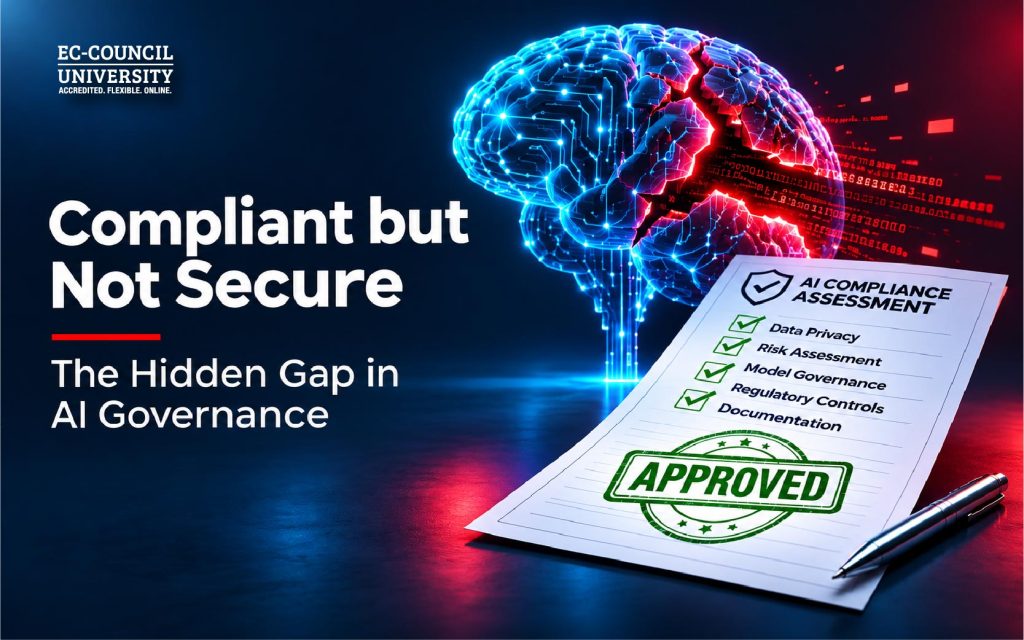
Picture an AI system that passes every compliance check. The paperwork is clean. The risk category is approved. The auditors sign off.
Six months later, attackers bend it to their will.
Nothing in the audit is false. It simply measures the wrong moment in time. That is the problem I want to unpack here. Compliance and security are not the same thing. With AI, the gap between them grows wider every day.
I work as a security consultant and penetration tester, where technical security meets governance. That lens shapes how I see AI governance. When a system holds passports, biometrics and travel records, a gap is never theoretical. Someone real pays the price.
Why AI Breaks the Old Rulebook
Most AI regulation works like a sorting machine. Regulators look at a system before launch. They ask what harm it could cause. Then they place it in a risk category: minimal, limited, high or unacceptable.
The EU AI Act follows this model. So do many frameworks built in its image. For traditional software, the approach makes sense. Code does what you write. Its behavior stays put until someone changes it.
AI doesn’t work that way.
An AI model produces probable answers, not fixed ones. It learns from data, and data shifts. Its operating environment changes. Users feed it inputs nobody predicted. Over time, the model drifts away from the version the auditors approved.
So a system labeled “limited risk” at launch can quietly become high risk. New training data can do it. A new use case can do it. A clever attacker certainly can. Yet most certification processes have no way to notice. The label stays the same while the system underneath it changes.
This is the heart of the issue. Static rules try to govern systems that never stand still.
Zero Trust Fits AI Better
Cybersecurity faced a similar problem years ago. The answer was Zero Trust.
Zero Trust starts from one simple rule. Trust nothing by default. Not users, not devices, not inputs. Verify every request, every time, wherever it comes from. NIST lays out this approach in its Zero Trust Architecture guidance, SP 800-207.
Now compare the two mindsets. Risk-based governance assumes we can predict behavior. Zero Trust assumes we can’t, and plans for it.
For AI, the second assumption is simply more honest. User inputs shape what a model does. A crafted prompt can push it off course. A manipulated document can slip past an automated check. Poisoned training data can corrupt its judgment from within.
Think about AI that helps verify identity documents or flag fraud. If it trusts the wrong input, the damage spreads fast. Personal records leak. Genuine applicants face wrongful rejection. The harm is legal, financial and deeply human.
Treating every input as suspect isn’t paranoia. For adaptive systems, it’s basic hygiene.
Compliant Parts, Ungoverned Pipelines
There’s a second blind spot. Regulators tend to assess AI systems one at a time. Real deployments rarely look like that.
Modern AI often runs in hybrid setups. Some models live in the cloud. Others run on local servers or devices. Data moves between them constantly. Each handoff creates a new trust boundary. Each boundary is a fresh attack surface.
Now add borders. Identity data often crosses countries as it moves through a workflow. One record can fall under GDPR and Kenya’s Data Protection Act at once. The challenge stops being purely technical. It becomes legal and structural too.
Picture that record passing through four AI components. Each one is individually compliant. Each has its own paperwork. But who governs the pipeline as a whole? Often, nobody does.
Attackers love that gap. They don’t need to break the strongest link. They only need the seam between two links that nobody watches.
The Kenyan Picture: Fast Adoption, Borrowed Control
This gap feels especially sharp from where I sit in Nairobi.
Kenya adopts AI quickly. Businesses, institutions and individuals all embrace it. But much of that adoption runs on platforms built elsewhere. Control over data, model behavior and security is, in effect, outsourced.
Some countries take a different route. They build hybrid systems that keep key models and data under local control. That choice gives them more visibility and easier audits. It reflects a clear decision to keep sovereignty over their AI.
Kenya is making real progress. The Data Protection Act 2019 sets firm rules for handling personal data. The National AI Strategy 2025–2030 signals serious intent. At the continental level, the African Union’s AI strategy offers a shared foundation.
Yet here’s the uncomfortable truth. A system can meet every obligation under the Data Protection Act and still fail. It can collect minimal data and get proper consent. It can still fall to adversarial manipulation or silent model drift.
The law asks how you handle data. It doesn’t ask you to prove your AI resists attack. That’s the compliance-security gap in a single example.
What Africa needs next is technical depth. Strategies must become enforceable, security-focused rules. Those rules must match how AI actually behaves.
A Five-Layer Model for Adaptive AI Security
So what does better governance look like? I propose an approach I call the Adaptive AI Security Model, or AASM. It has five layers. Each one turns a one-time check into an ongoing habit.
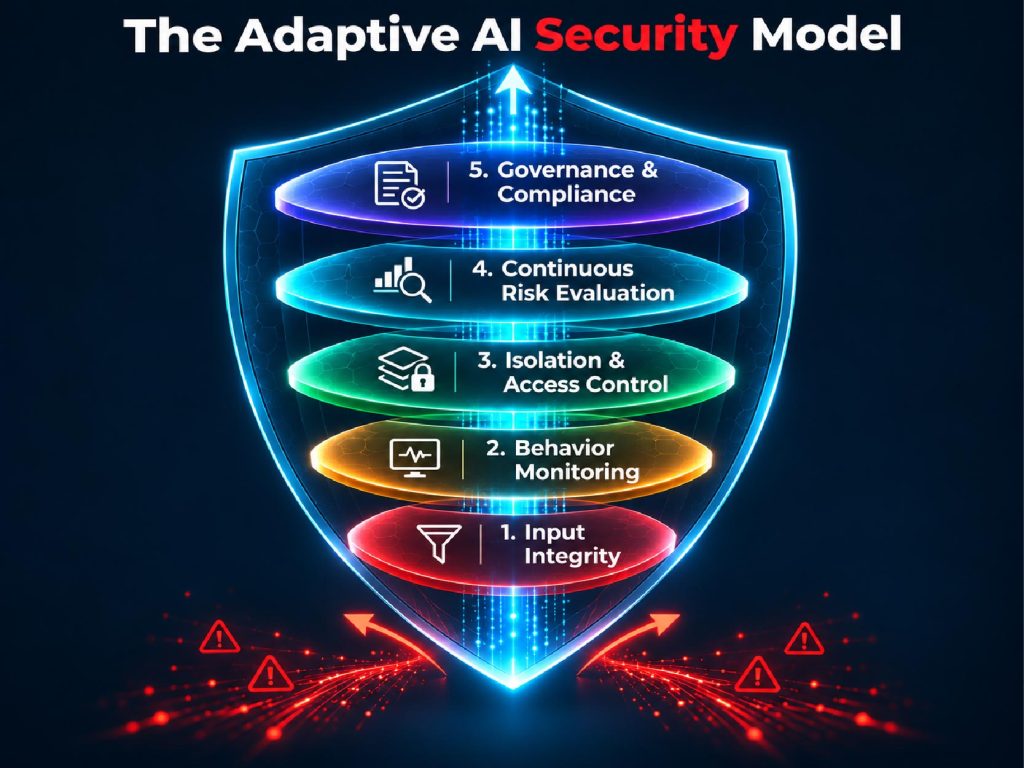
- Input integrity: The system validates every input before the model sees it. This layer screens for adversarial prompts and tampered documents. For biometric data, it checks submissions against enrollment records. Bad data stops at the door.
- Model behavior monitoring: This layer tracks the model’s outputs against a validated baseline. When decisions start to drift, it raises a A human reviews the change before it affects real people.
- System isolation and access control: AI components sit in separate, segmented environments. Zero Trust governs every interaction between Role-based access decides who touches inputs, outputs and training data. These controls map directly to duties under GDPR and Kenyan data protection law.
- Continuous risk: Risk profiles update as the system evolves. This layer aligns with the NIST AI Risk Management Framework. It replaces the single certification moment with ongoing assessment.
- Governance and compliance integration: Security moves inside the compliance process instead of running beside it. This layer aligns with ISO/IEC 42001, Kenya’s Data Protection Act and GDPR Approval then reflects how resilient a system really is. Not just how tidy its documentation looks.
Compliance Has to Keep Moving
AI makes our defenses smarter. It spots threats faster than any human team. But it also opens doors that old rulebooks never imagined.
Compliance still matters. It creates accountability and builds trust. The problem isn’t compliance itself. It’s compliance that freezes in place while the system keeps learning.
The fix is a change in habit. Monitor, don’t just certify. Ask often whether yesterday’s approval still holds today.
For organizations that handle sensitive data across borders, this shift isn’t optional. It’s the price of real accountability. For fast-growing digital economies like Kenya, the time to get it right is now.
AI changes every day. Our governance needs to change with it. Until it does, compliance stays a stack of paperwork, not a promise of security.