An Overview of Adversary-in-the-Middle (AiTM) Attacks
.Adversary-in-the-middle (AiTM) attacks are yet another example of cybercriminals continually finding ways around conventional cybersecurity defenses. Designed to bypass passwords and multifactor authentication (MFA) security protocols, AiTM attacks intercept authentication in real time, granting cybercriminals access to business accounts without necessarily cracking passwords or directly defeating every authentication control.
For businesses that depend on secure cloud platforms, remote access, and digital collaboration, understanding AiTM attacks is essential to protecting sensitive information, financial assets, and customer trust. So, how do AiTM attacks work, and what can your organization do to prevent them?
What is an Adversary-in-the-Middle (AiTM) Attack?
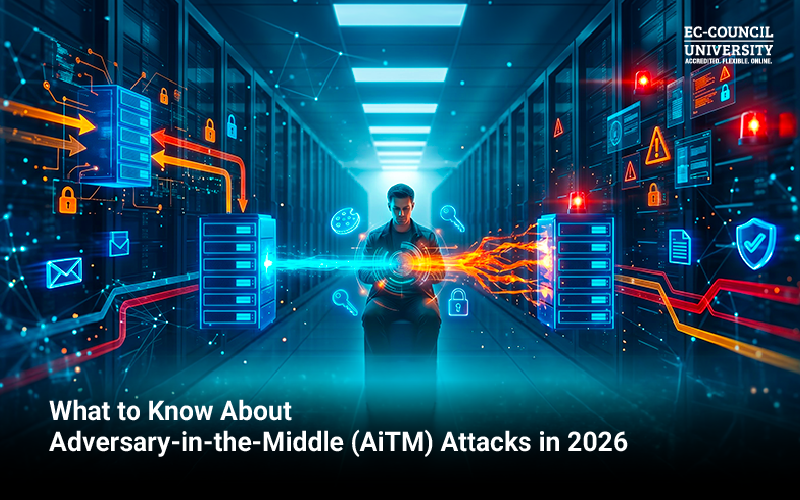
An adversary-in-the-middle attack occurs when a cybercriminal positions themselves between two communicating parties to intercept, monitor, or manipulate their communications.
The broader AiTM technique is recognized in MITRE ATT&CK under technique T1557 (1). In contemporary identity-focused attacks, cybercriminals frequently use malicious proxy websites to relay authentication traffic between victims and legitimate services. This enables them to capture credentials and, potentially, authenticated session cookies or access tokens.
Unlike traditional credential phishing, which typically collects login details through a fraudulent page, an AiTM phishing proxy can interact with the genuine service in real time. The victim may see a legitimate authentication flow and complete MFA, while the attacker captures the resulting authenticated session.
How Do Adversary-in-the-Middle (AiTM) Attacks Work?
- The attacker delivers a phishing lure: The victim receives an email or message containing a link to a fraudulent login page. Common lures include shared documents, voicemail notifications, password-expiration alerts, and urgent HR communications.
- The victim visits a malicious proxy: The phishing website sits between the victim and the legitimate service, relaying requests and responses rather than simply displaying a static fake login form.
- The victim authenticates: The user enters their credentials and completes the requested MFA step. The legitimate service may successfully authenticate the user.
- The attacker captures the session: Depending on the attack and authentication flow, the malicious intermediary can capture an authenticated session cookie or token.
- The attacker accesses the account: The attacker may reuse the stolen session to access the victim’s account and pursue additional objectives, including data theft, fraudulent payments, and business email compromise.
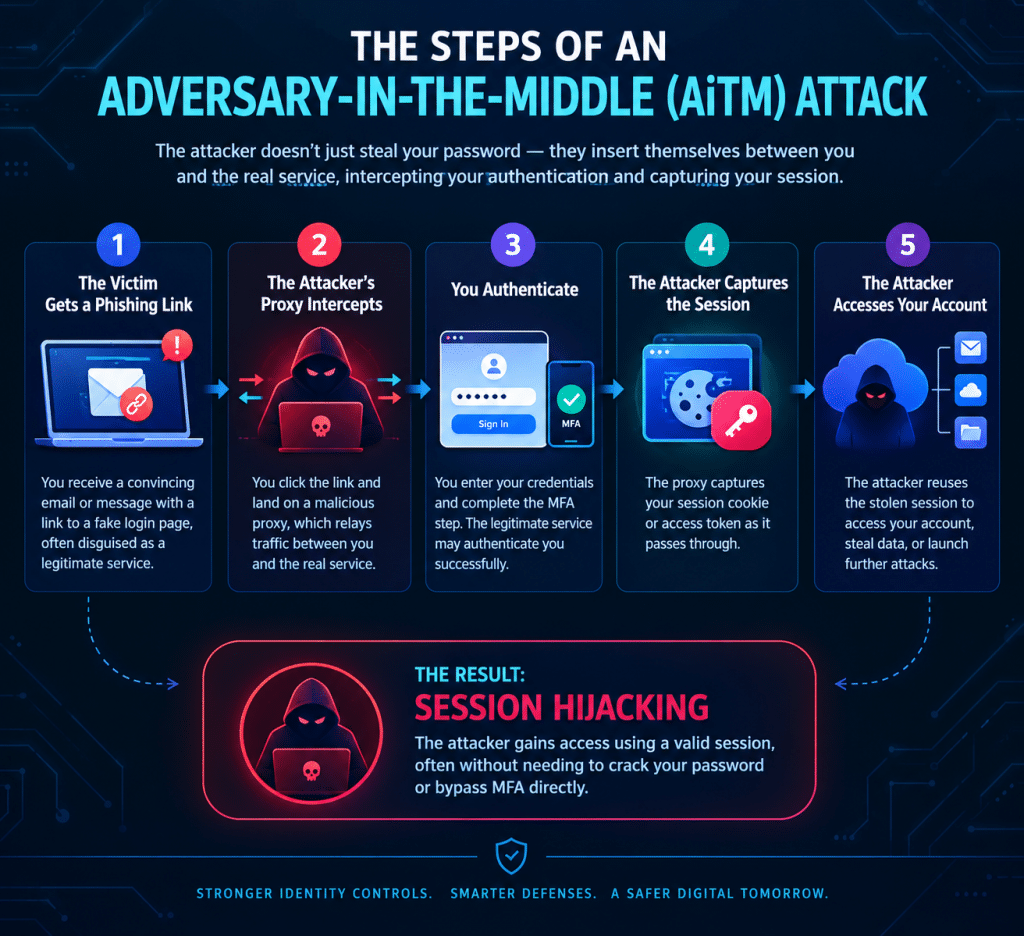
A critical point: MFA may have worked exactly as designed. The attacker exploits the authenticated session created after verification, rather than necessarily defeating the authentication factor itself.
Why Are Adversary-in-the-Middle Attacks a Serious Threat in 2026?
Several developments make AiTM attacks particularly relevant to modern organizations:
- MFA Bypass Through Session Theft
MFA significantly improves account security, but not every MFA method resists real-time phishing. Attackers can relay authentication requests and capture sessions after users complete conventional MFA challenges. This does not mean MFA is ineffective. It means organizations must distinguish between MFA, which adds another verification step, and authentication, which cryptographically binds verification to the legitimate website. - Phishing-as-a-Service Lowers the Barrier to Entry
PhaaS platforms provide cybercriminals with ready-made phishing infrastructure, templates, and other capabilities. Some support AiTM techniques, enabling attackers with limited technical expertise to conduct sophisticated credential and session theft campaigns. Microsoft’s January 2026 research (2) documented phishing campaigns involving platforms such as Tycoon2FA, illustrating how these capabilities can support large-scale credential theft and subsequent business email compromise. - Trusted Collaboration Platforms Can Become Attack Vectors
Attackers may exploit familiar file-sharing workflows, including links to documents hosted on collaboration platforms, to make phishing messages appear credible. In January 2026, Microsoft (3) documented a multistage AiTM and business email compromise campaign that abused SharePoint file-sharing services. Following the account compromise, attackers used trusted identities to distribute additional phishing messages and created inbox rules to help maintain access or evade detection. The lesson is straightforward: a familiar platform or apparently trusted sender does not automatically make a link safe. - AI-Themed Lures Add Another Layer of Deception
Cybercriminals are now leveraging AI tools to make phishing campaigns more effective. Fake AI-product pages, fraudulent sign-in prompts, and impersonation of popular AI brands can encourage users to disclose credentials or approve suspicious authentication requests. In September 2026, Microsoft (4) described campaigns impersonating AI platforms and tools, including a Claude-themed campaign that harvested credentials and access tokens using AiTM techniques.
What Are the Consequences of an Adversary-in-the-Middle Attack?
A successful AiTM attack can extend well beyond a compromised login:
- Account takeover: Attackers gain access to email, cloud applications, and other business resources.
- Business email compromise: Criminals impersonate employees, manipulate business conversations, or redirect payments.
- Data theft: Compromised sessions expose confidential documents, customer information, and intellectual property.
- Further phishing: Attackers exploit a trusted account to target colleagues, customers, and business partners.
- Persistence and expanded access: Attackers may create inbox rules, modify account settings, or pursue additional access within the organization.
- Financial and reputational damage: Fraud, incident response costs, operational disruption, and loss of customer confidence can follow.
How Can Organizations Prevent AiTM Attacks?
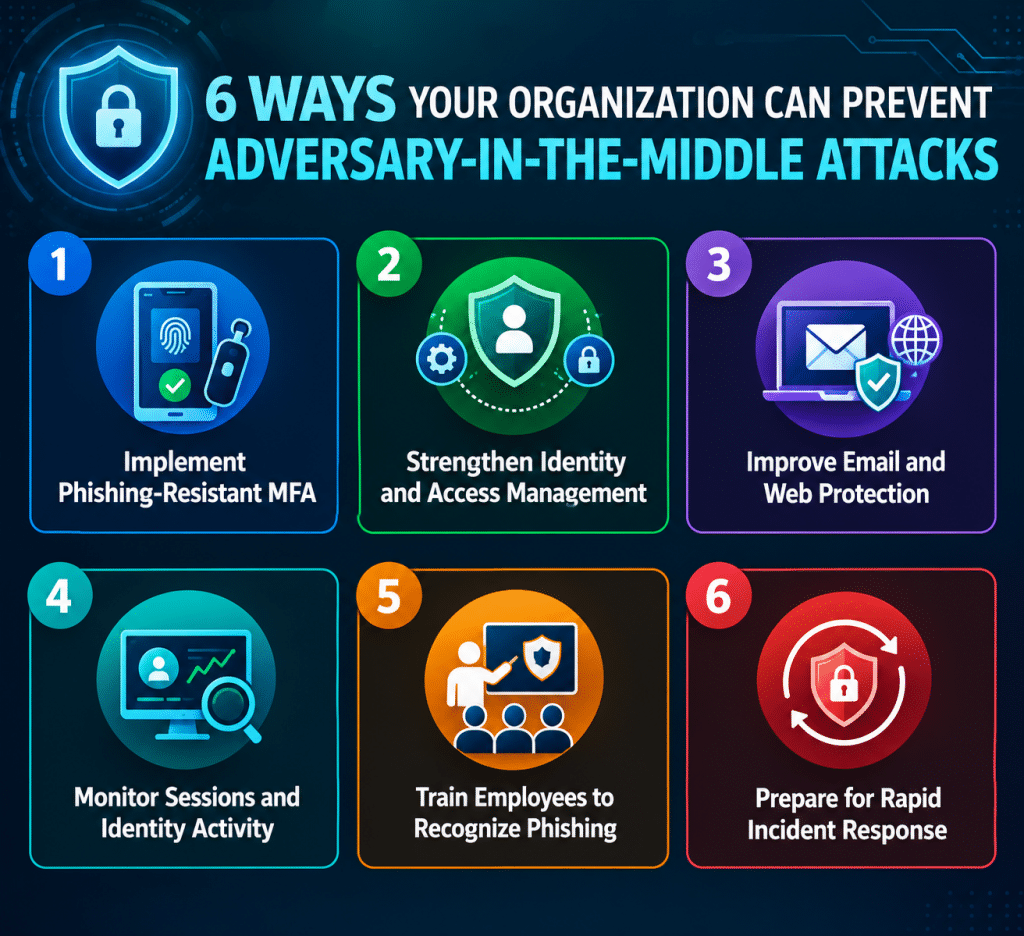
1. Implement Phishing-Resistant MFA
Prioritize FIDO2 (Fast Identity Online 2)/WebAuthn-based passkeys or security keys, which use cryptographic authentication tied to the legitimate website’s origin. These mechanisms provide stronger protection against credential-relay phishing than conventional one-time codes or push-based authentication alone.
2. Strengthen Identity and Access Management
Apply least-privilege access, conditional access policies, device-compliance checks, and risk-based sign-in controls. Restrict administrative privileges and require stronger controls for sensitive applications.
3. Improve Email and Web Protection
4. Monitor Sessions and Identity Activity
5. Train Employees to Recognize Phishing
Teach employees to inspect unexpected login requests, verify sensitive requests through trusted channels, and report suspicious messages. Emphasize that a familiar brand, a valid HTTPS connection, or a successful MFA prompt does not automatically establish trust. Consider these 10 best practices for organizations to strengthen employee cybersecurity awareness.
6. Prepare for Rapid Incident Response
Develop the Expertise to Combat Evolving AiTM Threats
Adversary-in-the-middle attacks expose a fundamental challenge in modern cybersecurity: authenticating a user successfully does not always guarantee that the resulting session remains under that user’s control. As phishing infrastructure becomes more accessible and attackers exploit trusted business workflows, organizations need professionals who can investigate identity-based attacks, implement phishing-resistant controls, and coordinate effective incident response.
In this regard, EC-Council University (ECCU) offers online cybersecurity degrees and certification courses designed to help professionals build the technical knowledge and strategic capabilities in areas such as security operations, digital forensics, incident management, cloud security, and cybersecurity leadership. Whether you want to strengthen your organization’s defenses or advance your cybersecurity career, ECCU can empower you with the expertise to confront threats such as AiTM attacks and contribute to a more resilient digital environment.
Talk to our advisors to discover your next step in advanced cybersecurity education:
Frequently Asked Questions
What does AiTM mean in cybersecurity?
How is an AiTM attack different from a traditional phishing attack?
Can AiTM attacks bypass multifactor authentication?
What is session hijacking in an AiTM attack?
What are common warning signs of an AiTM attack?
How can businesses protect themselves against AiTM attacks?
Are AiTM attacks the same as man-in-the-middle (MiTM) attacks?
How can cybersecurity professionals defend against AiTM attacks?
- – MITRE ATT&CK technique T1557
- – https://www.microsoft.com/en-us/security/blog/2026/01/06/phishing-actors-exploit-complex-routing-and-misconfigurations-to-spoof-domains/
- – https://www.microsoft.com/en-us/security/blog/2026/01/21/multistage-aitm-phishing-bec-campaign-abusing-sharepoint/
- – https://www.microsoft.com/en-us/security/blog/2026/09/10/detect-and-disrupt-ai-themed-attacks-with-microsoft-defender/