The security analyst job has never been static. But what’s happening right now goes beyond a skills upgrade or a tooling refresh. AI is reshaping the core operating model of the security operations center: what analysts do, what they no longer do, and what they now need to know to stay effective. For anyone working in or heading toward a security analyst career, this shift demands attention. Not alarm. Attention.
This blog breaks down what has actually changed in the SOC, which new skills are becoming non-negotiable, where human judgment still holds the line, and what a realistic reskilling path looks like heading into the next few years.
Key Takeaways:
- AI hasn’t just automated SOC tasks; it has changed what “doing the job well” actually means.
- Tier 1 analyst work is shrinking fast; the analysts moving up are the ones who saw it coming.
- Prompt engineering and AI output validation are now core analyst skills, not niceto-haves.
- The SOC’s biggest liability in 2026 is an analyst who trusts AI output without questioning it.
- Human judgment still owns the decisions that carry business, legal, and reputational weight.
- Four new roles are emerging by 2030; none of them look like the classic security analyst job.
- The right graduate program doesn’t just teach cybersecurity; it teaches you how to work with AI inside it.
The State of the SOC in 2026: What Has Actually Changed
From Alert Fatigue to AI-Assisted Triage
The classic SOC had a volume problem. Analysts processed thousands of alerts daily. Many were false positives. The real threats hid inside the noise, and no team could triage fast enough to catch them all. That’s the problem AI was built to solve, and in 2026, it’s solving it at scale.
Modern SIEM and SOAR platforms now integrate LLM-based reasoning directly into the alert pipeline. Instead of surfacing raw log data, the platform hands analysts a summarized incident brief: what happened, what it connects to, and why it likely matters. Microsoft Security Copilot, for instance, lets analysts query across Sentinel, Defender, and Entra ID using plain English, with no KQL required. What used to take hours now takes minutes.
The speed gains matter more than they might sound. ReliaQuest’s 2026 Annual Threat Report found that attackers achieved lateral movement in just 4 minutes during the fastest incidents in 2025. A SOC that can’t match that pace doesn’t get a second chance.
Published vendor benchmarks on mean-time-to-detect claim reductions as high as 50 to 80 percent, though independent measurement shows more modest improvements. The real gain for most teams comes in the investigation phase: AI compresses multi-hour analyst work into minutes by automatically correlating signals.
The Rise of Autonomous Threat Hunting
Beyond triage, AI agents are now operating across log sources without waiting for an analyst to prompt. These agents can pull telemetry from endpoints, identity systems, cloud environments, and network traffic, then surface patterns that suggest a hidden intrusion. CrowdStrike’s Charlotte Agentic SOAR, launched at RSA 2026, lets security teams orchestrate agent-to-agent and human-AI workflows across their entire security stack. IBM’s Autonomous Threat Operations Machine, integrated with Charlotte AI, takes this a step further by handling coordinated investigation and containment at machine speed.
This is what separates the AI-augmented SOC from the old model. The old model waited for a human to ask the right question. The new model investigates continuously, escalates what matters, and flags what needs a human decision.
What This Means for Tier 1 and Tier 2 Workflows
Tier 1 analyst work, including alert monitoring, initial triage, and false-positive filtering, is being compressed by automation. Gartner estimates that by 2028, half of Tier 1 analyst responsibilities will be handled by AI. Some analysts are interpreting this as a threat. The smarter read is that it’s a pressure to move upward.
Tier 2 work, including deeper investigation, pattern correlation, and threat hunting, is where skilled analysts are increasingly spending their time. AI handles the first pass. Humans handle judgment calls.
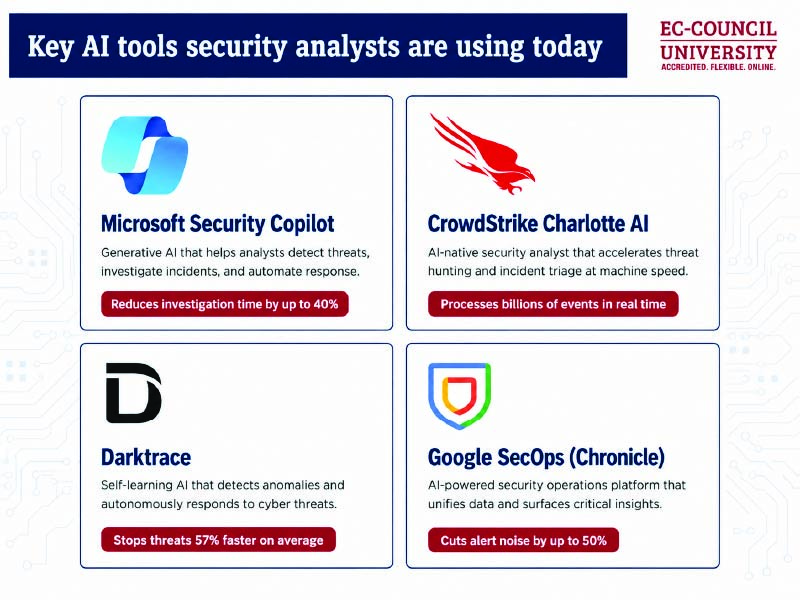
Key AI Tools Analysts Are Using Today
- Microsoft Security Copilot: natural language investigation across the Microsoft security stack; incident summarization in seconds
- CrowdStrike Charlotte AI: tasks that once took four days now take about one hour; acts as an autonomous Tier 1 analyst at machine speed
- Darktrace: AI-native detection focused on behavioral anomaly across network and email
- Google SecOps (Chronicle): threat intelligence and detection built on Googlescale data infrastructure
New Skills AI Is Demanding from Security Analysts
Prompt Engineering for Security Contexts
Knowing which tool to use matters less than knowing how to use it well. Analysts who can write precise, structured prompts get better outputs: tighter incident summaries, more accurate threat scoring, and actionable threat hunting queries. A vague prompt gives you a vague result. In a SOC, a vague result costs time you don’t have.
This isn’t about becoming a developer. It’s about speaking the machine’s language well enough to get reliable answers fast.
AI Output Validation: Knowing When the Machine Is Wrong
This is the skill most discussions skip, but it’s arguably the most important one right now. AI tools in the SOC hallucinate. Not often, but enough to matter. There are documented cases where an LLM flagged a non-existent lateral movement event while a real exfiltration alert sat deprioritized. Analysts who trust AI output uncritically become liabilities.
The skill is reading AI output with calibrated skepticism: checking whether the correlated data actually supports the conclusion, identifying confidence gaps, and knowing when to manually verify before acting. This is not intuition. It’s a trainable discipline.
Data Literacy and Pipeline Understanding
AI tools don’t generate insights from nothing. They work on whatever telemetry feeds into them. Analysts who understand how data moves through SIEM pipelines, what gets logged, what gets dropped, what gets normalized, can catch blind spots that pure AI users miss. Garbage data in, garbage alerts out.
Adversarial AI Awareness
Attackers are using AI too. Prompt injection, model poisoning, and adversarial inputs that manipulate AI security tools are no longer theoretical. They are catalogued attack patterns in the OWASP LLM Top 10. A security analyst who doesn’t understand how AI tools can be weaponized or manipulated is operating with a real blind spot.
In April 2026, 19 percent of security job descriptions required AI or ML skills, up from 8 percent just a month earlier. The demand is moving fast.
What AI Cannot Replace in a Security Analyst
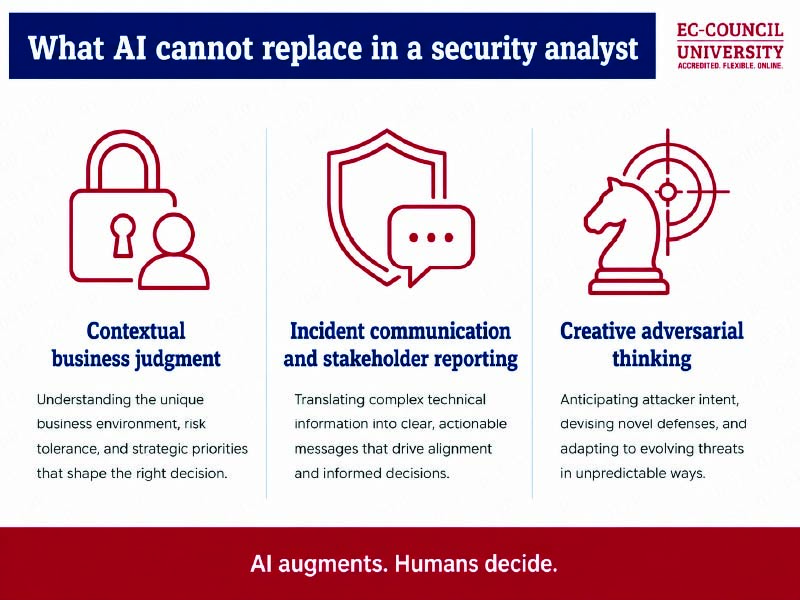
This is where it gets important to be clear. AI augments analysts. It does not replace the parts that require human reasoning.
Contextual business judgment. An AI tool sees a data exfiltration pattern. It doesn’t know that the CFO is in the middle of an acquisition that required emergency afterhours file transfers, or that the company’s legal team approved an exception last week. Situational context lives with humans.
Incident communication and stakeholder reporting. When something goes wrong, someone has to explain it to the board, the legal team, the regulators, and the press. That communication requires empathy, clarity, and the ability to translate technical events into business stakes. AI can draft a summary. A human decides what to say and how.
Creative adversarial thinking. Red team work depends on imagination: thinking like an attacker, not like a detection ruleset. AI can identify known patterns. It struggles to anticipate what a motivated, creative adversary hasn’t tried before. That gap belongs to human analysts for the foreseeable future.
Career Implications: What Analysts Should Do Now
Reskilling Priorities for 2026 and Beyond
Start with what’s already showing up in job descriptions: AI tool governance, detection engineering, and adversarial ML awareness. These are not abstract skills. They’re concrete, learnable, and increasingly required.
From there, build depth in at least one AI platform your target employers actually use, whether that’s Microsoft Copilot for Security, Charlotte AI, or another. Hands-on familiarity is worth more than conceptual knowledge.
How Graduate Education Fits the AI Era
Formal education is more valuable here than it might seem, but only if the curriculum reflects current industry practice. A master’s program in cybersecurity that doesn’t address AI integration, adversarial ML, and cloud AI security is already behind. The right program builds the foundational depth that solo upskilling rarely achieves, particularly in threat modeling, governance frameworks, and cross-functional incident response.
ECCU's MSCS: Security Analyst Specialization
EC-Council University’s MSCS with a Security Analyst specialization aligns directly with where the SOC is heading. The curriculum covers the technical depth the AI era demands, not just tool familiarity, but the analytical and governance skills that distinguish senior practitioners. ECCU updates curriculum to reflect real-world shifts as they happen, which matters in a field moving as fast as this one.
If you’re evaluating graduate programs, the question to ask is simple: does this program prepare me for the SOC as it exists today, or the SOC as it existed five years ago?
Certifications to Pair with Your Degree
CEH, CHFI, and CND remain relevant in the AI-augmented SOC, but their value now depends on how you apply them. CEH’s red team methodology feeds directly into adversarial AI thinking. CHFI’s digital forensics discipline applies cleanly to AI-assisted investigation. CND provides the network defense foundation that agentic tools operate on top of. These certifications work best as complements to structured graduate education, not as substitutes for it.
Also read: Best Cybersecurity Certifications to Launch Your Career
The Future Trajectory: Analyst Roles That Will Emerge by 2030
The Security Analyst title won’t disappear. But underneath it, the job architecture is changing. Here’s where the research points:
- Detection Engineer: builds and maintains AI-native detection logic. Sits between data engineering and security analysis. Already a real job title at scale.
- AI Threat Analyst: uses AI tools proactively to hunt threats across environments. Requires both security judgment and fluency in AI-assisted workflows.
- Security Automation Engineer: owns the agentic SOC infrastructure. Designs, tests, and governs the AI agents that handle Tier 1 and Tier 2 functions.
- AI Red Teamer: attacks AI systems to find vulnerabilities before real adversaries do. One of the fastest-growing specializations in cybersecurity right now.
The World Economic Forum projects that Information Security Analysts will remain among the top 15 fastest-growing professions globally through 2030. The volume of work isn’t shrinking. The nature of it is.
Also read: Security Analyst vs Cloud Security Architect
Stay Ahead of AI-Driven Change in the SOC
The analyst role is shifting fast. The professionals who will lead in the next five years are the ones building AI fluency now, not just using the tools, but understanding when to trust them and when to push back.
Explore ECCU’s MSCS, Security Analyst specialization, where the curriculum is continuously updated to reflect real-world industry shifts.
Frequently Asked Questions
Will AI replace entry-level security analyst jobs?
Not entirely, but the traditional Tier 1 role is being compressed. AI already handles alert monitoring, initial triage, and false positive filtering faster than entry-level analysts can. What’s opening up in its place are roles that require AI fluency: detection engineering, AI tool governance, and security automation. Analysts who upskill will find more opportunities, not fewer. Those who don’t will find the entry path narrower.
What AI tools should a security analyst learn in 2026?
Start with the platforms your target employers use. For Microsoft-heavy environments, Security Copilot is the most immediately practical. CrowdStrike Charlotte AI is essential if you’re targeting enterprise SOC roles. Beyond platform tools, build familiarity with AIassisted threat hunting workflows and learn how to evaluate and validate AI-generated findings. The tool matters less than the ability to work critically with AI output.
How does the NICE Framework map to AI-era analyst roles?
NIST released NICE Framework v2.2.0 in April 2026, and the AI Security Competency Area (NF-COM-002) was specifically updated in December 2025 to reflect new knowledge and skill requirements. The Cyber Defense Analyst work role (PR-CDA-001) maps directly to SOC analyst functions. For AI-era roles, look at the AI Security competency area for guidance on which knowledge and skill statements align with emerging job descriptions.
Does an MSCS help security analysts stay ahead of AI disruption?
Yes, if the program is structured around current industry practice. An MSCS builds the analytical depth, governance knowledge, and technical foundation that point solutions and certifications alone don’t cover. ECCU’s program specifically addresses the AI-era SOC, which means graduates enter the workforce with skills that are immediately applicable rather than already dated.
What is the difference between a security analyst and a threat intelligence analyst?
A security analyst works inside the SOC, monitoring, triaging, investigating, and responding to alerts. A threat intelligence analyst operates one level up from that:
researching threat actor behavior, tracking campaigns and techniques, and producing intelligence that helps the SOC team know what to look for. In practice, both roles are increasingly AI-assisted, but the threat intelligence analyst’s work is more externalfacing and research-intensive, while the security analyst’s is more operationally reactive.