There is no finish line in cybersecurity education. A master’s degree is a strong foundation. The field you graduate into will not be the same in five years. The threat landscape shifts faster than any credential can track. New attack surfaces emerge. Old assumptions expire. Stop learning after graduation, and you are already behind.
This is not a reason to feel overwhelmed. Cybersecurity is one of the most intellectually alive careers you can build. It demands that you keep growing. That demand, met deliberately, separates a long career from a short plateau.
The Shelf Life of Cybersecurity Knowledge
Think about what the threat environment looked like five years ago. Cloud-native infrastructure was maturing but not dominant. Generative AI was not yet a mainstream attack tool. OT and IoT convergence was a concern, not a crisis.
Today, all three sit at the center of active attack campaigns. Ransomware attacks surged 60% in the first half of 2025, driven partly by AI-powered threat groups. From 2023 to 2024, reported CVEs rose 30%, from 17,114 to 22,254. The attack surface is not stable. It compounds.
Technical knowledge has a shelf life in this environment. Skills built at 25 will not carry you to 45 without reinvestment. Adaptability is now the top hiring qualification in cybersecurity, cited by 61% of employers. The market already prices in the expectation that you will keep learning.
What Continuous Learning Actually Looks Like
Most people picture continuous learning as reading newsletters and attending webinars. That counts for something. But it is not a strategy. Real continuous learning has structure, and it builds in layers.
- Degree: Your foundation. It gives you technical literacy and the mental models to interpret what you encounter in the field.
- Certifications: The next layer, but only when tied to a specific role or skill gap. A credential without a career reason is just a line on a resume.
- Community learning: CTF competitions, ISAC participation, peer networks. These expose you to real-world problems that no classroom covers.
- Leadership development: As you advance, this becomes non-negotiable. Technical depth alone does not move you into the rooms where decisions get made.
Cybersecurity resilience depends less on headcount and more on continual skill development. Professionals who invest in structured, intentional learning build careers that last.
The Certification Treadmill vs. Strategic Learning
There is a real difference between collecting credentials and building expertise.
Many professionals chase certifications without a clear rationale. The resume grows. The coherence does not. Research is clear: cybersecurity certifications do not, on their own, lead to career advancement. They create leverage. Leverage only works in the right direction.
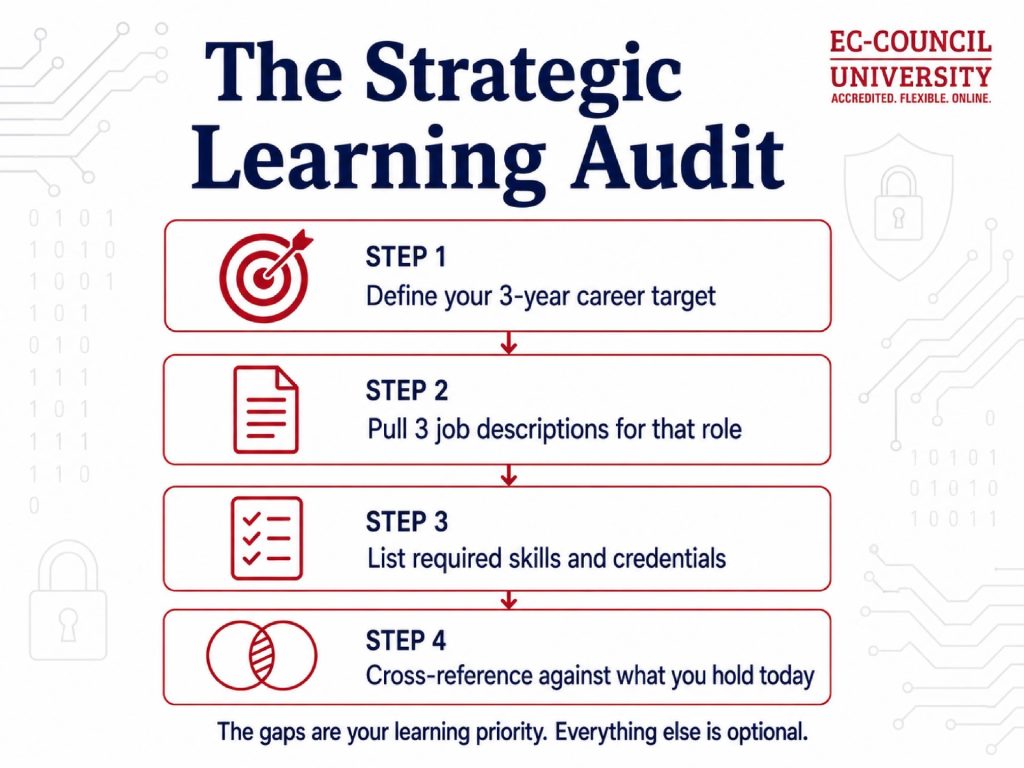
Strategic learning starts with your three-year career target. Work backwards from there. Want a cloud security leadership role? Identify the gaps between you and that position. Then find the credential that closes the most critical one fastest.
A practical audit is straightforward. Pull three job descriptions for your target role. List the skills and credentials appearing across all three. Cross-reference that against what you currently hold. The gaps are your learning priority. Everything else is optional.
86% of security professionals value certifications, and 65% see them as the clearest way to demonstrate competency. Timing and alignment matter as much as the credential itself.
Why Organizational Learning Culture Matters
Security teams do not operate in a vacuum. The organization either builds conditions for learning or it doesn’t. And the gap shows up quickly.
Most do the latter without realizing it. They freeze training budgets during cost cuts, treat certifications as personal expenses, and measure the security team on incident response rather than capability growth. Then, when people leave or gaps show up in a breach, they treat it as a talent problem. It is not. 54% of organizations cite skills shortages as a direct cause of breaches. Undertrained teams are a security liability, not just an HR one.
What this looks like in practice varies. Some teams run internal CTF competitions. Others rotate staff through threat intelligence working groups or sector ISACs. The format matters less than the signal it sends: that learning is expected, supported, and built into how the team operates.
That signal is what separates a learning culture from a learning policy nobody reads.
How ECCU Is Built for the Lifelong Learner
Most programs are built for one moment in your career. ECCU is built for all of them.
- Starting out or filling a specific gap: Non–degree courses run ten weeks and carry three credit hours each. You target one skill area, complete it, and move on. No degree commitment required.
- Building toward something bigger: Graduate certificates are stackable. Each one builds on the last and can ladder into a full master’s degree. Credit earned in a certificate program counts toward the degree later. You are not starting over at each stage. You are compounding.
- Ready for a leadership track: The full master’s program is there when the depth of a degree becomes the right move, whether that is now or three years from now.
- Earning credentials while you learn: EC-Council certifications, including the CEH and CND, are embedded in the coursework. You earn globally recognized credentials without sitting separate exams or duplicating effort.
- Studying around your career, not instead of it: Everything is online. The structure was designed for people with full-time jobs, not for people who can afford to step away from them.
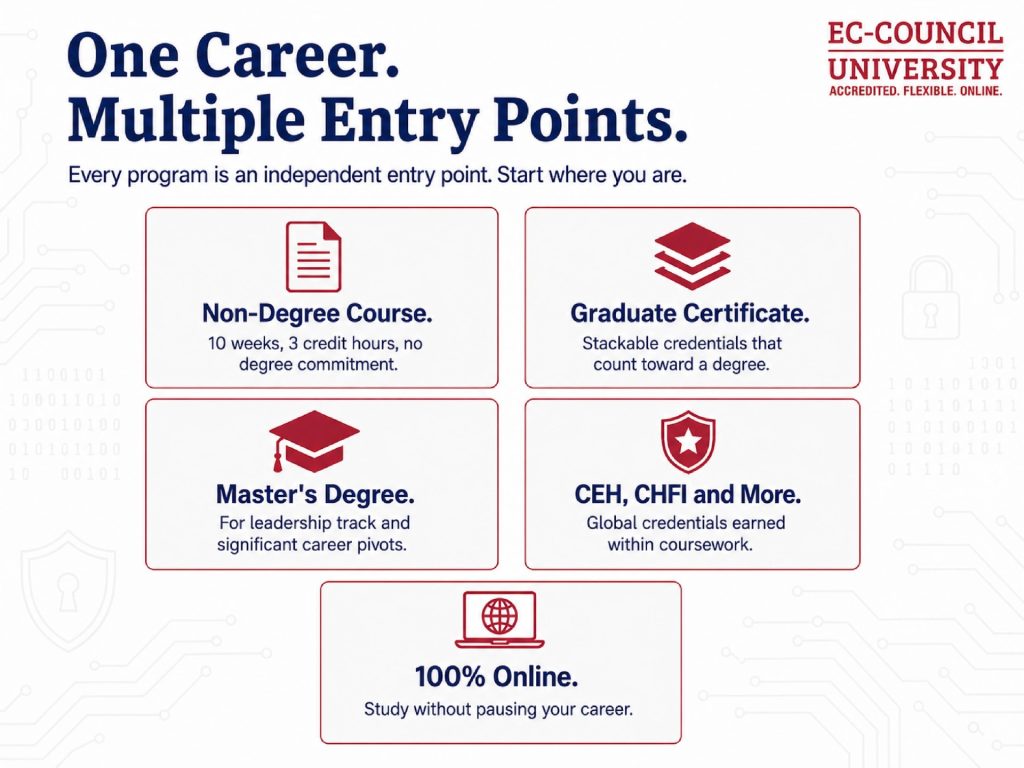
The program you need today does not have to be the last one you take. Whatever stage you are at, there is an entry point and a next step.
Explore ECCU’s non-degree courses, graduate certificates, and degree programs
Building Your Personal Learning Roadmap
A plan that stays theoretical never gets executed. Here is a four-step structure that works.
Step 1: Audit your current skills against your target role
Pull three to five job postings for the role you want. List every required skill. Score yourself honestly against each one.
Step 2: Identify the two or three gaps with the highest ROI
Not every gap is equal. Some skills are prerequisites. Others are differentiators. Focus on what unblocks the most career movement.
Step 3: Choose the right credential type for the depth you need
A non-degree course works when the gap is targeted and the timeline is tight. A graduate certificate builds role-level competency. A full degree works for leadership or a significant career pivot.
Step 4: Put it in the calendar
A learning goal without a scheduled start date is a wish. Block the time. Register for the course. Treat it like a work commitment, because it is one.
If you are ready to take that step, ECCU has a program built for wherever you are in your career.
Explore ECCU’s non-degree courses, graduate certificates, and degree programs
The Career Is Built After Graduation
What you learned in your degree program matters. It gave you language, frameworks, and the foundation to enter the field with credibility.
But the field keeps moving. New threat actors emerge. New technologies create new attack surfaces. The skills that got you hired will not keep you relevant a decade from now.
A cybersecurity career is not built on what you knew at graduation. It is built on what you learn after. The professionals who understand that early are the ones still leading twenty years later.
Frequently Asked Questions
The most effective professionals combine structured and informal learning. Certifications and courses handle the structured side. CTF competitions, threat intelligence communities, and peer networks handle the rest. Reading vendor advisories and CVE updates helps too. The key is consistency. Occasional bursts of learning do not compound. Regular, intentional habits do.
Yes, when chosen deliberately. 86% of security professionals value certifications, and 65% see them as the clearest way to demonstrate competency. The caveat is alignment. A certification tied to a specific role or skill gap delivers real career leverage. One collected without a clear rationale just adds a line to your resume.
Start with a skills audit against your target role. Identify the two or three gaps with the highest career impact. Then choose the right format: a short course for a targeted gap, a certificate for role-level competency, a degree for a bigger shift. Upskilling works best when it is specific, not broad.
Yes. ECCU offers non-degree courses that run for 10 weeks and carry 3 credit hours each. They are open to working professionals who want targeted upskilling without a degree commitment. If your goals change later, the credit you earn can count toward a graduate certificate or a full master’s degree program.