
Transitioning from military service to a civilian career can feel overwhelming. But in cybersecurity, veterans already possess many of the qualities that the industry urgently needs. These qualities include discipline, operational thinking, leadership, and mission-focused problem-solving.
A common challenge veterans face is knowing how to use their GI Bill® education benefits earned through military service to build a long-term cybersecurity career. Many veterans either leave GI Bill® benefits unused or fail to maximize them strategically. Understanding GI Bill® extensions and supplemental education programs can significantly expand career opportunities in cybersecurity.
GI Bill® Benefits: What Veterans Need to Know
The Post-9/11 GI Bill® remains one of the most valuable education benefits available to veterans. It can help cover:
- Tuition and fees for on-campus and online degrees
- Housing allowances
- Costs of books and supplies
- Certification and training fees
Most eligible veterans receive up to 36 months of education benefits. For veterans seeking to build successful cybersecurity careers, these benefits can be used toward online degree programs at a DEAC-accredited institution like EC-Council University (ECCU).
However, veterans should carefully plan how they use their GI Bill® education benefits. Strategic planning matters. Some veterans use benefits too early on short-term training without reserving enough months for advanced education later. Others fail to realize that extension opportunities may exist through STEM-related provisions.
GI Bill® Extensions: Current Provisions
- Edith Nourse Rogers STEM Scholarship
One of the most important extension opportunities for cybersecurity students is the U.S. Department of Veterans Affairs Edith Nourse Rogers STEM Scholarship. This program provides eligible veterans with up to 9 additional months of benefits or up to $30,000 toward eligible STEM degree programs, including those in computer science and cybersecurity.
Eligibility Requirements
To qualify, veterans generally must:
- Be enrolled in an approved undergraduate STEM program
- Have completed at least 60 semester credit hours
- Have six months or fewer remaining on their Post-9/11 GI Bill® benefits
- Be pursuing a program requiring at least 120 credit hours
How to Apply
Veterans can apply directly through the Rogers STEM Scholarship Application page on the official VA website. The VA states that applications typically take about 15 minutes to complete and are generally reviewed within 30 days.
- VET TEC Program
Another important option is the U.S. Department of Veterans Affairs VET TEC program. Unlike traditional degree programs, VET TEC focuses on shorter-term technical training designed to help veterans quickly enter high-demand technology careers, including cybersecurity.
VET TEC may help veterans pursue:
- Cybersecurity boot camps
- Technical certification preparation
- Intensive workforce training programs
This approach can work well for veterans who want to enter the workforce quickly before pursuing a full bachelor’s or master’s degree later.
Important: Keep Track of Policy Changes
Veterans should always verify current policies directly on VA.gov, as GI Bill® rules, extension eligibility, and funding availability can change over time.
How ECCU Supports Veteran Students
EC-Council University (ECCU) is a VA-approved institution that supports veterans pursuing cybersecurity education using GI Bill® benefits. All our learning options are 100% online and cybersecurity-focused, making them particularly attractive for military veterans transitioning into civilian cyber careers.
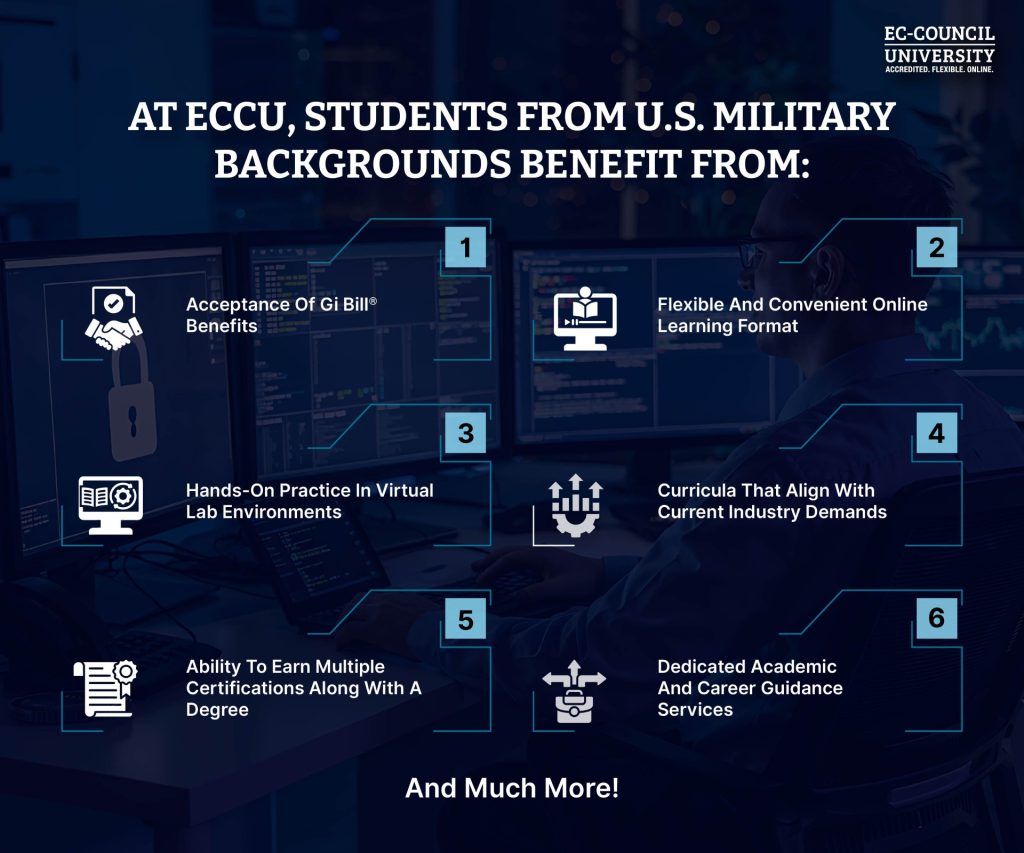
ECCU programs that qualify for GI Bill® benefits include:
- Bachelor of Science in Cyber Security
- Master of Science in Cyber Security
- Master of Science in Computer Science
- Master of Business Administration (Cybersecurity Focus)
- Graduate Certificate Programs
These programs help veterans build practical, employer-relevant skills in areas such as:
- Ethical hacking and penetration testing
- Cloud security engineering
- Incident response
- Threat intelligence
- Digital forensics
- AI cybersecurity
- Cybersecurity leadership
- And much more
Because many employers value both military experience and cybersecurity expertise, veterans who combine their operational background with formal cyber education often become highly competitive candidates.
Here’s Retired Major Timothy Amerson explaining how studying at ECCU empowered his standing as a national cybersecurity leader:
Using GI Bill® Benefits Strategically
Veterans should approach using the GI Bill® like a long-term investment strategy.
1. Start with Certifications
One effective approach is to use programs like VET TEC for foundational certifications first. This can help veterans enter the workforce more quickly, while preserving GI Bill® benefits for a full-fledged degree program in the future.
2. Stack Credentials Strategically
A strong educational pathway may look like this:
- Begin by gaining entry-level certifications
- Proceed to earn a bachelor’s degree in cybersecurity
- Pursue a master’s degree in cybersecurity leadership that embeds advanced certifications into the coursework
This “stacking” approach allows veterans to progressively increase both their earning potential and leadership opportunities.
3. Work with a VA Benefits Counselor
Veterans should also consult a VA education counselor before committing benefits. The official VA Education and Training page offers guidance on:
- Remaining entitlement calculations
- STEM Scholarship eligibility
- VET TEC updates
- Transferability rules
- Housing allowance questions
Remember:
Careful planning can prevent veterans from exhausting benefits prematurely.
In Summary
GI Bill® benefits are among the most valuable tools for career transition for military veterans. These benefits can open pathways to certifications and degrees that lead to high-paying cybersecurity job roles in one of the world’s fastest-growing industries. That’s why veterans need to understand GI Bill® extensions in order to maximize their potential.
For individuals ready to translate their military service into civilian cybersecurity careers, ECCU provides a VA-approved, veteran-friendly environment where GI Bill® benefits can be fully leveraged to build meaningful, long-term cybersecurity careers.
For personalized guidance:
Frequently Asked Questions (FAQs)
It is a VA scholarship that provides eligible veterans with up to 9 additional months of education benefits or $30,000 in benefits for qualifying STEM programs.
Yes. Cybersecurity programs generally qualify under the computer and information science fields approved by the VA.
In some cases, yes. Certain veterans may qualify for additional months through the STEM Scholarship.
Veterans should always confirm the latest eligibility rules and updates through the official VA.gov website.