
Why Businesses Need an Enterprise AI Governance Policy
AI is leading a digital transformation revolution across every major industry. From generative AI assistants to autonomous AI agents, organizations are integrating intelligent technologies into increasingly critical business processes. However, without appropriate oversight, AI adoption can expose organizations to data breaches, intellectual property disputes, regulatory violations, biased decisions, and reputational damage. For enterprise leaders, the challenge lies in establishing clear rules that enable innovation while protecting the organization, its workforce, customers, and stakeholders.
A robust enterprise AI governance policy provides that foundation. It defines acceptable AI use, establishes accountability, sets security and ethical requirements, and creates processes for managing AI risks throughout the technology lifecycle.
This article outlines a clear step-by-step roadmap for developing and implementing an effective enterprise AI governance policy. Here’s where to begin:
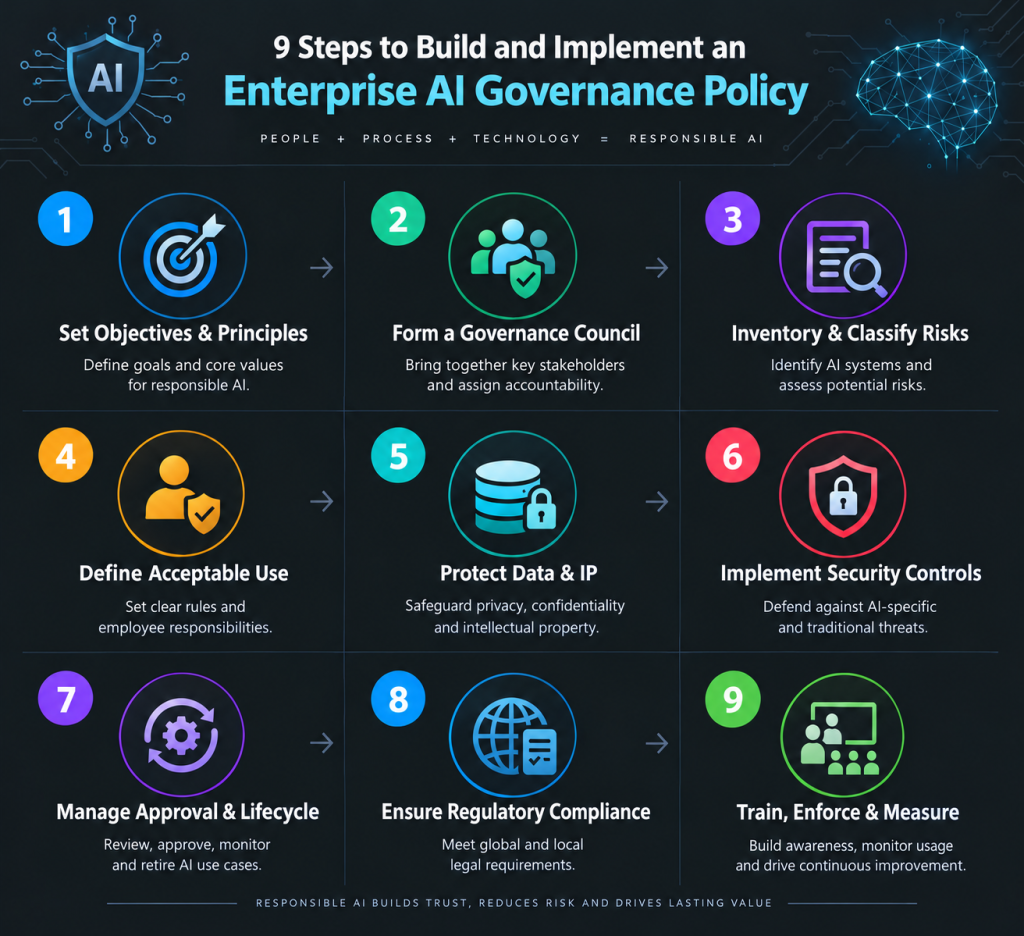
1. Establish Clear AI Governance Objectives and Principles
- Accountability: Assign clear responsibility for AI-related decisions and outcomes.
- Transparency: Communicate when AI materially influences decisions or generates content where disclosure is appropriate or required.
- Fairness: Identify and mitigate unjustified bias and discriminatory outcomes.
- Privacy: Protect personal information and restrict its use to authorized purposes.
- Security: Protect AI models, data, integrations, credentials, and connected systems.
- Human oversight: Ensure qualified individuals can review, challenge, and intervene in consequential AI-supported decisions.
- Reliability: Test AI outputs and systems for accuracy, robustness, and suitability for their intended purposes.
2. Form an Enterprise AI Governance Council
- Executive leadership: Defines risk appetite, allocates resources, and oversees program effectiveness.
- AI Governance Office: Maintains the AI inventory, coordinates risk assessments, and tracks approvals.
- Cybersecurity and IT: Implements security controls, access restrictions, monitoring, and cyber incident response.
- Legal, privacy, and compliance teams: Evaluate regulatory obligations, contractual requirements, intellectual property, and privacy risks.
- Business owners: Justify AI use cases, oversee operational performance, and remain accountable for business outcomes.
- Employees and contractors: Follow approved practices, verify AI outputs, and report potential violations.
3. Inventory AI Systems and Classify Their Risks
You cannot govern what you do not know exists. Begin by identifying the AI tools employees use, including enterprise copilots, public AI chatbots, third-party SaaS applications, developer assistants, internal models, and AI agents. Create a centralized AI inventory that records each application’s purpose, owner, vendor, data access, integrations, applicable jurisdictions, and security requirements.
Next, classify AI use cases according to their potential impact. For example, drafting non-confidential text using an approved assistant may present relatively low risk. An AI application that processes sensitive customer records requires stronger safeguards. A system that influences hiring, employee evaluation, financial eligibility, or other consequential decisions warrants more rigorous assessment and human oversight.
Establish four internal categories: low risk, moderate risk, high risk, and prohibited or unacceptable use. Define the approval requirements and safeguards associated with each category.
Importantly, internal risk categories do not replace legal classifications. Organizations must separately determine whether particular applications trigger requirements under applicable laws, including the EU AI Act (1) where relevant.
4. Define Acceptable AI Use and Employee Responsibilities
Employees need straightforward instructions they can apply to everyday work. The policy should clearly distinguish permitted activities from restricted and prohibited conduct. Employees should be required to:
- Use approved AI tools and authorized corporate accounts.
- Verify AI-generated facts, calculations, recommendations, and citations before relying on them.
- Review outputs for bias, inaccuracies, inappropriate content, and unintended disclosure.
- Obtain approval before connecting AI applications to internal databases, email, source-code repositories, or other enterprise systems.
- Disclose AI assistance when required by law, contract, client commitments, or internal procedures.
- Report accidental data disclosures, suspicious AI behavior, and policy violations promptly.
Prohibit employees from submitting confidential business information to unapproved AI services, bypassing security controls, fabricating evidence, generating deceptive content for unauthorized purposes, or using AI to facilitate unlawful discrimination.
The policy should also address AI-assisted recruitment, employee monitoring, customer communications, software development, research, and other function-specific activities.
Avoid blanket restrictions that unnecessarily prevent legitimate productivity gains. Instead, provide approved tools, practical examples, and streamlined approval procedures that make compliant behavior the easiest option.
5. Protect Data Privacy, Confidentiality, and Intellectual Property
Data governance is one of the most important components of enterprise AI policy. Establish a data classification matrix that specifies which information employees may submit to different AI environments. Public information may be suitable for approved tools, while internal, confidential, and restricted information should require progressively stronger authorization and safeguards.
Employees must understand that AI vendors may handle prompts, uploaded files, generated outputs, and usage logs differently. Before using an AI-based service, evaluate its data retention practices, model training terms, access controls, hosting arrangements, deletion procedures, and contractual protections.
Require employees to avoid relying on shadow AI tools, minimize the information they share, remove unnecessary identifiers, and comply with applicable privacy and cross-border data transfer requirements.
Intellectual property deserves equal attention. Employees should not upload proprietary code, trade secrets, licensed materials, customer deliverables, or confidential research without authorization. Before publishing AI-generated content or deploying code generated by AI, verify licensing conditions, third-party rights, security vulnerabilities, and applicable ownership requirements. Never assume that AI-generated content is automatically original, exclusively owned by the organization, or free from copyright and licensing concerns.
6. Implement AI-Specific Security Controls
Traditional cybersecurity controls remain essential, but AI systems introduce additional attack surfaces that require specialized safeguards. Implement controls across the AI lifecycle:
- Identity and access management: Enforce least privilege, multifactor authentication, and controlled service identities.
- Data loss prevention: Restrict unauthorized uploads, external sharing, and access to sensitive information.
- AI threat protection: Test for prompt injection, jailbreaks, data extraction, malicious inputs, and unsafe output handling.
- Agent security: Restrict AI agents to approved tools, data sources, and actions; require human confirmation for consequential or irreversible operations.
- Monitoring and logging: Record relevant access events, approvals, configuration changes, and security incidents while protecting sensitive logs.
- Testing and validation: Conduct threat modeling, AI penetration testing, vulnerability assessments, and performance evaluations before deployment and after significant changes.
Integrate AI-related incidents into the organization’s existing security operations and incident response processes. Define how teams will contain affected systems, revoke compromised access, preserve evidence, assess exposure, and meet applicable notification obligations.
7. Establish an AI Approval and Lifecycle Management Process
- Step 1 – Submit: The business owner explains the use case, expected benefits, proposed tool, and data requirements.
- Step 2 – Assess: Relevant teams evaluate security, privacy, ethical, legal, operational, and third-party risks.
- Step 3 – Test: Technical specialists validate performance, accuracy, robustness, fairness, security, and human oversight requirements.
- Step 4 – Approve: An authorized decision-maker records the approval, required safeguards, accountable owner, and residual risks.
- Step 5 – Deploy and monitor: Teams implement approved controls, monitor performance, investigate incidents, and reassess the system when its model, data, purpose, permissions, or operating environment changes materially.
- Step 6 – Retire when necessary: Suspend or decommission systems that no longer meet business requirements or cannot operate within acceptable risk limits.
8. Address AI Regulatory Compliance Across Jurisdictions
Multinational organizations must account for different AI, privacy, employment, cybersecurity, and region-specific requirements. Map the legal obligations that apply to each use case, business entity, and jurisdiction. Relevant considerations may include the EU AI Act, the General Data Protection Regulation (GDPR) (2), applicable U.S. state privacy laws, employment regulations, and industry-specific requirements.
Use a global minimum policy supported by local legal addenda. Local teams should identify additional obligations only if they do not weaken enterprise-wide safeguards, unless a formally approved, legally justified exception applies.
9. Train Employees, Enforce Compliance, and Measure Results
Even a well-written policy will fail if employees do not understand it or the organization cannot enforce it. Deliver role-based training for employees, managers, developers, cybersecurity teams, procurement specialists, and executives. Use practical scenarios involving confidential data exposure, fabricated AI outputs, biased recommendations, prompt injection attacks, and unauthorized AI integrations.
Combine training with preventive technical controls, monitoring, periodic audits, and clear incident reporting channels. Enforce proportionate consequences for violations while encouraging employees to promptly and in good faith report accidental mistakes.
Finally, measure whether the program works. Track AI inventory coverage, risk assessment completion, approved-tool usage, training effectiveness, incident trends, remediation timelines, vendor assurance, and the effectiveness of human oversight.
Review these measures regularly and use the findings to improve the policy as technologies, threats, and regulations evolve.
Develop the Expertise to Lead Responsible AI Governance
Building a robust enterprise AI governance policy demands a coordinated approach to leadership, cybersecurity, risk management, privacy, ethics, regulatory compliance, employee education, and continuous assurance. Organizations need people who can translate these requirements into practical governance structures, assess emerging AI risks, establish effective controls, and maintain accountability throughout the AI lifecycle.
EC-Council University’s Certified Responsible AI Governance & Ethics (C|RAGE) certification helps you develop such capabilities by focusing on AI governance frameworks, regulatory compliance, ethical principles, AI risk and threat management, third-party risk, security architecture, privacy, incident response, and AI assurance and auditing.
Learners can obtain the C|RAGE certification through:
For cybersecurity and business leaders, the goal is to make responsible AI use a repeatable organizational practice, one that supports innovation while protecting people, information, and business integrity. Having the knowledge, skills, and acumen to build and deploy a robust AI governance policy goes a long way toward achieving this goal.
For more information on ECCU’s C|RAGE certification:
Frequently Asked Questions About Enterprise AI Policy
What is an enterprise AI governance policy?
An enterprise AI governance policy is a formal set of principles, rules, responsibilities, and controls that guides how an organization selects, develops, deploys, and uses AI. It addresses security, privacy, ethics, compliance, accountability, and risk management.
Why is AI governance important for businesses?
AI governance helps organizations reduce the risks of data exposure, security incidents, biased decisions, intellectual property disputes, and regulatory noncompliance. It also enables employees to use approved AI tools more confidently and consistently.
What should an enterprise AI governance policy include?
It should address acceptable AI use, governance responsibilities, risk classification, data privacy, confidentiality, intellectual property, AI security, ethical requirements, vendor management, approval procedures, monitoring, incident response, training, and enforcement.
Who should be responsible for AI governance?
Executive leadership should sponsor the program, while a cross-functional AI Governance Council oversees policy and risk decisions. Cybersecurity, legal, privacy, compliance, IT, business owners, and employees each have defined responsibilities.
How can organizations prevent employees from exposing confidential data to AI tools?
Organizations should approve suitable enterprise AI tools, classify data, enforce access controls and data loss prevention, assess vendor data-handling practices, train employees, and monitor for unauthorized disclosures. Highly sensitive data should remain restricted unless a specific use case has been authorized and appropriately protected.
How can organizations enforce AI governance policies?
They can combine approved-tool controls, technical safeguards, employee training, monitoring, audits, incident reporting, documented approvals, and proportionate disciplinary procedures. Regular reviews help identify gaps and keep the policy effective.