Why Are AI-Focused Cybersecurity Certifications Becoming Important?
The skyrocketing demand for AI security expertise reflects a broader shift in modern-day cybersecurity talent requirements. According to the 2025 ISC2 Cybersecurity Workforce Study (1), which surveyed over 16,000 cybersecurity professionals and business leaders worldwide, organizations are focusing heavily on skill development as they attempt to navigate evolving AI security challenges. This is because AI introduces attack surfaces that traditional security controls may not adequately resolve on their own. These include prompt injection attacks, model manipulation, disclosure of sensitive information, insecure AI integrations, granting excessive permissions to autonomous AI agents, and more.
AI-focused cybersecurity certifications help professionals understand AI security risks and develop the skills to identify, assess, and mitigate them. They may also provide structured learning pathways to specialize in offensive AI security, AI governance, AI program management, or AI security engineering.
Let’s go deeper and examine the main career benefits of earning AI-focused cybersecurity certifications:
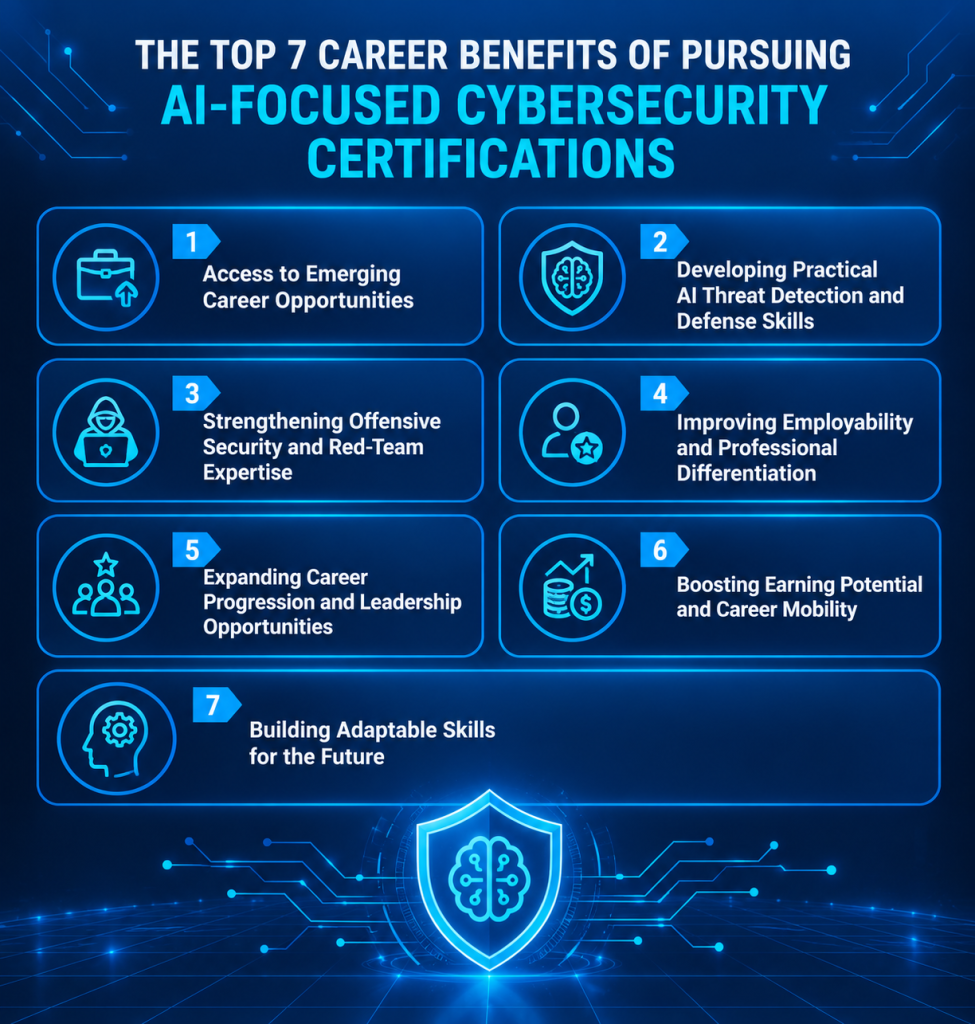
7 Career Benefits of AI-Focused Cybersecurity Certifications
Thinking of getting an AI-focused cybersecurity certification? Here’s how it can boost your career:
1. Access Emerging Career Opportunities
As organizations rush to integrate AI into their products, services, and internal operations, they need professionals who understand the corresponding security implications of widespread AI adoption.
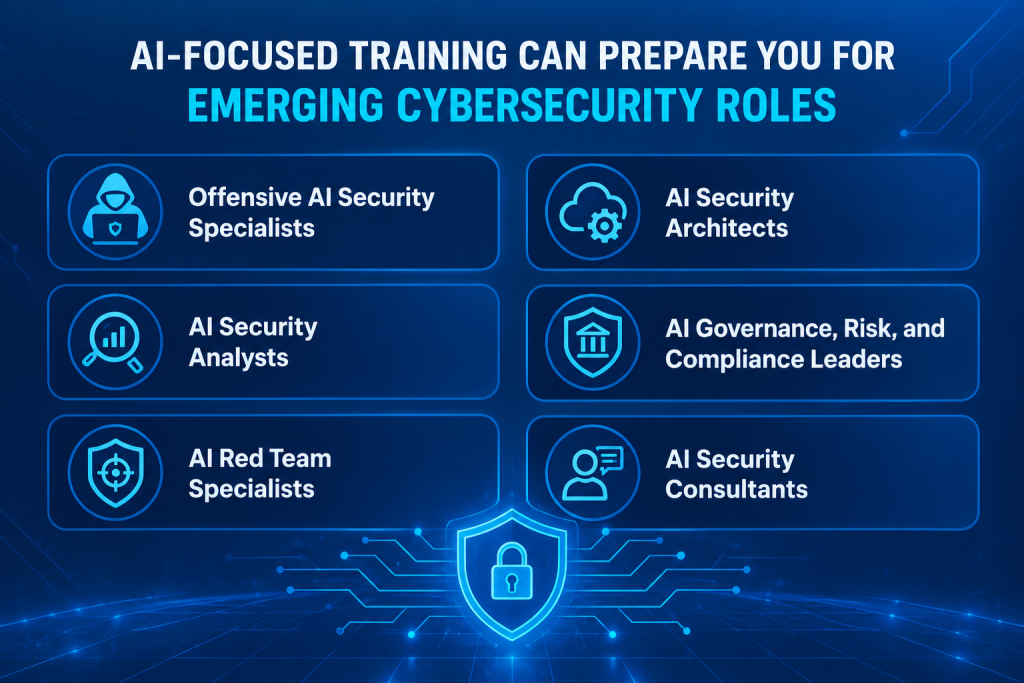
These roles involve securing AI applications, testing models against adversarial attacks, protecting sensitive data, and evaluating vulnerabilities in AI-powered workflows. Relevant certifications can help differentiate your professional profile when pursuing these opportunities. However, employers will also consider your practical experience, technical skills, and the requirements of each position.
2. Develop Practical AI Threat Detection and Defense Skills
AI-powered systems introduce security challenges that require specialized knowledge. Certifications that address AI security can help you understand prompt injection, data poisoning, model exploitation, sensitive information leakage, and attacks against AI agents.
You can apply this knowledge to evaluate AI applications, strengthen access controls, protect data pipelines, and identify weaknesses before attackers exploit them. These capabilities can complement your existing experience in security operations, penetration testing, incident response, vulnerability management, and application security.
3. Strengthen Offensive Security and Red-Team Expertise
Traditional penetration testing does not automatically cover every vulnerability introduced by AI models, retrieval-augmented generation (RAG) pipelines, and agentic workflows. Offensive AI security certifications can help you develop specialized skills to:
- Identify AI-specific attack surfaces.
- Test LLMs for prompt injection and jailbreak vulnerabilities.
- Red-team AI models to detect uncovered flaws.
- Evaluate insecure AI integrations and excessive agent permissions.
- Simulate adversarial attacks in authorized environments.
- Validate security controls and recommend remediation measures.
For penetration testers, ethical hackers, and red-team professionals, these capabilities can broaden the scope of their assessments and enable them to pursue specialized AI security assignments.
4. Improve Employability and Professional Differentiation
Employers need evidence that candidates can apply AI security practices in actual business operations, rather than understand them in theory. An AI-focused certification can demonstrate your commitment to professional development and provide structured evidence of specialized learning. Programs that include virtual practice labs, scenario-based assessments, and applied projects can offer additional value.
To strengthen your profile, combine certification training with demonstrable skills, documented projects, and a clear understanding of AI security frameworks. The objective is not simply to add another credential to your resume. It is to show employers how you can apply AI security knowledge to real organizational challenges.
5. Expand Career Progression and Leadership Opportunities
AI security is both a technical discipline and an organizational responsibility. Businesses need professionals who can assess AI risks, establish policies, oversee controls, and communicate security implications to leadership. Depending on your existing experience, AI-focused education can support progression toward security architecture, AI risk management, GRC leadership, AI program management, and responsible AI oversight.
Professionals who understand both technical security requirements and organizational governance can help translate complex AI risks into practical controls and informed business decisions.
6. Boost Earning Potential and Career Mobility
Specialized AI security expertise can help you compete for advanced job roles, expand your consulting services, or qualify for more complex security assignments. For example, a penetration tester could pursue AI red-team assessments, while a GRC professional could expand into AI risk and governance. A cloud security engineer could develop expertise in securing AI infrastructure, APIs, and integrated services.
However, a certification does not guarantee higher compensation, promotion, or employment. Your earning potential will depend on your experience, location, employer, demonstrable skills, and the responsibilities of your target role. Evaluate the return on investment by comparing certification costs, study time, and relevant job requirements with the opportunities available to you.
7. Build Adaptable Skills for the Future
AI application and attack methods continue to evolve. Professionals who regularly update their skills are better positioned to adapt to changing security requirements.
AI-focused certifications can help you develop a foundation in AI threat modeling, adversarial testing, secure deployment, governance, and continuous risk assessment. Combine this learning with established cybersecurity fundamentals and ongoing practical experience. This approach helps you remain adaptable as organizations introduce new AI systems and security challenges.
How to Choose the Right AI Cybersecurity Certifications
Before enrolling, evaluate each certification option against these five criteria:
- Define your career objective: Decide whether you want to specialize in offensive AI security, engineering, security operations, or governance.
- Evaluate the curriculum: Look for coverage of relevant AI vulnerabilities, security controls, current frameworks, and realistic attack scenarios.
- Prioritize practical learning: Hands-on labs, applied assessments, and real-world exercises can help you translate theoretical knowledge into workplace capabilities.
- Verify credential credibility: Research the certification provider, assessment requirements, recognition, and relevance to the roles you want.
- Consider the return on investment: Compare program costs and time commitments with job requirements, employer expectations, and opportunities to apply your new skills.
You should also consider whether the certification complements your existing credentials or helps you transition into a new specialization. Professionals with established cybersecurity experience may benefit from advanced, focused AI training rather than repeating foundational material.
State-of-the-Art AI Cybersecurity Certifications from ECCU
AI is reshaping the cybersecurity profession, creating opportunities for professionals who can secure AI systems and help organizations deploy them responsibly. The right certifications can help you develop specialized capabilities, strengthen your professional profile, and prepare for evolving responsibilities.
EC-Council University (ECCU) offers the following advanced AI-focused cybersecurity certification courses for professionals seeking to build expertise in these areas:
- The Certified Offensive AI Security Professional (C|OASP) certification focuses on identifying and testing AI vulnerabilities, assessing LLMs and AI agents, and applying offensive security techniques to strengthen AI defenses. It can help security practitioners expand their capabilities into AI red teaming and adversarial security testing.
- The Certified Responsible AI Governance & Ethics (C|RAGE) certification is dedicated to AI risk management, governance structures, ethical oversight, compliance, and assurance. It can help professionals develop the knowledge required to oversee AI systems responsibly and align organizational practices with relevant frameworks and standards.
Together, these certifications address complementary dimensions of AI security: testing and defending AI systems, and governing their responsible use. Choose the pathway that best aligns with your professional objectives, or explore both if your responsibilities span technical security and organizational governance. By investing in relevant AI-focused cybersecurity education, you can strengthen your technical or governance expertise, demonstrate your commitment to continuous learning, and prepare for new opportunities in increasingly AI-driven business environments.
For more information about ECCU’s AI-focused cybersecurity certifications:
Frequently Asked Questions About AI Cybersecurity Certifications
What are AI-focused cybersecurity certifications?
AI-focused cybersecurity certifications validate knowledge and skills related to securing AI systems, assessing AI-specific threats, testing models and applications, or managing AI governance and risk. Their scope varies by program and specialization.
Are AI-focused cybersecurity certifications worth it?
They can be valuable if they teach skills relevant to your career goals and include credible assessments or practical exercises. Evaluate the curriculum, recognition, cost, and employer requirements before enrolling.
Which AI cybersecurity certification is best for penetration testers?
An offensive AI security certification is a strong option for penetration testers seeking to assess LLMs, AI agents, and AI-powered applications. C|OASP is one program designed around these capabilities.
Which AI certification is best for GRC professionals?
A certification focused on responsible AI governance, risk management, ethics, and compliance may be the best fit. C|RAGE is designed for professionals seeking these capabilities.
Can AI cybersecurity certifications help increase salary?
They may improve your competitiveness for specialized roles, but they do not guarantee a salary increase. Compensation depends on your experience, location, employer, practical skills, and the responsibilities of the role.
Do I need AI or machine learning experience before pursuing an AI security certification?
Prerequisites vary. Some certification courses focus on applying security principles to AI systems, while others require deeper technical knowledge. Review the admission criteria and recommended background before enrolling.
Are AI cybersecurity certifications useful for experienced cybersecurity professionals?
Yes. Experienced professionals can use them to extend existing skills into AI red teaming, AI application security, secure AI engineering, risk management, or governance.
What is the difference between the C|OASP and C|RAGE certifications?
C|OASP focuses on offensive AI security, including testing AI systems and identifying vulnerabilities. C|RAGE covers responsible AI governance, ethics, risk management, and compliance. Your choice should reflect whether you want to specialize primarily in technical AI security testing or organizational AI oversight.