Entry-level cybersecurity jobs draw a big crowd of applicants. Most hold similar degrees and look identical on paper. So how does a hiring manager choose?
Often, they choose the person who can show real work. That is what a cybersecurity portfolio does. It is a living collection of documented, verifiable projects. It is not your resume repeated in a new format. Instead, it proves you can analyze, defend, investigate, and explain.
This guide shows bachelor’s students how to build one during their degree. You will learn what to include and what to leave out. You will also see how coursework becomes portfolio material, term by term. Done well, your portfolio helps you stand out before graduation.
Key Takeaways
- A degree shows you studied, while a portfolio shows you can work.
- Strong portfolios mix lab writeups, projects, and verified certifications.
- Your coursework already produces most of the raw material you need.
- A portfolio rushed in the final term always looks thin.
- Clear, sanitized writeups matter as much as technical skill.
- Link your portfolio everywhere you apply, and keep it fresh.
Why a Portfolio Matters More Than a Transcript
A transcript tells employers which courses you passed. It cannot show how you think under pressure. A portfolio can.
Hiring research backs this up. ISC2 surveyed hiring managers for its latest Hiring Trends Report. 89% of them would consider candidates with only entry-level certifications. Only 81% said the same about candidates with education alone. That gap says a lot about what employers value.
Job listings also keep asking for more experience. Our guide to credential inflation in cybersecurity explains why this happens. A portfolio answers that pressure with evidence. It also answers whether a bachelor’s degree alone is enough. Paired with real work, it usually is.
Soft skills count, too. In ISC2’s latest workforce study, problem solving topped managers’ lists at 29%. Good writeups show that skill better than any grade.
What Belongs in a Strong Cybersecurity Portfolio
Think of your portfolio as a small, tidy case file. Each piece should answer one question: what did you do?
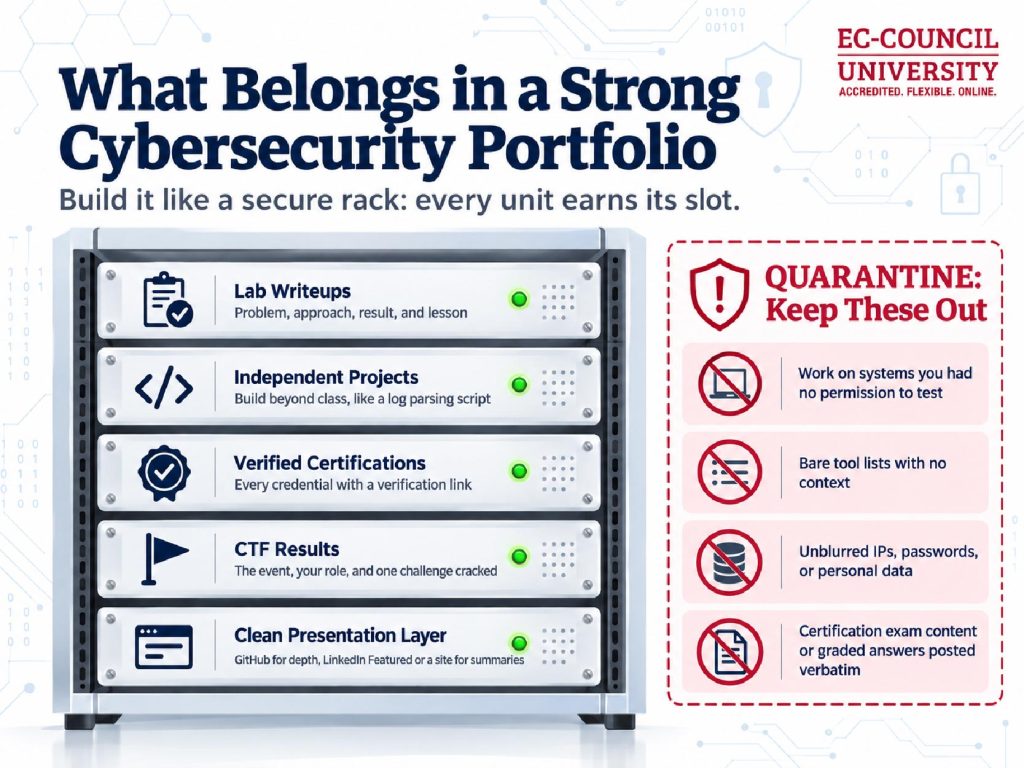
- Lab writeups. Document the problem, your approach, the result, and the lesson.
- Independent projects. Build something beyond class, such as a log parsing script.
- Verified certifications. List each credential with a verification link. Employers can check EC-Council credentials through its Aspen portal.
- CTF results. Note the event, your role, and one challenge you cracked.
- A clean presentation layer. Use GitHub for code and detailed writeups. Use a personal site or LinkedIn Featured for short summaries. Give every project a clear title and a one-paragraph summary.
Never post work from systems you had no permission to test. That includes a neighbor’s Wi-Fi or your employer’s servers. Skip bare tool lists, too. “Nmap, Wireshark, Metasploit” says nothing without context.
Blur IP addresses, passwords, and personal details in screenshots. Never share certification exam content, either. Candidates agree to keep it confidential. Finally, do not post graded lab answers word for word. Write your own analysis instead.
Turning BSCS Coursework Into Portfolio Material
ECCU’s Bachelor of Science in Cyber Security is a completer program. Students join with transferred credits, usually from an associate degree. Courses run in 10-week online terms. Virtual labs stay open whenever you want to practice. See how hands-on labs in online cybersecurity programs build real skill.
The degree also builds in up to six EC-Council certifications. Exam vouchers come included in tuition. So you collect third-party proof while you study. Our breakdown of the benefits of cybersecurity certifications explains why employers care.
Course order can vary, so confirm your plan with an advisor.
Before You Enroll
Early Terms: Foundations, CTIA, and CSA
Middle Terms: CND, CEH, and CHFI
Final Term: Your Flagship Piece
Common Mistakes Bachelor's Students Make
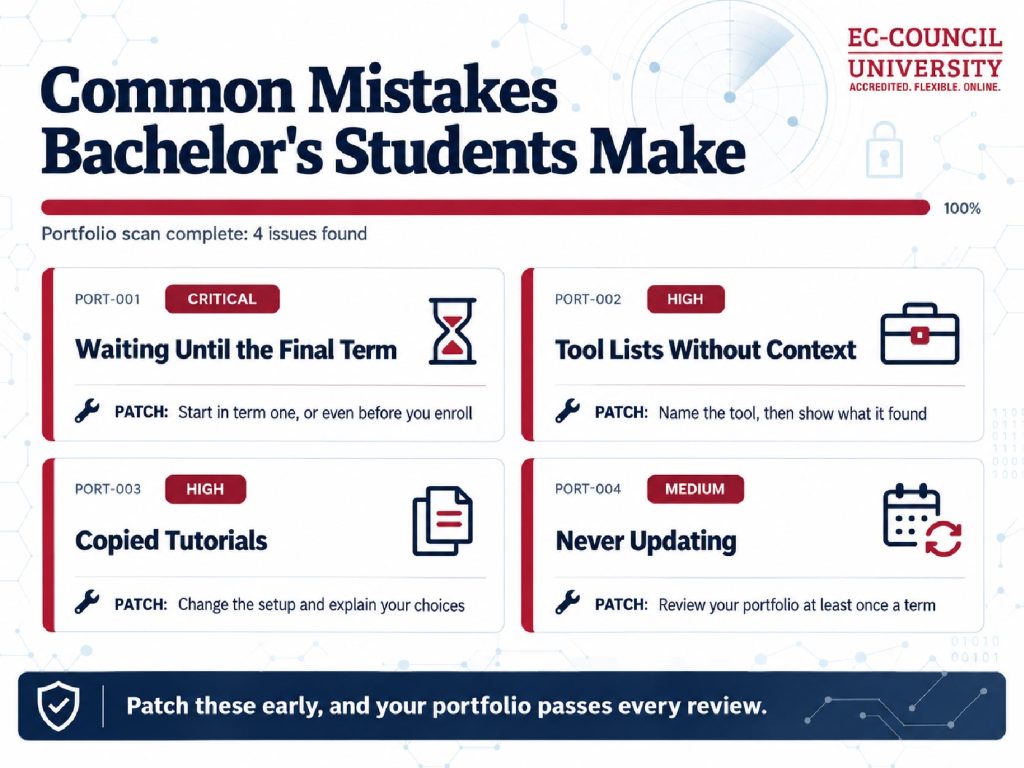
The biggest mistake is waiting. A portfolio started in the final term looks rushed.
Tool lists without context come next. Name the tool, then show what it found.
Copied tutorials also backfire. If you followed a guide, change the setup. Then explain your choices in your own words.
Finally, many students never update their portfolio. Stale pages suggest you stopped learning. Review yours at least once a term.
How Your Portfolio Connects to Your Job Search
Your portfolio strengthens every other part of your application. Link your best projects straight from your resume. These steps to build a cybersecurity resume show where links fit best.
Interviews get easier, too. You can walk through a real investigation instead of a hypothetical. Tag each project with the role it supports. Browse these entry-level cybersecurity roles for graduates to choose tags.
Certifications tie everything together. EC-Council issues CEH, CND, and CHFI, so employers can verify them independently.
Final Checklist Before You Apply
Run through this list before you send a single application:
- A handful of documented projects across different security domains
- At least one flagship piece, ideally your capstone or internship
- Recent updates, with no section left untouched for months
- A working verification link beside every certification
- Sanitized screenshots with no passwords, IPs, or personal data
- Your portfolio link on your resume, LinkedIn profile, and applications
Frequently Asked Questions
What is a cybersecurity portfolio and why do I need one?
It is a collection of documented, verifiable security work. It shows employers what you can actually do. That matters when many applicants hold similar degrees.
How do I build a cybersecurity portfolio with no work experience?
Start with labs, coursework, CTFs, and small independent projects. Document each one clearly. Employers care about demonstrated skill, not job titles alone.
What projects should I include in a cybersecurity portfolio as a student?
Aim for a mix of defensive, offensive, and forensic work. Alert triage writeups and lab pentest reports are strong picks. Forensic investigations and simple security scripts work well, too.
Should I use GitHub or a personal website for my cybersecurity portfolio?
Use both if you can. GitHub suits code, scripts, and detailed writeups. A personal site or LinkedIn Featured suits short, readable summaries.
How many projects should be in a cybersecurity portfolio?
Quality beats quantity every time. A handful of well-documented projects across several domains works well. Make sure at least one stands out as your flagship.
Can coursework and class labs count as portfolio projects?
Yes, as long as you add your own analysis. Avoid posting graded answers word for word. Explain your process and what you learned.
Do certifications like CEH belong in a cybersecurity portfolio?
Yes. They give employers third-party proof of your knowledge. Add a verification link beside each credential.
How early in a cybersecurity degree should I start building a portfolio?
Start in your first term, or even before you enroll. Early work shows growth over time. It also spares you a stressful final-term scramble.
What's the difference between a cybersecurity resume and a cybersecurity portfolio?
A resume summarizes your skills and history. A portfolio shows the actual work behind those claims. The best applications link the two.
How does ECCU's BSCS in Cybersecurity help students build a portfolio while still in school?
The program pairs its technical courses with virtual labs. Many of those labs turn naturally into writeups. The capstone or internship then becomes your flagship piece.