Firewalls Are Evolving to Keep Pace with Modern-Day Cybersecurity Requirements
For decades, firewalls have served as the first line of defense against cyber threats. They filtered network traffic, blocked unauthorized access, and helped organizations establish secure perimeters around their systems. However, the cybersecurity landscape of 2026 looks dramatically different from the one that shaped traditional firewall technology.
Today’s organizations operate across hybrid cloud environments, support remote and hybrid workforces, deploy AI-powered applications, and increasingly rely on autonomous AI agents. At the same time, cybercriminals are using AI to accelerate attacks, automate reconnaissance, and make social engineering campaigns more potent.
As a result, firewalls are undergoing their most significant transformation since the introduction of Next-Generation Firewalls (NGFWs). In 2026, the most innovative firewall technologies are becoming AI-aware, identity-aware, cloud-native, and capable of protecting generative AI systems.
Let’s explore the latest firewall trends reshaping enterprise security this year.
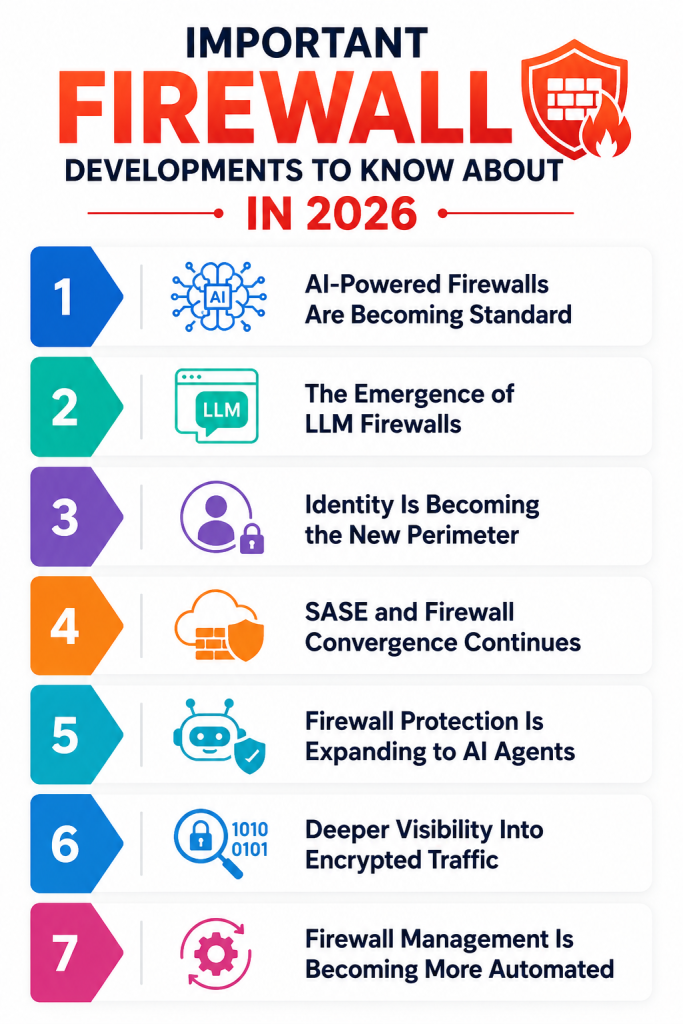
1. AI-Powered Firewalls Are Becoming Standard
Firewall vendors are integrating AI capabilities into their platforms to improve detection, automation, and response. Traditional firewalls relied heavily on predefined rules and known attack signatures. While these methods remain important, modern threats evolve too quickly for static defenses alone. Today’s AI-enhanced firewalls can:
- Detect unusual user behavior
- Identify previously unseen threats
- Prioritize high-risk alerts
- Recommend policy changes
- Automate incident response actions
The growing demand for AI-enabled security solutions is contributing to increased investment in firewall technologies. Industry analysts have noted that AI-driven data center growth is accelerating demand for advanced network security platforms and firewall infrastructure. For security teams facing staffing shortages and alert fatigue, AI-assisted firewalls can significantly improve operational efficiency.
2. The Emergence of LLM Firewalls
One of the most important cybersecurity developments of 2026 is the rise of the LLM firewall. As organizations rapidly deploy generative AI tools, AI copilots, chatbots, and autonomous agents, they face a new category of security risks that traditional firewalls were never designed to address.
According to research published by TechTarget (1), LLM firewalls have emerged as a dedicated security layer that monitors and protects interactions with large language models. These solutions help organizations defend against prompt injection attacks, data leakage, privilege escalation attempts, malicious code generation, and model misuse. An LLM firewall typically performs three critical functions:
- Prompt Inspection: Incoming prompts are analyzed for prompt injection attempts, jailbreak techniques, malicious instructions, and social engineering attacks.
- Response Inspection: Generated outputs are reviewed for sensitive information disclosure, regulatory compliance violations, toxic or harmful content, and intellectual property exposure.
- Agent Security Controls: As AI agents gain access to tools, databases, and business applications, LLM firewalls help enforce authorization policies and prevent unauthorized actions.
Industry analyst Christopher Rodriguez of IDC accurately summarized the importance of LLM firewalls:
“An LLM firewall is increasingly necessary as organizations roll out their own LLMs and LLM-enabled applications.”
As AI adoption accelerates, many experts believe LLM firewalls will become as essential as web application firewalls are today.
3. Identity Is the New Perimeter
The traditional network perimeter continues to disappear. Users now access applications from home offices, mobile devices, public networks, and multiple cloud environments. In response, firewall technologies are shifting toward identity-based security models.
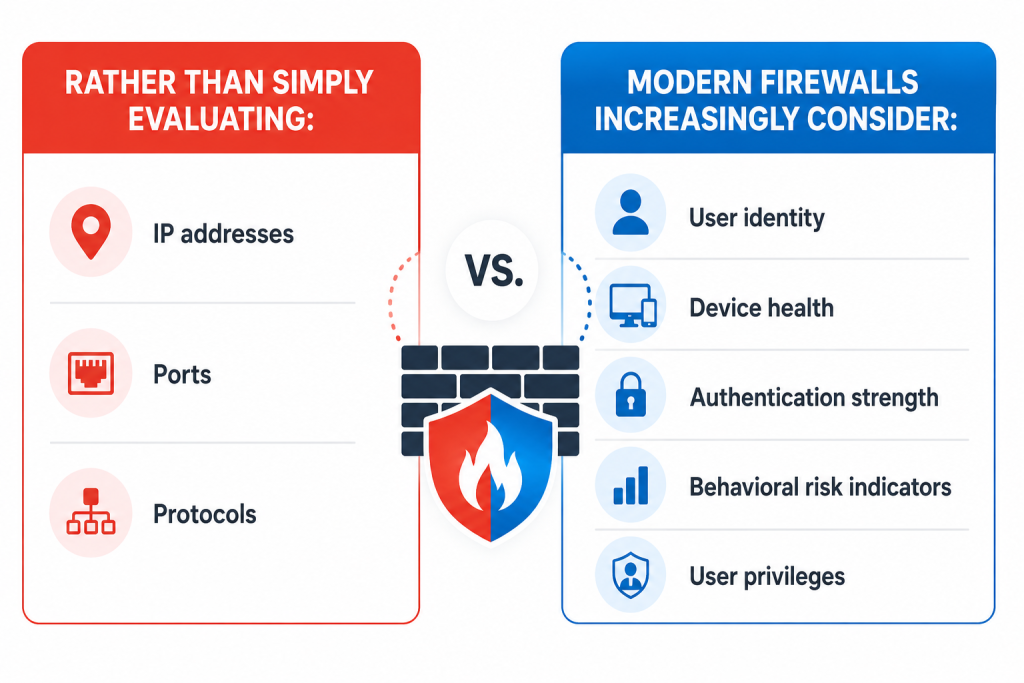
This shift aligns closely with Zero Trust security principles, which assume that no user or device should be trusted automatically.
4. SASE and Firewall Convergence Continues
Another major trend in 2026 is the continued convergence of firewall functionality with Secure Access Service Edge (SASE) architectures. Historically, organizations managed separate tools for firewalls, VPNs, Secure Web Gateways (SWGs), Cloud Access Security Brokers (CASBs), and SD-WAN. Today, many organizations are consolidating these technologies into unified cloud-delivered platforms.
The benefits include:
- Simplified management
- Consistent security policies
- Better visibility
- Improved scalability
- Reduced operational complexity
For organizations supporting distributed workforces, SASE-enabled firewall architectures have become increasingly attractive.
5. Firewall Protection Is Expanding to AI Agents
One of the most noteworthy cybersecurity concerns of 2026 involves autonomous AI agents. These systems can access business applications, query databases, execute workflows, interact with APIs, and make operational decisions independently. But while powerful, they also introduce new attack surfaces. As a result, modern firewall platforms are beginning to incorporate controls specifically designed to monitor and govern AI agent activity. These controls may:
- Restrict tool access
- Require human approval for sensitive actions
- Enforce least-privilege permissions
- Detect abnormal agent behavior
The 2026 firewall is increasingly responsible for protecting both human users and machine actors.
6. Deeper Visibility Into Encrypted Traffic
Encrypted traffic now dominates internet communications. While encryption improves privacy and security, it also creates challenges for defenders because attackers frequently use encrypted channels to conceal malicious activity.
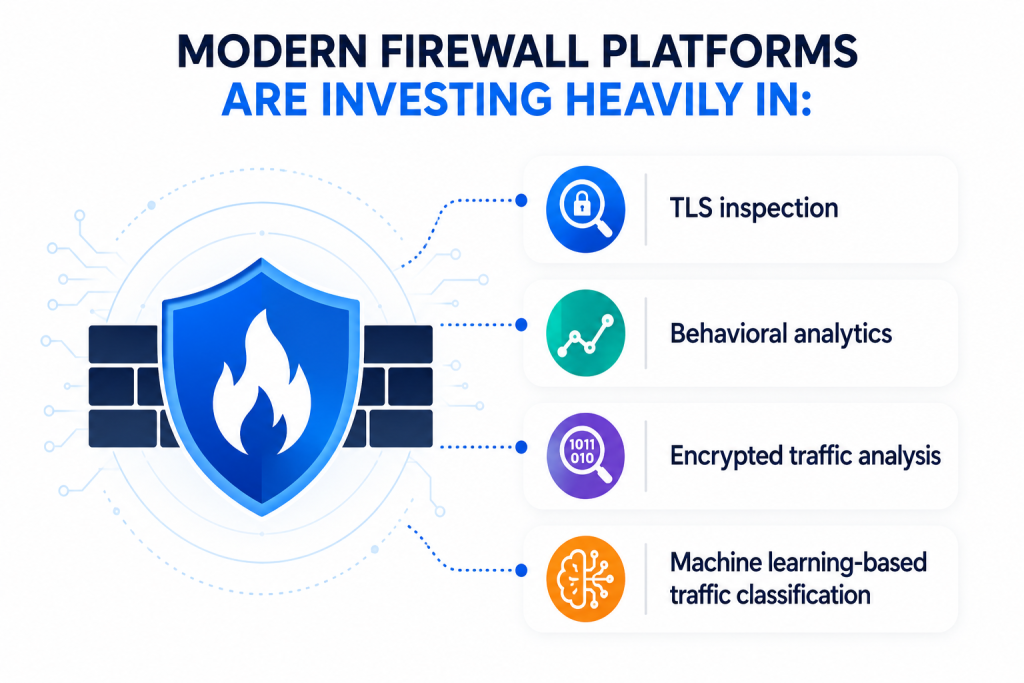
Rather than relying solely on packet contents, advanced solutions increasingly analyze traffic patterns, metadata, and behavioral indicators to identify suspicious activity hidden within encrypted communications. This capability is becoming increasingly important as ransomware groups and advanced threat actors continue to leverage encryption to evade detection.
7. Firewall Management Is Becoming More Automated
Firewall administration has traditionally been complex and time-consuming. Large enterprises often maintain thousands of firewall rules accumulated over many years, which is why misconfigurations remain one of the most common causes of security gaps. To address this challenge, vendors are increasingly introducing AI-assisted management capabilities that can:
- Analyze existing rules
- Detect redundant policies
- Recommend optimizations
- Translate natural language requests into configurations
This automation helps cybersecurity teams reduce complexity while improving policy consistency across hybrid environments.
The Future of Firewalls
Firewalls in 2026 look very different from the ones a decade ago. Instead of serving solely as a network traffic filter, today’s firewall platforms are comprehensive security enforcement systems that protect IT networks, cloud environments, applications, identities, AI models, and autonomous agents.
At the same time, business leaders must recognize that no firewall can solve every cybersecurity challenge. AI governance, identity security, and resilience planning are becoming equally important components of modern cybersecurity strategies. Organizations that embrace these next-generation firewall capabilities will be better positioned to defend against emerging threats while safely enabling innovation in AI, cloud computing, and other technologies.
Develop Advanced Firewall Expertise at EC-Council University
As firewall technologies evolve to incorporate AI, Zero Trust, cloud security, and autonomous agent protection, cybersecurity professionals must develop skills that extend far beyond traditional network defense.
EC-Council University (ECCU) equips learners with the knowledge needed to design, implement, optimize, and manage modern security architectures through world-class online degree programs and industry-recognized certification courses. Students gain practical experience in network security, ethical hacking and penetration testing, threat intelligence, cloud computing, cyber risk management, incident response, and much more. These core competencies support effective firewall deployment and administration. Our programs also explore frontier topics such as offensive AI security and AI governance, helping learners stay ahead of the latest firewall innovations.
Whether you’re advancing your career or preparing for leadership roles, ECCU provides the technical and strategic expertise needed to secure today’s increasingly complex digital environments. To know more about studying at ECCU:
Frequently Asked Questions About Firewalls in 2026
An LLM firewall is a security layer that monitors, filters, and controls interactions with large language models (LLMs). It helps prevent prompt injection attacks, data leakage, jailbreak attempts, and unauthorized actions by AI agents.
Firewalls are becoming AI-powered, identity-aware, cloud-native, and capable of protecting generative AI applications and autonomous agents. They increasingly integrate with Zero Trust and SASE architectures.
Traditional firewalls primarily analyze network traffic using predefined rules and signatures. AI-powered firewalls use machine learning and behavioral analytics to detect unknown threats, automate responses, and improve policy management.
AI agents can autonomously interact with databases, APIs, cloud services, and business applications. This means firewalls must now enforce permissions, monitor actions, and prevent unauthorized activities performed by these systems.
SASE combines networking and security services, including firewalls, SD-WAN, CASB, SWG, and Zero Trust controls, into a unified cloud-delivered platform that protects users and applications regardless of location.
No. Traditional firewall functions remain essential, but modern organizations increasingly require advanced capabilities such as AI-powered threat detection, identity-based access control, cloud security integration, and AI application protection.