An Overview of SASE
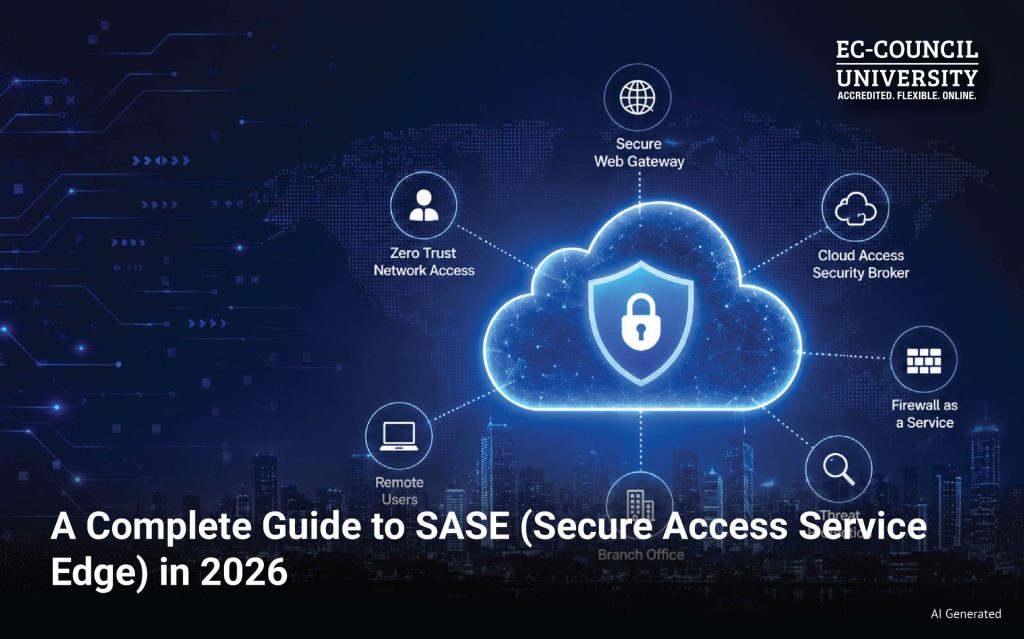
Organizations no longer operate within the confines of a traditional corporate network. Employees work remotely, applications are cloud-based, and business data moves continuously across multiple environments. As a result, security architectures built around centralized data centers and perimeter defenses are struggling to keep pace. This shift has accelerated the adoption of Secure Access Service Edge, or SASE for short.
SASE is considered one of the most transformative cybersecurity frameworks of the modern era. Introduced by Gartner in 2019, it combines networking and security services into a unified cloud-delivered architecture that protects users, devices, applications, and data regardless of location. Rather than forcing traffic through centralized security appliances, SASE delivers security controls directly from the cloud, closer to users and applications.
In this article, we’ll examine how SASE works, why organizations are adopting it, how it supports Zero Trust security, and why cybersecurity professionals should develop SASE expertise. Let’s dive in.
What Is SASE?
SASE (Secure Access Service Edge) is a cloud-native cybersecurity framework that converges networking and security capabilities into a single service. Gartner analyst Neil McDonald coined the term to describe the convergence of software-defined networking and cloud-delivered security technologies. Rather than treating networking and security as separate functions, SASE integrates them into a unified platform that can be managed centrally while enforcing policies consistently across users, devices, and locations.
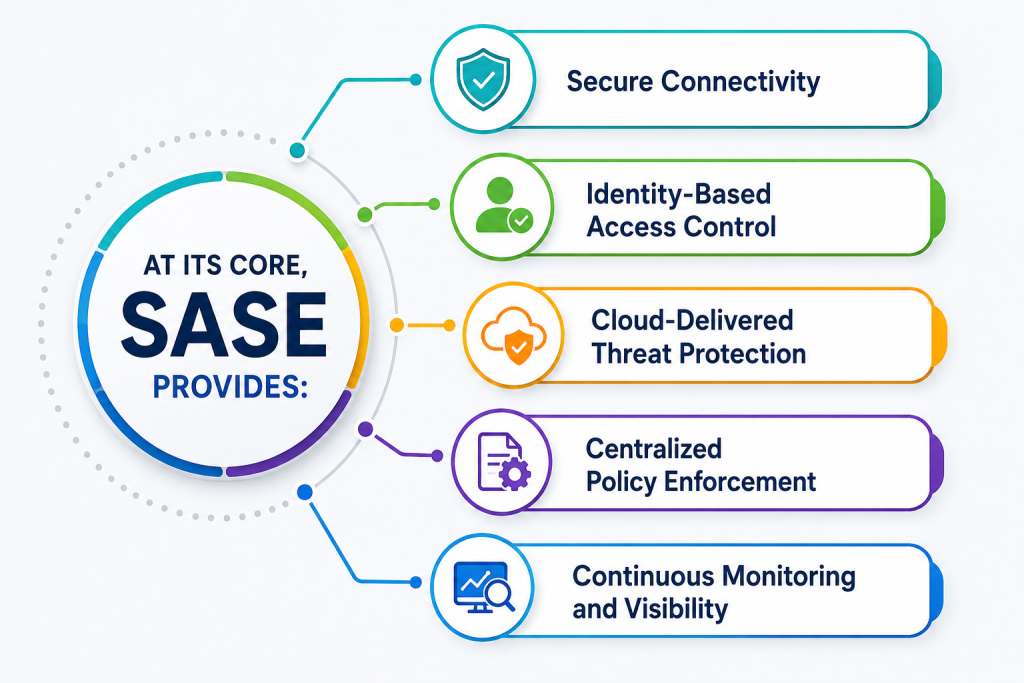
This architecture enables organizations to secure digital operations regardless of whether employees are working from headquarters, home offices, branch locations, or while traveling.
Why SASE Was Created
Traditional security architectures were designed for a bygone era. For decades, organizations operated under a hub-and-spoke model in which users, applications, and data primarily resided within a corporate network. Security teams protected this environment using firewalls, VPNs, and perimeter defenses.
However, digital transformation fundamentally changed how businesses operate. Modern organizations now rely on:
- Remote and hybrid workforces
- Cloud-first infrastructure
- Software-as-a-Service (SaaS) applications
- Mobile devices and users
- Multi-cloud environments
As applications moved to the cloud and users began accessing resources from virtually anywhere, routing traffic through centralized VPN gateways created performance bottlenecks, management complexity, and security gaps. SASE emerged to address these challenges by bringing security controls closer to users and applications while enabling direct, secure cloud access. Gartner describes SASE as a model designed specifically for cloud, mobile, and edge-driven enterprises.
Core Components of SASE
A SASE platform combines both networking and security technologies:
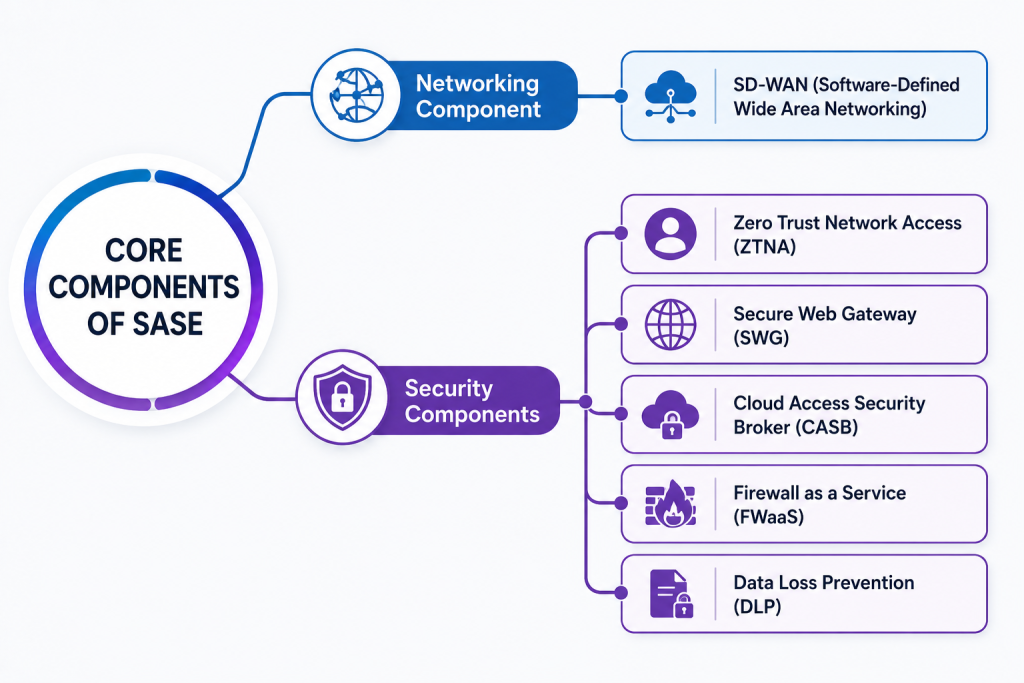
Networking Component of SASE
- SD-WAN (Software-Defined Wide Area Networking)
SD-WAN forms the networking foundation of SASE. It optimizes traffic routing across networks, improves application performance, reduces latency, and enhances reliability through Intelligent Path Selection. By dynamically selecting the best network path, SD-WAN ensures users receive optimal performance when accessing cloud services and business applications.
Security Components of SASE
- Zero Trust Network Access (ZTNA)
ZTNA replaces traditional VPNs with a more secure access model. Instead of granting broad network access, ZTNA verifies user identity, evaluates device security posture, grants access only to authorized applications, and continuously validates trust levels. This diminishes the odds of unauthorized access and lateral movement.
- Secure Web Gateway (SWG)
SWG protects users while browsing the internet. Its capabilities include web traffic inspection, malware filtering, URL filtering, and prevention of malicious downloads. By inspecting traffic in real time, SWGs help prevent web-based attacks before they reach users.
- Cloud Access Security Broker (CASB)
CASBs provide visibility and control over cloud applications. They help organizations discover shadow IT, monitor SaaS usage, enforce compliance policies, and protect sensitive cloud-stored data. As SaaS adoption continues to rise, CASBs have become critical for cloud governance.
- Firewall as a Service (FWaaS)
FWaaS delivers enterprise-grade firewall capabilities from the cloud. The benefits of FWaaS include consistent security policies everywhere, simplified deployment, centralized management, and scalability without hardware upgrades.
- Data Loss Prevention (DLP)
DLP solutions can prevent sensitive information from being exposed or stolen. Their capabilities include data classification, content inspection, policy-based controls, and prevention of unauthorized data transfers.
Together, these technologies form the security foundation of modern SASE platforms.
Key Principles of SASE
While implementations vary, most SASE architectures are built on these core principles:
- Cloud-Native Security Delivery: Security services are delivered directly from the cloud rather than through on-premises hardware.
- Identity-Centric Access Control: Identity becomes the primary security perimeter rather than the network location.
- Zero Trust Security: Users and devices are never automatically trusted. Every access request must be verified.
- Continuous Authentication and Verification: Trust is continuously evaluated throughout a session, not only at login.
- Policy-Based Enforcement: Security decisions are automated through centralized policies.
- Unified Management and Visibility: Administrators gain a centralized command dashboard for managing networking and security operations.
Main Benefits of SASE
SASE brings the following benefits to organizations:
- Improved Security: SASE significantly strengthens organizational security by reducing the attack surface, enforcing Zero Trust principles, securing remote users, and enabling continuous monitoring. Because access is based on identity and context, attackers face greater difficulty exploiting compromised credentials or gaining broad network access.
- Better VPN User Experience: Traditional VPNs often create frustrating user experiences. SASE improves VPN performance through direct-to-cloud access, intelligent traffic routing, reduced latency, and elimination of VPN bottlenecks. Users gain faster access to applications while maintaining strong security.
- Simplified Management: Many organizations manage numerous disconnected security tools. SASE consolidates access control, web security, cloud security, firewall management, and data protection. This reduces complexity and administrative overhead.
- Scalability: Because SASE is cloud-delivered, organizations can scale rapidly. Whether adding new users, branch offices, cloud environments, or remote workers, the SASE architecture can expand without major infrastructure investments.
- Cost Efficiency: Organizations often realize cost savings by reducing hardware purchases, simplifying operations, lowering maintenance costs, and consolidating vendors. SASE’s cloud-native delivery eliminates many expenses associated with legacy infrastructure.
Common SASE Use Cases
Organizations deploy SASE in a variety of scenarios:
- Securing Remote and Hybrid Workers: SASE enables secure access regardless of user location.
- Replacing Legacy VPNs: ZTNA offers more granular, secure access than traditional VPNs.
- Protecting Cloud and SaaS Applications: CASB and SWG capabilities help secure cloud workloads and applications.
- Supporting Digital Transformation: SASE aligns security with cloud-first business initiatives.
- Securing Branch Offices: Organizations can protect distributed offices without deploying extensive hardware.
- Enabling Secure Third-Party Access: Contractors, vendors, and partners can receive limited access to specific resources.
- Protecting Multi-Cloud Environments: SASE provides consistent security policies across multiple cloud providers.
How SASE Supports Zero Trust
Zero Trust is now a vital pillar of modern cybersecurity strategies.
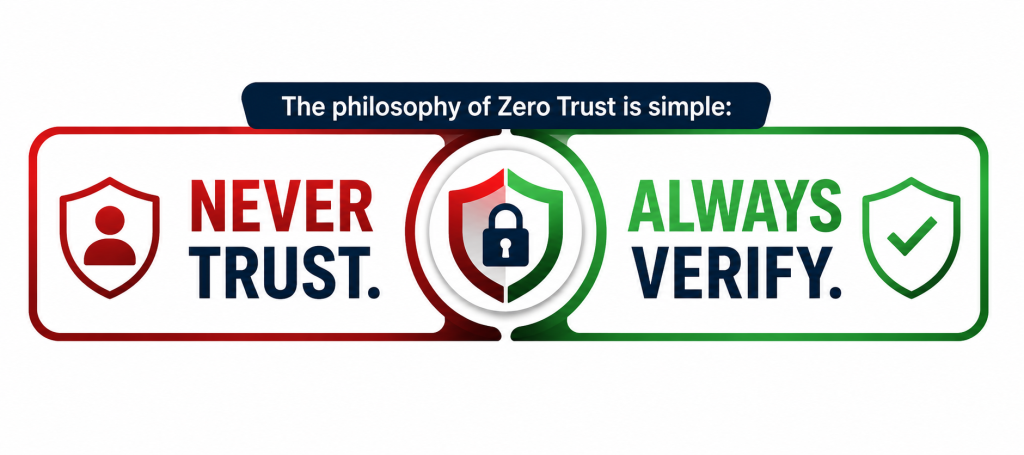
SASE operationalizes Zero Trust principles by enabling organizations to:
- Verify Users Continuously: Authentication does not end after login, and risk is continuously evaluated.
- Authenticate Devices: Only trusted, compliant devices are granted access.
- Enforce Least-Privilege Access: Users receive only the permissions necessary to perform their roles.
- Monitor Behavior in Real Time: Anomalous behavior can trigger additional verification or access restrictions.
- Restrict Lateral Movement: Application-level access prevents attackers from freely moving across networks after compromise.
By combining identity, context, and continuous monitoring, SASE creates a practical framework for implementing Zero Trust at scale.
Challenges of SASE Adoption
Despite its benefits, adopting SASE is not without challenges.
- Legacy Infrastructure Integration: Many organizations still operate older systems that were not designed for cloud-native security models.
- Identity Management Complexity: Strong identity governance is essential for successful SASE deployments.
- Vendor Selection: The SASE market contains numerous vendors with varying capabilities. Choosing the right platform requires careful evaluation.
- Policy Migration: Existing security policies often require modernization and restructuring.
- User Training and Change Management: Employees and administrators must understand new access methods and security workflows.
Organizations that invest in planning and phased implementation are generally more successful in overcoming these obstacles.
Future Trends in SASE (2026 and Beyond)
The SASE landscape continues to evolve rapidly, and several emerging trends are shaping its future:
- AI-Driven Threat Detection and Response: AI is increasingly being used to identify threats, automate investigations, and accelerate incident response.
- Deeper Identity Security Integration: Identity is becoming the primary security control point, driving tighter integration between SASE and identity security platforms.
- Enhanced Support for Autonomous AI Agents: As organizations deploy AI agents within business workflows, SASE platforms will need to secure machine identities and agent communications.
- Post-Quantum Cryptography: Organizations are beginning to prepare for a future in which quantum computing may threaten current encryption methods, making post-quantum cryptography an emerging consideration.
- Unified SASE and SSE Platforms: Vendors continue consolidating networking and security capabilities into more integrated offerings.
- Self-Healing Security Architectures: Automation will increasingly enable systems to identify, isolate, and remediate threats with minimal human intervention.
Why Cybersecurity Professionals Should Learn SASE
SASE has rapidly become one of the most valuable skill sets in enterprise cybersecurity because it sits at the intersection of several high-demand disciplines, such as cloud security engineering, network security, Zero Trust architecture, Identity and Access Management (IAM), and security operations. Organizations are looking for professionals who understand how these domains work together within modern cloud-native environments.
As businesses continue embracing remote work, SaaS applications, and multi-cloud strategies, demand for SASE expertise is also growing substantially. For cybersecurity professionals who seek career advancement, developing expertise in SASE can provide a significant competitive advantage.
At EC-Council University (ECCU), our advanced cybersecurity degrees and certification courses help learners become proficient in both strategic and technical SASE knowledge and skills, qualifying them for relevant high-paying cybersecurity roles. To know more:
Frequently Asked Questions About SASE
SASE stands for Secure Access Service Edge, a cloud-delivered architecture that combines networking and security services into a unified platform.
In many organizations, SASE solutions use Zero Trust Network Access (ZTNA) to replace traditional VPNs. ZTNA provides application-specific access rather than broad network connectivity, improving security.
Security Service Edge (SSE) focuses primarily on security services such as SWG, CASB, ZTNA, and DLP. SASE includes SSE capabilities plus networking services such as SD-WAN.
SASE enables continuous verification of users and devices, least-privilege access, real-time monitoring, and application-level security controls that align closely with Zero Trust principles.
Cybersecurity architects, network engineers, cloud security specialists, security analysts, IAM professionals, and C-level cybersecurity leaders can all benefit from developing SASE expertise.
No. Organizations of all sizes can benefit from SASE. Small and mid-sized businesses often use SASE to simplify security management while improving protection for remote users and cloud applications.