Cybersecurity professionals face a recurring question: should you pursue a certification or a degree? The CISSP and an MSCS both carry weight in the industry. Both can open doors. But they are built for different purposes, and chasing the wrong one at the wrong stage can cost you time, money, and momentum. This blog breaks down what each credential actually gives you, where each one falls short on its own, and why the smartest career paths tend to combine both.
Key Takeaways
- CISSP validates what you already know; an MSCS builds what you don’t yet have.
- You need five years of paid experience before CISSP certifies you.
- An accredited MSCS can satisfy up to one of those five required years.
- Federal and defense roles increasingly require graduate-level credentials for advancement.
- ECCU embeds industry certifications directly into its MSCS coursework.
- The strongest cybersecurity CVs carry both a degree and a certification stack.
- Choosing one over the other is a timing question, not a quality question.
What Each Credential Actually Represents
The CISSP is a vendor-neutral certification governed by ISC2. It tests knowledge across eight security domains, from risk management to software development security. To earn it, candidates must complete at least five years of paid, full-time work experience across two or more of those domains. Passing the exam without that experience earns you Associate of ISC2 status, giving you six years to close the gap. The CISSP does not teach you security from scratch. It confirms that you already know it.
An MSCS is a different animal. It is an accredited graduate degree, awarded after completing structured coursework, applied labs, and capstone projects across 12 courses over roughly two years. Where the CISSP measures a defined body of knowledge, the MSCS builds new capability. It adds depth in specialization, breadth across domains, and the kind of research and leadership fluency that exams rarely develop.
The CISSP at a Glance
The CISSP is widely considered the gold standard for senior security practitioners. ISC2 reports over 168,000 active holders globally. The exam covers eight domains using adaptive testing, running between 125 and 175 questions over three hours. Once certified, holders must earn 120 CPE credits every three years and pay a $135 annual maintenance fee to stay active.
Employers value the CISSP as a screening signal. In 2026, there are over 70,000 US job listings explicitly requiring the credential. It functions as a baseline filter for senior security roles, not a starting point for building expertise.
Practical Note: Holding a qualifying graduate degree in a related field can reduce the CISSP experience requirement by up to 1 year, meaning 4 years of qualifying work experience instead of 5. Only one such waiver applies, so a degree and a certification cannot be combined to reduce the total by 2 years.
The MSCS at a Glance
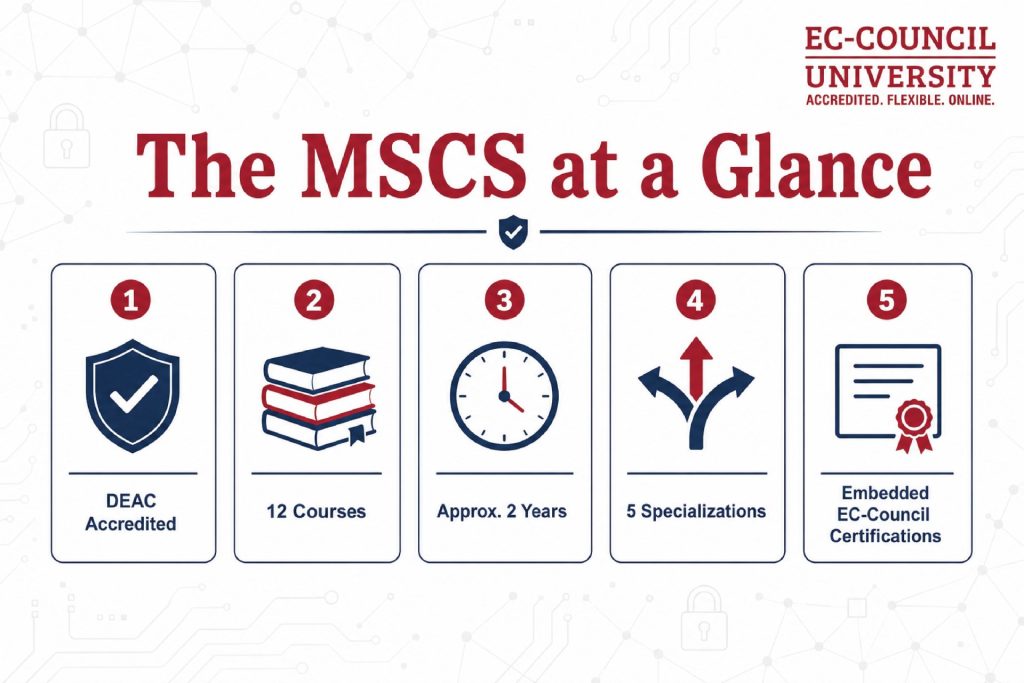
EC–Council University’s MSCS is accredited by DEAC, recognized by both the US Department of Education and CHEA. The program spans 12 courses and runs for approximately two years. Students choose one of five specialization tracks:
- Security Analyst
- Cloud Security Architect
- Digital Forensics
- Incident Management and Cyber Operations
- Executive Leadership in Information Assurance
Each track embeds three to five EC-Council certification exam vouchers directly into the coursework, including CEH, CND, CHFI, CPENT, CCISO, and others, depending on the specialization. Students are not paying for exam prep separately. The preparation is the degree itself.
Credit transfer adds flexibility. Up to 18 graduate credit hours can transfer into the program. Of those, up to 9 can come from existing EC-Council certifications like CEH or CND. If you have already invested in those credentials, that investment converts into academic credit and shortens your time to graduation.
How the Learning Actually Differs
A certification exam confirms what you already know. A graduate degree builds what you do not yet have.
The CISSP rewards breadth and a managerial mindset. Experienced candidates who prepare well can pass within a few months of focused study. The exam tests whether you can think like a security leader, not whether you can build one from scratch. That is its strength and its ceiling.
Graduate coursework works differently. Labs, capstone projects, and written deliverables develop skills that no exam can replicate: structuring a risk analysis, leading a forensic investigation, communicating security posture to executives, and reading threat intelligence critically. These are the skills that matter at the director and CISO level.
ECCU’s virtual labs give students 24/7 access to real-world simulation environments. Graduates leave with a project portfolio, not just a certificate. That distinction matters when two candidates have the same credentials on paper.
The AI dimension is worth noting here. ECCU integrates AI security into its curriculum, including AI governance certifications like CAIPM and CRAGE in relevant specializations. The CISSP’s 2024 updated exam outline also weaves AI governance concepts across all eight domains. Both paths are evolving to meet the same emerging threat landscape. A degree, however, gives you the structured space to reason through it rather than just recognize it. For a deeper look at how ECCU approaches this, the AI in Cybersecurity Master’s Degree page is worth reading.
Career Mobility and Long-Term ROI
Where each credential opens doors matters more than the credential itself.
The CISSP accelerates access to senior technical and managerial roles. Certified professionals report an average salary of around $131,000 in the US. That is a strong number. But certifications rarely satisfy the criteria for federal senior leadership roles or satisfy grade advancement in government contexts without an accompanying academic credential.
For federal and defense hiring, a graduate degree carries real weight. Under the DoD Cyber Workforce Framework (DCWF), a qualifying education credential from an accredited institution can satisfy the foundational qualification requirement for assigned work roles, provided the curriculum covers the relevant core knowledge areas. ECCouncil certifications embedded in the MSCS are recognized under DoD 8140 across 31 DCWF work roles.
The BLS reports the 2024 median salary for information security analysts at $124,910. For computer and information systems managers, that figure rises to $171,200. The degree is often what separates analyst-track professionals from those who move into management. According to ECCU’s own disclosure data, 1 in 2 MSCS graduates earns an annual salary above $100,000.
Mid-career professionals who stall around $110,000 to $125,000 without a graduate degree are a documented pattern in this field. The degree is frequently what breaks that ceiling. For more on that trajectory, Is a Master’s in Cybersecurity Worth It? lays out the case in detail.
Why It Does Not Have to Be Either/Or
The candidates who position themselves best hold both. The sequencing matters.
Here is what a realistic path looks like at three career stages:
- Career changer: Start with the MSCS. Use it to build the foundational knowledge and earn embedded certifications during coursework. The degree provides the structured entry that jumping straight to certifications cannot.
- Mid-career IT professional: Pursue the MSCS while accruing the qualifying work experience for CISSP. By the time you graduate, you may already be at the four or five-year experience mark. You arrive at the CISSP exam with academic depth and a credential stack already in place.
- Aspiring leader: The MSCS’s Executive Leadership in Information Assurance specialization directly targets CISO-track positioning. Add CISSP after you hit the experience gate. Pair that with the CCISO certification that ECCU embeds into that specialization, and you have an unusually strong combination for senior hiring panels.
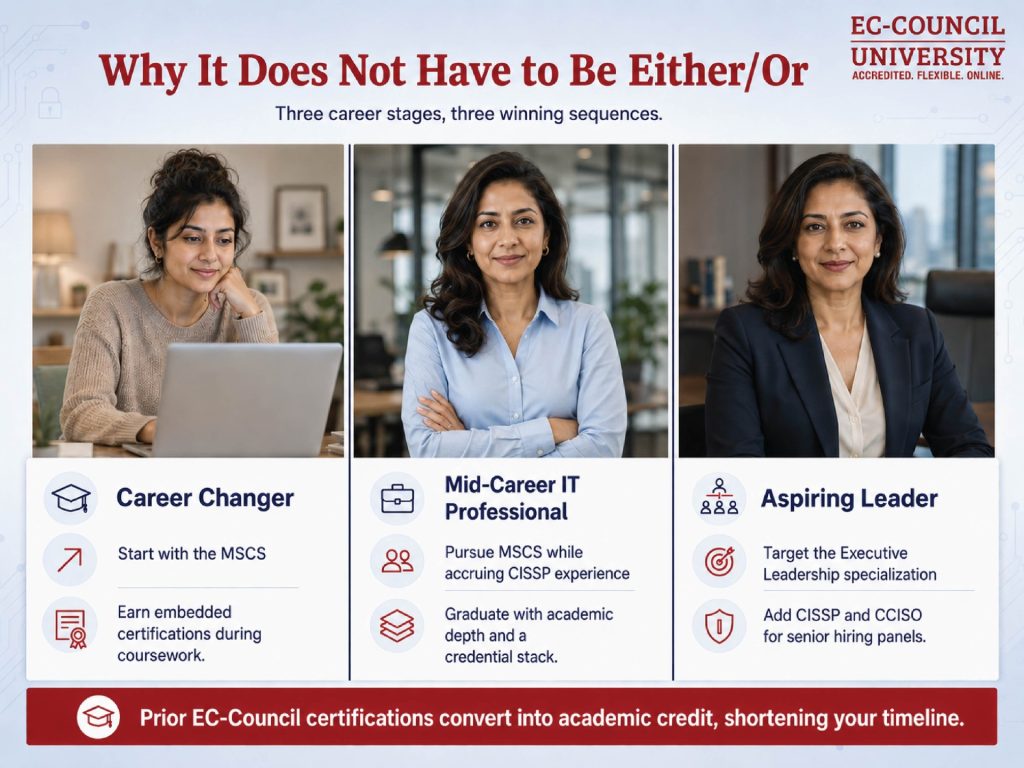
The ECCU credit transfer policy also rewards those who already hold EC-Council certifications. Previous credentials do not go to waste. They convert into academic credit that shortens the degree timeline and reduces the overall cost of the investment.
A useful overview of where each degree can take you professionally is available at Top Career Options with a Master’s in Cybersecurity.
Conclusion
The CISSP and an MSCS are not rivals. They answer different questions at different points in a career. One validates what you already know. The other builds what you will need next. The professionals who treat them as a sequence rather than a choice tend to go further, faster.
Frequently Asked Questions
Neither is universally better. The CISSP validates experience and domain knowledge for senior technical roles. An MSCS builds the governance, leadership, and research depth that leadership roles actually require. Most high-performing cybersecurity professionals eventually hold both, and the right one to pursue first depends on where you are in your career.
Yes, and it is actually a smart approach. You can enroll in ECCU’s MSCS while actively building the work experience required for CISSP. By the time you graduate, you may already meet the five-year experience threshold, putting you in a strong position to sit the exam without delay.
Yes. Each of the five specialization tracks embeds three to five EC-Council certification exam vouchers directly into the coursework at no additional cost. Depending on your specialization, these include credentials like CEH, CND, CHFI, CPENT, CCISO, CAIPM, and CRAGE.
It depends on the role and sector. For federal, defense, and national infrastructure positions, a graduate degree often carries more weight in hiring panels and supports work-role qualification under DoD 8140. For technical senior roles in enterprise settings, CISSP is frequently mandated. At the director and CISO level, employers typically expect both.
The standard program is 12 courses completed over approximately two years. Students who transfer eligible graduate credits, including credits from qualifying EC-Council certifications, can significantly reduce that timeline, potentially completing the degree in 12 to 18 months.