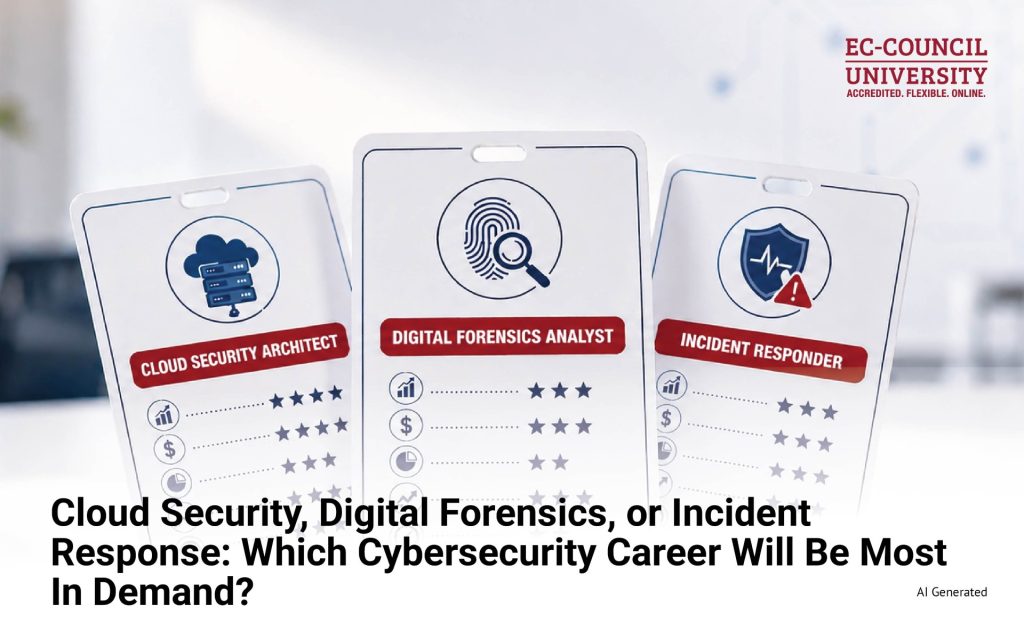
Cybersecurity offers more than one way in. Cloud security, digital forensics, and incident response sit at the center of that choice, and each pulls from a different instinct. One is architectural. One is investigative. One runs on adrenaline and quick decisions. This piece breaks down what each path actually demands, where the market is pulling hardest right now, and how ECCU’s MSCS specializations map onto that reality. The goal is not to crown one winner and move on. It is to help you match your strengths to a track that still makes sense five years from now.
Key Takeaways
- Cloud security currently holds the strongest demand and the highest pay ceiling.
- Digital forensics does meaningful work, but its salary data is inconsistent across sources.
- Incident response has the largest volume of open roles right now.
- AI is already compressing entry-level SOC and triage work.
- All three tracks share a technical core you can build on later.
- ECCU maps each path to a distinct MSCS specialization and certification set.
- Personal fit matters just as much as market demand.
Why Specialization Now Beats Being a Generalist
Attack surfaces have fragmented, and hiring managers have noticed. Over 90% of organizations report real skills gaps, even with thousands of open roles on the table. That gap is not about headcount. It is about depth. A resume that reads “cybersecurity generalist” competes poorly against one that reads “cloud security” or “digital forensics.” If you are already weighing a security analyst role against a cloud security architect track, that comparison alone shows how differently the two paths pay and progress. Specialization gives you a defined lane, and defined lanes are what get shortlisted.
Cloud Security: Securing the New Perimeter

Cloud migration created a new kind of exposure, and organizations are still catching up to it. Misconfigurations, sprawling multi-cloud setups, and shared-responsibility confusion keep this specialization at the top of hiring lists.
Core roles: cloud security architect, cloud security engineer, identity and posture management specialist.
Skills that define the track:
- Zero trust design and identity access management
- Container and serverless security
- Cloud-native logging and monitoring across providers
ISC2 now ranks cloud security as the second most in-demand skill in the field, right behind AI. Cloud-related roles are projected to grow 25 to 26% through 2034, against a 4% average across all occupations. Demand for the AWS Security Specialty certification alone jumped 73% in a single year. Salaries for cloud security engineers typically land between $120,000 and $160,000 a year. ECCU’s Cloud Security Architect specialization builds directly toward this track, with labs covering enterprise and cloud infrastructure defense.
Digital Forensics: Following the Evidence

This track sits closer to investigation than infrastructure. Litigation, insider threat cases, ransomware recovery, and regulatory inquiries all keep forensic work steady, even if it moves at a different pace than cloud hiring.
Core roles include forensic analyst, incident investigator, and expert-witness support work. The skill set centers on evidence handling and chain of custody, plus disk, memory, and network forensics. If you are weighing whether this path is worth a dedicated master’s degree in 2026, the case largely comes down to how much you value investigative depth over infrastructure work.
Here is an honest caveat. The Bureau of Labor Statistics does not track digital forensics as its own category. It gets folded into information security analyst roles, projected to grow 29% through 2034, or into forensic science technicians, projected at 13% growth with a median wage of $67,440. Salary estimates from other sources vary widely too. The work is real and growing, but the data on it is genuinely messier than for cloud or incident response. ECCU’s Digital Forensics specialization aligns with the CHFI body of knowledge and covers mobile forensics, evidence preservation, and cyber law.
Incident Response: First on the Scene
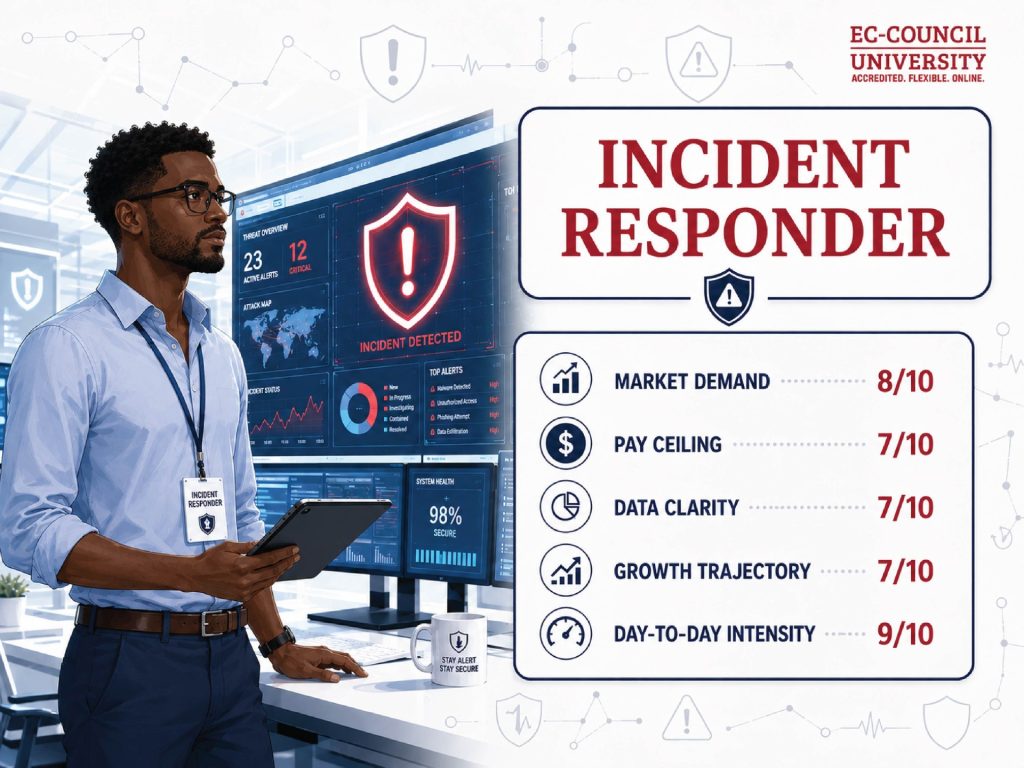
Breach frequency, SOC maturity, and tightening disclosure timelines all feed this track. It is where most people enter defensive cybersecurity, and incident responders remain among the most in–demand hires in the field today.
Core roles: incident responder, SOC analyst, threat hunter, IR lead. The skill set includes triage, containment, threat intelligence, and post-incident review, all covered in more depth in this guide to managing cyber incident response.
SOC analyst postings rose 31% year over year, and the sheer volume of entry points makes this track accessible. But there is a real shift underway. AI-augmented SOC tools are shrinking repetitive alert triage, the exact task that used to define entry-level work here. Investigation and oversight are growing instead. It is also the most demanding track day to day. 44% of cybersecurity professionals report severe stress or burnout, much of it concentrated in SOC and IR seats. ECCU’s Incident Management and Cyber Operations specialization covers incident handling, disaster recovery, and business continuity.
Side-by-Side: Outlook, Pay, and Day-to-Day
- Cloud security: highest pay ceiling, strongest and cleanest demand data, steady architectural work.
- Digital forensics: meaningful investigative work, softer and less consistent market data, more litigation-driven.
- Incident response: most open roles today, highest stress levels, entry-level work under AI pressure.
The NICE Framework translates each of these into concrete hiring language employers already recognize, which is worth reviewing once you narrow your choice.
How to Choose, and Why You May Not Have To
Ask yourself a simple question first. Do you want to build systems, investigate evidence, or respond in real time? That instinct usually points you in the right direction faster than any salary chart.
Here is the good news. A graduate degree builds a shared core across all three. Network defense, ethical hacking fundamentals, and risk management show up in every ECCU specialization. That means an early choice does not lock you in permanently. Professionals move from incident response into forensics, or from forensics into cloud security, once they have a few years of experience behind them.
Conclusion
If pure market pull and pay potential matter most to you, cloud security is currently the strongest bet. If your interests already lean toward investigative or legal work, forensics remains a solid, purposeful path despite messier data. If you want the widest entry point and don’t mind a demanding pace, incident response still opens the most doors.
Compare ECCU’s MSCS specialization pages and talk to an admission advisor to see which track actually fits your goals.
Frequently Asked Questions
Cloud security currently has the highest pay ceiling of the three, driven by acute talent shortages in multi-cloud and zero-trust environments. Digital forensics and incident response pay well too, but their salary bands run lower and vary more by employer and region.
Certifications alone can open entry-level doors in either field. A master’s degree becomes more useful once you are aiming for architect, lead, or management-level roles that expect deeper credentials.
Yes. All three tracks share core cybersecurity fundamentals, and professionals regularly move between forensics, incident response, and cloud security as their interests and experience shift.
The Incident Management and Cyber Operations specialization is built for this track, covering incident handling, disaster recovery, and business continuity planning.
Yes. All three specializations map to real hiring needs in federal and defense environments, particularly incident response and digital forensics, where investigative and compliance work is constant.