
A cybersecurity master’s degree can open real doors. But the tuition bill stops many qualified candidates before they even apply. Most people do not walk away because the coursework scares them. They walk away because nobody hands them a clear plan to pay for it. This guide breaks down how to actually fund a cybersecurity master’s degree. It covers scholarships, employer support, military benefits, credit transfer, and how to think about the investment itself. By the end, you will have a realistic path forward, not just a list of options.
Key Takeaways
- Treat tuition as an investment, not just a bill.
- Scholarships can meaningfully cut your cost, but eligibility varies by scholarship.
- Employer tuition assistance can cover a full course tax free every year.
- Military tuition assistance rarely covers a full course alone.
- Certifications you already hold can convert into real course credit.
- Stacking multiple funding sources works better than relying on one.
Start With ROI, Not Sticker Price
Sticker price scares people. ROI tells a different story. The real question is not what the degree costs. It is what it returns over a career. A master’s in cybersecurity often unlocks leadership tracks, specialist pay bands, and roles that a certification alone cannot reach. At ECCU, roughly 1 in 2 graduates report salaries above six figures, based on the university’s own disclosure data. That number will not hold true for every student. But it reframes the conversation. Instead of asking “Can I afford this?” ask “What does this unlock, and over what timeframe?”
Scholarships and Grants
Scholarships rarely cover a full degree, but they add up when you stack them. Here is what is actually available at the master’s level, and who qualifies:
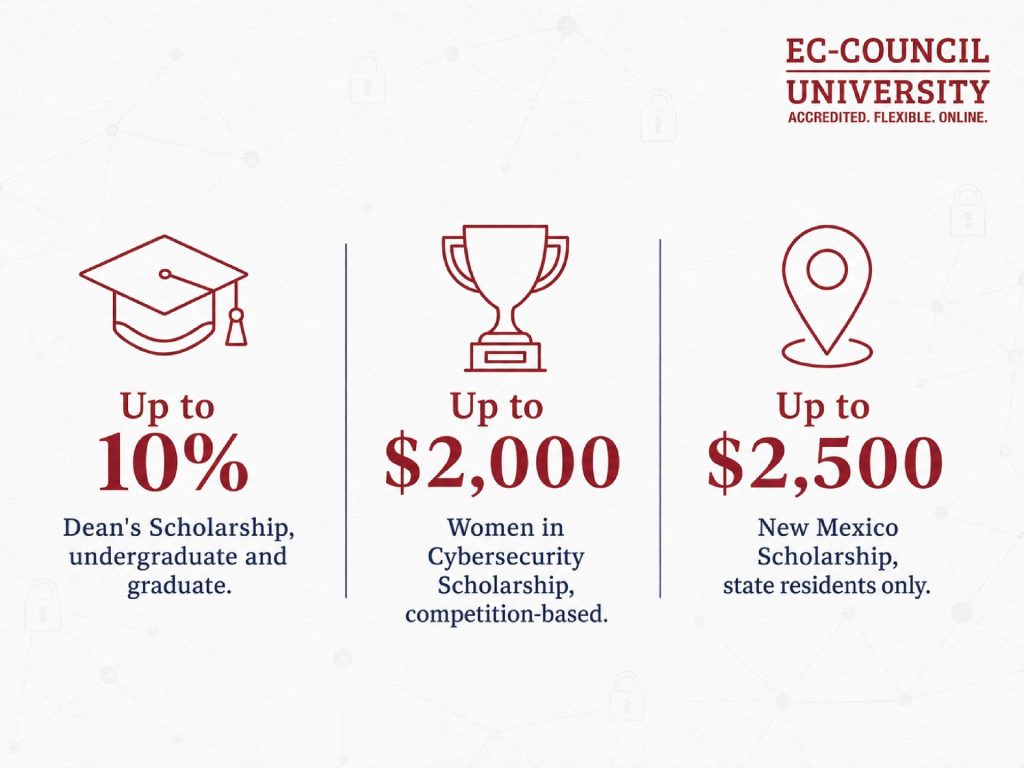
- Dean’s Scholarship: covers 10% of tuition for academically strong applicants at both the bachelor’s and master’s level. This is your broadest option.
- Women in Cybersecurity Scholarship: worth up to $2,000, awarded to women who place in an EC-Council recognized cybersecurity competition.
- New Mexico Scholarship: a one-time $2,500 award, but only for verified New Mexico residents.
Scholarships are awarded case by case. Talk to an Enrollment Advisor early, since some awards can be combined and others cannot.
Employer Tuition Assistance
Most working professionals overlook this option, and it is often the biggest lever available. Under IRS Section 127, employers can pay up to $5,250 per year toward an employee’s education, tax-free, for undergraduate or graduate coursework. On ECCU’s per-course pricing, that comfortably covers three courses a year. To win sponsorship, frame the ask around business impact. Show how coursework maps to real skill gaps on your team, and use the language your employer already recognizes, such as the NICE Cybersecurity Workforce Framework, to describe what the degree builds toward.
Military and Veteran Benefits
Military tuition assistance pays up to $250 per credit hour, capped at $4,500 per fiscal year, so it usually covers part of a course rather than the whole thing at ECCU’s percredit rate. The Post-9/11 GI Bill goes further and can fund most or all of a master’s degree, depending on your remaining entitlement and pace of study. ECCU is approved to accept GI Bill benefits and works with a dedicated veterans team to walk through eligibility.
For a full breakdown of how these two benefits differ and interact, see our GI Bill vs. Tuition Assistance guide.
Cut Costs With Transfer Credit
If you already hold industry certifications, do not start your degree from zero. ECCU allows up to 18 semester credit hours of graduate transfer credit from prior learning and qualifying certifications, out of the 36 credits required for the MSCS. That can shave close to a year off your timeline and cut a proportional share of tuition. Certifications from EC-Council itself, along with other recognized credentials, are evaluated individually against ECCU’s course map, so the exact credit awarded depends on what you already hold.
Build Your Personal Funding Plan
A funding plan works best when you build it in order, not all at once.
- Estimate your net cost after any scholarships you are likely to qualify for.
- Confirm what your employer will cover, and get it in writing before you enroll.
- Check your military entitlement, if applicable, and how many months remain.
- Apply any transfer credit first, since it changes your total cost.
- Sequence remaining funding sources by certainty, using the most reliable ones first.
- Pace your terms around your work schedule, not the other way around.
Conclusion
Financing a cybersecurity master’s degree is rarely about finding one silver bullet. It is about stacking the right combination of scholarships, employer support, benefits, and credit transfer for your specific situation. Visit ECCU’s financial assistance and scholarships pages to see what applies to you, and talk to an Enrollment Advisor to build a funding plan around your actual numbers, not averages.
Frequently Asked Questions
ECCU’s MSCS runs roughly $19,440 to $20,440 in total tuition, depending on specialization track, plus miscellaneous fees. Exact per-course pricing is listed on ECCU’s tuition page.
Master’s applicants can pursue the Dean’s Scholarship, the Women in Cybersecurity Scholarship, and the New Mexico Scholarship for state residents, among others. Awards are decided on a case-by-case basis, so eligibility depends on your background.
Yes. Many employers offer tax-free tuition support under IRS Section 127, up to $5,250 a year. Building a business case around workforce needs improves your odds of approval.
Military tuition assistance covers part of a course, while the Post-9/11 GI Bill can cover most or all of the degree, depending on entitlement. ECCU accepts both and has a dedicated veterans team.
Master’s students can transfer up to 18 of the 36 required credit hours through qualifying certifications and prior learning. That can cut the program’s cost and timeline.