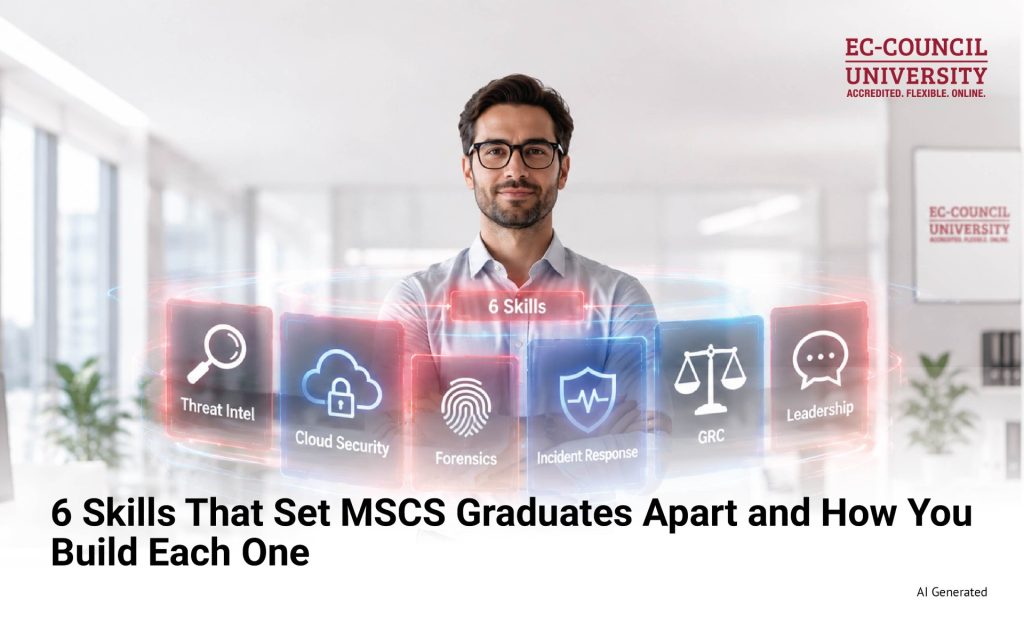
A cybersecurity master’s degree gets you an interview. It rarely gets you the job on its own. What separates hired candidates from passed-over ones is not the diploma. It is the durable, transferable skills behind it. This piece breaks down six skills that matter most. They show up again and again in job descriptions and promotion conversations. It also shows how ECCU’s MSCS program builds each one. That happens through specialization tracks, hands-on labs, and a capstone project. Think of the degree less as a line on your resume. Think of it as the engine that builds those skills.
Key takeaways
- Employers hire for skills, not just credentials.
- Skills mapped to NICE work roles translate directly to a resume.
- The strongest candidates can prove skills, not just claim them.
- ECCU’s five specializations each build a distinct, job-ready skill set.
- Certifications sit inside coursework, not bolted on afterward.
- Hands-on labs and a capstone project turn theory into applied practice.
Skill 1: Advanced Threat Analysis and Intelligence
Anyone can run a scanner and read the output. Fewer people can explain what the output means for the business. That gap defines the difference between an analyst and a strategist. Advanced threat analysis means connecting technical indicators to real organizational risk. It means anticipating the next move, not reacting to the last one.
ECCU builds this skill through analysis-heavy coursework and dedicated threatintelligence labs. Students pursue Security Analyst-track credentials like CEH, CND, and CPENT. They practice vulnerability assessment and penetration testing in live lab environments. The Certified Offensive AI Security Professional (COASP) credential adds a newer layer. It covers how AI-driven attacks change the threat landscape. The capstone project then applies this analysis to a real case, not a hypothetical one from a textbook.
Skill 2: Architecting Secure Systems (Cloud and Zero Trust)
Patching after a breach is expensive and reactive. Designing systems that assume compromise from the start is not. That is the logic behind zero trust architecture. It is reshaping how organizations build infrastructure. We covered this shift in more depth in our 2026 cybersecurity skills guide.
ECCU’s Cloud Security Architect specialization builds this skill directly. Students learn to plan, configure, and defend both on-premise and cloud systems. Coursework covers secure programming practices that catch bugs before deployment, not after. Students work toward the Certified Application Security Engineer (CASE) credential. They also pursue the Certified Cloud Security Engineer (CCSE) credential. Both map directly to real hardening and architecture work.
Skill 3: Digital Forensics and Investigation
A breach without a clean investigation trail is just a mess. A breach with proper forensic documentation becomes usable evidence. It can hold up in court or an audit. That distinction matters more than most technical teams realize.
ECCU’s Digital Forensics specialization is built around this exact skill. Coursework covers network intrusion investigation, mobile forensics, and digital evidence preservation. It maps closely to the CHFI certification body of knowledge. That stands for Certified Hacking Forensic Investigator. Students also work toward CEH and CND credentials alongside CHFI. The goal is not just finding what happened. It is proving what happened, in a way that survives scrutiny.
Skill 4: Incident Response and Operational Tempo
A breach does not wait for a convenient time. Response speed and structure decide how much damage it causes. Panic is not a strategy. A rehearsed playbook is.
ECCU’s Incident Management and Cyber Operations specialization builds this under pressure. Students train in incident handling, disaster recovery, and business continuity planning. They work toward the EC-Council Disaster Recovery Professional (EDRP) credential. They also pursue the EC-Council Certified Incident Handler (ECIH) credential. Simulations recreate the pressure of a live incident, not a classroom exercise. This operational tempo now matters as much as technical depth, a shift we unpack further in our guide to staying ahead in cybersecurity.
Skill 5: Governance, Risk, and Compliance Fluency
Technical fixes do not mean much to a board without context. GRC fluency means translating risk into language executives understand. It also means knowing which framework applies where.
ECCU builds this through risk and compliance coursework tied to real frameworks. Students learn to map roles against the NICE Workforce Framework. They also study the DoD Cyber Workforce Framework, known as DCWF. Coursework toward the CCISO credential reinforces this fluency. That stands for Certified Chief Information Security Officer. It is one of the certifications embedded in the Executive Leadership specialization. Auditors, regulators, and boards all speak in frameworks. Fluent graduates do not need a translator.
Skill 6: Security Leadership and Communication
The best technical mind does not always win the budget argument. The person who can explain risk clearly usually does. Leadership in cybersecurity is not just about managing people. It is about managing understanding.
ECCU builds this through core leadership coursework across the program. Students practice written and strategic communication throughout their coursework. The capstone defense forces students to present findings to a real audience. The Executive Leadership specialization adds credentials like CAIPM and CRAGE. CAIPM stands for Certified AI Program Manager. CRAGE covers responsible AI governance and ethics. Both reflect how AI now sits inside leadership conversations, not just technical ones.
How to Demonstrate These Skills to Employers
A resume claim is cheap. Proof is not. Global cybercrime costs are projected to reach $10.5 trillion in 2026, and employers no longer take skills on faith.
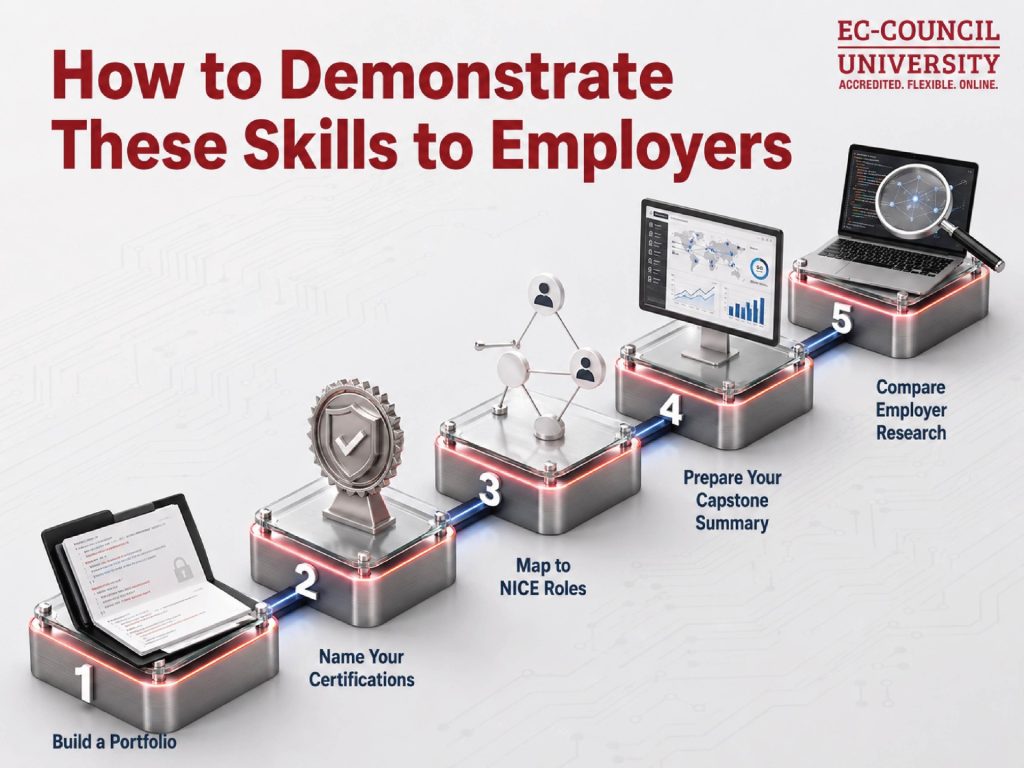
Here is how to prove yours:
- Build a portfolio from real capstone work, not class assignments.
- Name your certifications directly on your resume.
- Map your specialization to NICE work roles employers already search for.
- Keep a short summary of your capstone defense ready for interviews.
- Compare notes with what employers want. It covers skills computer science graduates need too, even outside a cybersecurity specialization.
Conclusion
Six skills, five specializations, one degree built to produce both. That is the real value of ECCU’s MSCS program. The credential opens the door. The skills behind it keep you in the room.
See how ECCU’s MSCS curriculum and specializations build each of these skills in detail. Request the program brochure and start mapping your own path.
Frequently Asked Questions
Employers want proof of applied skill, not just credentials. That means threat analysis, secure architecture, incident response, and GRC fluency. It also means explaining risk clearly to non-technical stakeholders.
ECCU’s MSCS leans heavily practical. Hands-on labs and embedded certifications apply theory throughout the program. The capstone project does the same at the end.
ECCU uses virtual labs available anytime, plus live weekly classes. Simulation environments mirror real security incidents closely. Certifications are built into coursework instead of studied separately.
GRC fluency and clear communication matter most for leadership roles. The ability to translate technical risk into a business decision matters too. That is what separates a CISO candidate from a strong analyst.
Lean on capstone artifacts, embedded certifications, and specialization coursework as evidence. Map your coursework to NICE work roles on your resume. That signals applied skill even without years on the job.