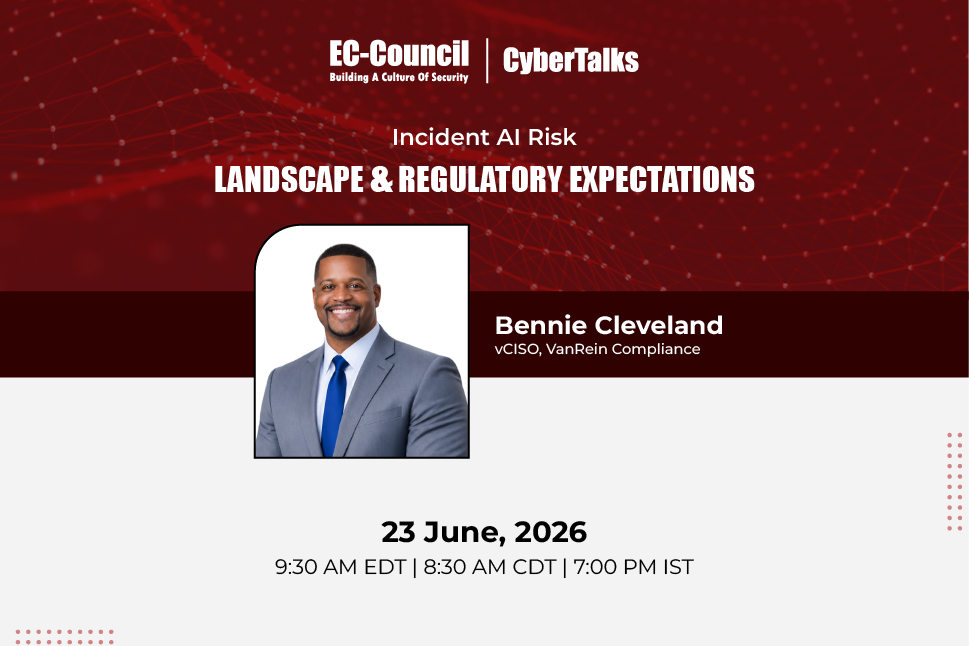
Date: June 23, 2026
Time: 9:30 AM EDT | 8:30 AM CDT | 7:00 PM IST
Topic: Incident AI Risk Landscape & Regulatory Expectations
Abstract:
AI adoption is growing rapidly across industries like healthcare, finance, and insurance. But with this growth comes a new set of risks, ranging from data privacy and bias to security and compliance. Many organizations struggle to clearly understand these risks or keep up with evolving regulations.
This session breaks down the AI risk landscape in simple terms. It introduces widely used frameworks such as NIST AI RMF and ISO 42001, along with sector-specific regulations like HIPAA. The focus is on helping you connect these guidelines to real-world governance practices, assess your organization’s readiness, and move from reactive compliance to proactive AI governance.
By the end of the session, you’ll have a clear understanding of AI-related risks, regulatory expectations, and practical steps to start building a strong AI governance foundation within your organization.
Key Takeaways:
- Understand key AI risks: ethical, operational, legal, and reputational
- Learn how frameworks like NIST AI RMF, ISO 42001, and HIPAA guide governance
- Identify gaps in your organization’s AI readiness and maturity
- Align regulatory expectations with business and compliance needs
- Build a risk-aware foundation for AI strategy and adoption
Speaker:
 Bennie Cleveland, vCISO, VanRein Compliance
Bio: Bennie Cleveland is a seasoned cybersecurity executive and enterprise risk strategist with more than 20 years of experience leading cybersecurity, compliance, incident response, disaster recovery, AI governance, and resilience programs across financial services, healthcare, life sciences, SaaS, higher education, insurance, retail, and technology sectors.
In his current role at VanRein Compliance, Bennie serves as a vCISO, cybersecurity advisor, and auditor, bringing hands-on leadership across cybersecurity governance, disaster recovery, incident response, penetration testing, audit readiness, and regulatory compliance. He helps organizations strengthen their security posture by assessing risk, validating controls, identifying vulnerabilities, improving resilience, and aligning security programs with frameworks such as NIST, HIPAA, HITRUST, SOC 2, ISO 27001, and industry best practices. Bennie brings both strategic executive guidance and practical execution, helping clients move from compliance gaps and security uncertainty to measurable risk reduction, audit readiness, and operational resilience. He helps organizations assess risk, strengthen security posture, validate technical controls, prepare for audits, and align cybersecurity programs with business objectives, regulatory requirements, and operational resilience goals.
His work spans leading frameworks and standards, including NIST AI RMF, ISO/IEC 42001, NIST CSF, HIPAA, HITRUST, ISO 27001, SOC 2, GDPR, and related governance requirements. Bennie focuses on translating technical, operational, and AI-driven risk into practical business controls, executive decision-making, and audit-ready evidence.
Bennie holds a broad portfolio of credentials, including but not limited to: CCISO, CISM, CISA, CRISC, CGEIT, CHFI, CEH, PMP, EDRP, AAIA, AIGP, and CIPM, reflecting his depth across cybersecurity leadership, governance, risk, compliance, audit, penetration testing, incident response, disaster recovery, privacy, and emerging AI audit practices. He is known for bridging strategy and execution by helping organizations move from reactive compliance to proactive, measurable cyber and AI governance programs.