Introduction (ICYMI): Escalation, Perception, and the Limits of Control
Part 2 examined how cyber conflict extends beyond the digital domain into real-world consequences.
We learned that cyber operations are not confined to networks. They can affect critical infrastructure, financial systems, and even physical assets. The Stuxnet example demonstrated that cyber capabilities can produce kinetic effects without traditional military force.
More importantly, escalation in cyberspace is not driven by intent, but by perception. Because cyber operations obscure intent and operate in conditions of ambiguity, defenders are often forced to interpret actions through a worst-case scenario lens. An intrusion may be seen as espionage or as preparation for an attack. This uncertainty creates nonlinear escalation pathways, where a single cyber incident can trigger:
- Economic sanctions
- Diplomatic crises
- Military posturing
In such an environment, escalation becomes a web of interconnected reactions across domains, and this raises a critical strategic question:
If cyber conflict is continuous, ambiguous, and prone to unpredictable escalation, how do states maintain stability?
The answer lies in how cyber strategy has evolved.
Rather than relying solely on deterrence or reactive responses, states are increasingly adopting persistent engagement to manage escalation in real time. This approach reflects a shift from attempting to prevent all cyber activity to actively shaping the environment in which it occurs.
Watch Julie Beck’s deep dive episode on cyber conflict, escalation, and persistent engagement:
Part 3 builds on this foundation by examining how persistent engagement is operationalized, why legal frameworks remain insufficient, and what this means for the future of cyber stability in an era of continuous digital conflict.
Operationalizing Persistent Engagement
Persistent engagement is not merely a theoretical construct. It is actively implemented through a set of operational practices:
- Defending forward involves positioning capabilities closer to adversary networks to enhance early threat detection.
- Disruption at source seeks to interfere with malicious activity before it matures into operationally significant threats.
- Friction imposition introduces continuous obstacles that degrade adversary efficiency, increase operational costs, and reduce overall effectiveness.
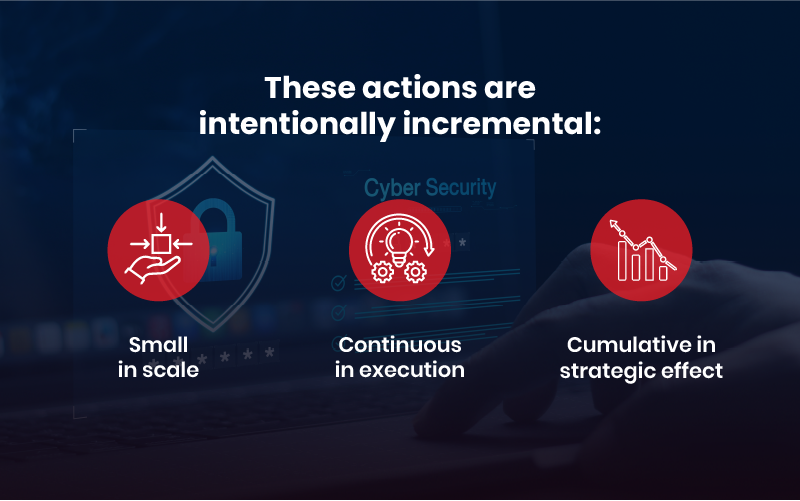
The objective is not decisive victory in a singular engagement, but the gradual shaping of adversary behavior over time.
Legal Ambiguity and the Expansion of the Gray Zone
Cyber conflict unfolds within a legal framework that remains fragmented and underdeveloped. There is no universal consensus on fundamental questions:
- What constitutes a cyber “attack”?
- When is the right to self-defense triggered?
- How should proportionality be assessed in digital operations?
This absence of clarity has significant implications. States increasingly operate within a “gray zone” below the threshold of armed conflict, where behavior is governed less by formal legal constraints and more by evolving norms and strategic practice.
In this context, persistent engagement emerges not simply as a strategic preference, but as a functional necessity.
Cyber Conflict as Continuous Strategic Competition
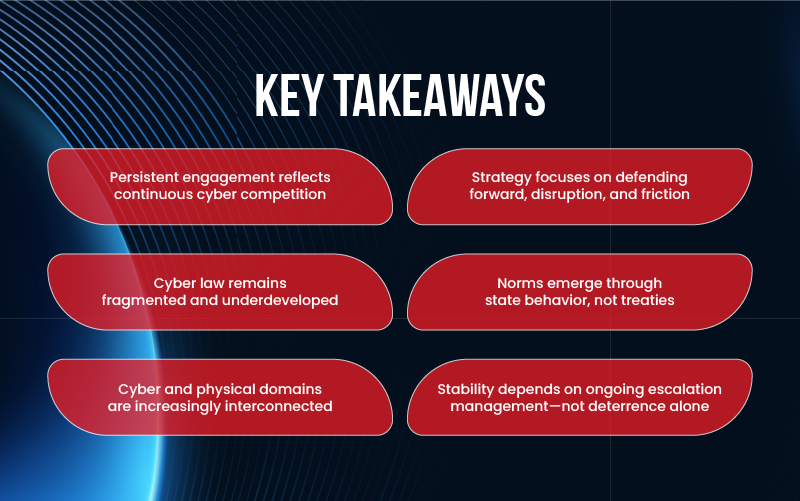
Taken together, these dynamics point to a fundamental conclusion: cyber conflict is persistent, not episodic.
It unfolds under conditions of:
- Continuous interaction
- Endemic ambiguity
- Legal indeterminacy
Strategic stability, therefore, is no longer achieved through static deterrence or clearly demarcated red lines. Instead, it is produced through ongoing engagement and the careful management of escalation dynamics.
Strategic Implications
Several implications follow for policymakers and practitioners:
- Cyber operations can produce tangible, real-world consequences across critical systems
- Escalation dynamics are shaped more by perception than by demonstrable intent
- Significant strategic competition occurs below conventional thresholds of war
- Legal and normative frameworks remain misaligned with technological realities
- Persistent engagement represents an adaptive strategy for managing, rather than resolving, conflict
Frequently Asked Questions
Persistent engagement is built on the principles of defending forward (proactive positioning), disrupting early (preventing attacks from maturing), and increasing friction (making adversary operations harder).
Deterrence relies on the threat of retaliation, while persistent engagement focuses on continuous interaction and influence, shaping adversary behavior over time rather than reacting after an attack.
No. While international law applies to cyberspace, there are no universally agreed definitions of cyber “use of force”, armed attack thresholds, or proportional response.
Cyber operations occur constantly through espionage, probing, and disruption without clear start or end points. This makes cyber conflict an ongoing strategic environment rather than a temporary event.
Cyber stability will likely depend on continuous engagement between states, informal norms shaped by behavior, and effective escalation management strategies. Rather than relying on strict rules, stability will emerge through ongoing interaction and adaptation.