Cyber Conflict Beyond the Technical Lens
Cyber conflict is often framed as a technical issue, centered on vulnerabilities, exploits, and defensive tools. But this perspective misses the bigger picture. Cyber operations are strategic instruments of statecraft, embedded in:
- Political competition
- Military planning
- Global security dynamics
To understand their true impact, cyber activity must be analyzed alongside deterrence theory, escalation dynamics, and international security frameworks.
Watch Julie Beck’s deep dive episode on cyber conflict, escalation, and persistent engagement:
The Analytical Imperative: Why Theory Still Matters
In the absence of a coherent theoretical framework, cyber incidents appear as discrete, disconnected events, such as isolated breaches, opportunistic intrusions, or episodic disruptions. But when they’re examined through the lens of strategic theory, these same activities assume far greater coherence. They can be understood as instruments of:
- Strategic signaling
- Coercive leverage
- Behavioral influence
- Operational preparation
Cyber theory transforms “noise” into intelligence about intent and strategy. This is why cyber conflict cannot be separated from traditional security studies. It must be evaluated with the same rigor applied to Cold War deterrence models.
The Structural Limits of Classical Deterrence
Classical deterrence theory assumes that threat actors are dissuaded from aggression when anticipated costs exceed expected gains. Its effectiveness, however, depends on three interrelated conditions:
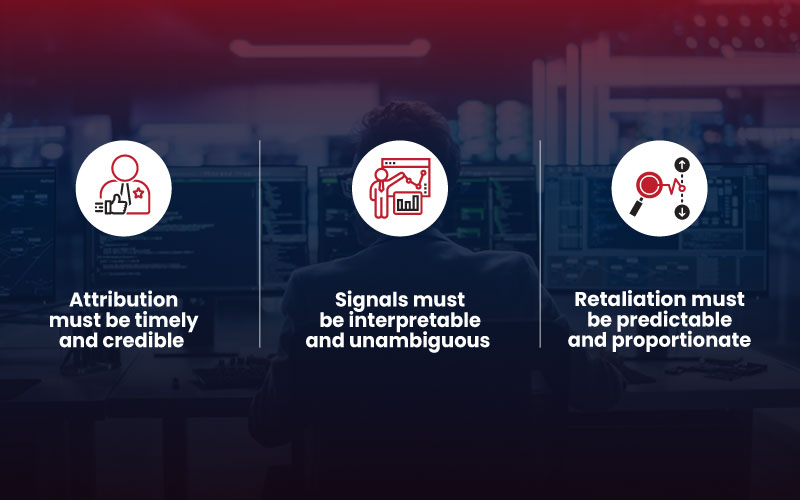
These conditions were largely satisfied in the nuclear context of the Cold War, where clearly defined red lines and catastrophic consequences contributed to a fragile but enduring strategic stability.
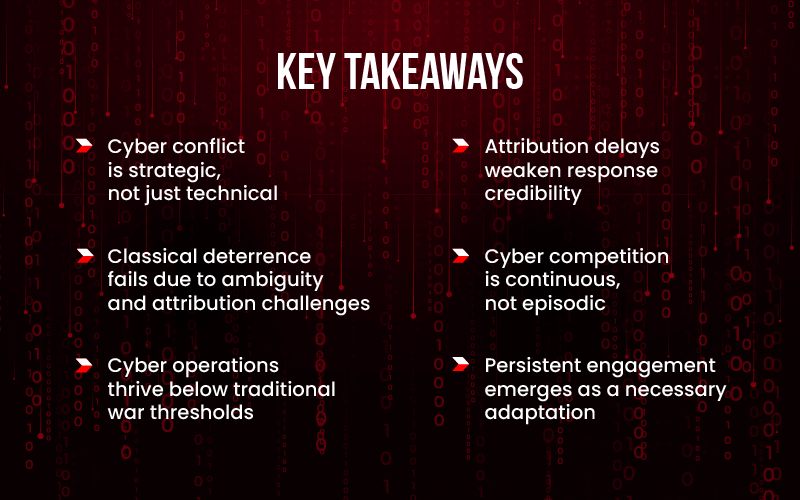
Cyberspace, by contrast, systematically undermines each of these assumptions. Attribution is often contested and delayed. Intent is inherently ambiguous. Operational thresholds remain ill-defined. As a result, deterrence in cyberspace fails to impose meaningful restraint. Rather than discouraging action, the inherent ambiguity incentivizes probing, experimentation, and persistent low-level competition.
Attribution and the Problem of Strategic Ambiguity
Attribution lies at the core of cyber instability. While technical forensics may identify probable sources of malicious activity, the transition from technical to political attribution is fraught with complexity.
States frequently confront a dilemma: they may possess high-confidence assessments of responsibility, yet lack the evidentiary threshold required for public attribution or coalition-building.
This produces a set of suboptimal strategic choices:
- Rapid responses based on incomplete or contested information could risk escalation
- Delayed responses could erode deterrent credibility
- Refraining from response can tacitly permit adversarial behavior
The cumulative effect is the normalization of cyber operations as a routine instrument of statecraft, rather than an exceptional act of conflict.
Persistent Engagement as Strategic Adaptation
In response to these structural constraints, states have begun to move beyond deterrence by punishment toward a doctrine of persistent engagement. This approach rests on several core assumptions:
- Cyber competition is continuous rather than episodic
- Reactive strategies are insufficient in a high-velocity domain
- Stability must be dynamically maintained through ongoing interaction
The objectives of persistent engagement are correspondingly pragmatic:
- To shape adversary behavior over time
- To reduce the likelihood of strategic surprise
- To manage, rather than eliminate, escalation risks
- To maintain persistent operational awareness
In this framework, strategic advantage derives not from isolated acts of retaliation but from sustained presence and influence within contested digital environments.
Frequently Asked Questions
Traditional deterrence depends on clear attribution, defined thresholds, and predictable retaliation. In cyberspace, attribution is often uncertain, actions are ambiguous, and responses are delayed—making deterrence far less effective.
Cyber conflict is continuous rather than episodic, often covert and deniable, and conducted below the threshold of war. Unlike traditional warfare, it rarely involves clear declarations or visible escalation paths.
The gray zone refers to activities that fall between peace and war. In cyberspace, states operate in the gray zone to achieve strategic goals without triggering formal military responses.
Attribution is difficult because attackers can mask their identity using proxies, route attacks through multiple countries, and blend espionage with offensive actions. Even when technically identified, proving responsibility publicly or legally is often complex.
Persistent engagement is a strategy that assumes cyber conflict is ongoing. Instead of waiting to respond to attacks, it focuses on continuously interacting with adversaries to shape their behavior and reduce risk.