
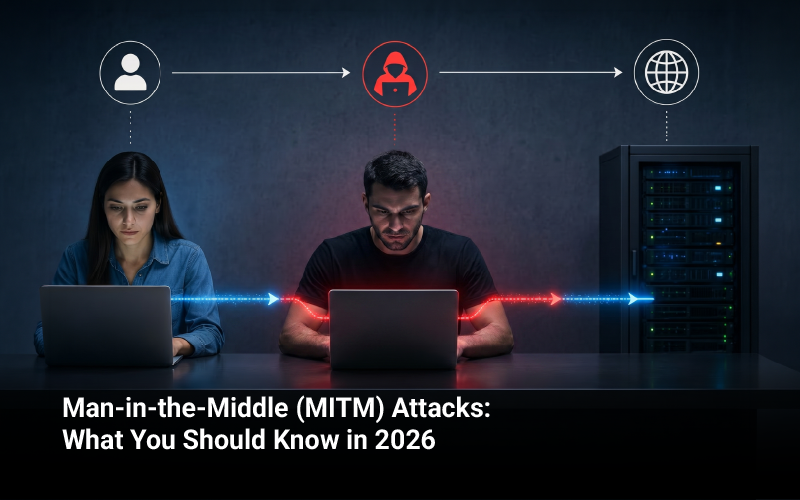
A Brief History and the Evolution of MITM Attacks
Man-in-the-Middle (MITM) attacks occur when a threat actor secretly intercepts and potentially alters communication between two parties who believe they are directly communicating with each other.
Historically, MITM attacks date back to early networked systems where unencrypted communication protocols (such as HTTP, FTP, and Telnet) were the norm. In the early 2000s, attackers exploited insecure public Wi-Fi networks, using tools like packet sniffers and ARP spoofing to capture sensitive data. By the mid-2010s, as HTTPS (the secure version of HTTP) began to gain traction, attackers pivoted to techniques such as SSL stripping, rogue certificates, and DNS hijacking. The Electronic Frontier Foundation reports that adoption of HTTPS for web traffic grew from 27% in 2013 to over 95% by late 2024, forcing attackers to innovate rather than retreat.
Today, in 2026, MITM attacks have become targeted, automated, and often enhanced by artificial intelligence. Threat actors now combine network-level interception with AI-driven social engineering and credential harvesting, creating hybrid attack models that are much harder to detect.
How Man-in-the-Middle (MITM) Attacks Differ from Other Cyber Threats
| Characteristic | MITM Attacks | Other Cyber Threats (Ransomware, Phishing) |
|---|---|---|
| Visibility | Operate silently, victims are usually unaware | Often visible (locked files, suspicious emails, etc.) |
| Attack Style | Passive interception with potential real-time manipulation | Active exploitation or deception |
| Impersonation | An attacker impersonates both parties in communication | An attacker impersonates both parties in communication |
| Timing of Impact | Gradual, long-term data theft or manipulation | Immediate disruption or data compromise |
| Detection Difficulty | Hard to detect due to a lack of obvious signs | Easier to detect due to alerts, anomalies, or user-facing symptoms |
| Primary Objective | Intercept, monitor, and alter communication | Encrypt data, steal credentials, or trick users |
| User Awareness | Minimal to none during the attack | Often requires user interaction (clicking links, downloading files) |
| Common Targets | Network communications, sessions, credentials | Endpoints, email systems, and user behavior |
Understanding MITM Attacks: Techniques and Stages
A typical MITM attack unfolds in two main phases:
1. Interception
Attackers position themselves between the victim and the target system. Common methods include:
- ARP spoofing
- DNS spoofing
- Wi-Fi eavesdropping (rogue access points)
- IP spoofing
2. Decryption and Manipulation
Once traffic is intercepted, attackers may:
- Decrypt data (if encryption is weak or compromised)
- Inject malicious payloads
- Redirect users to fake websites
- Capture credentials and session tokens
Modern MITM attacks often leverage automation to execute these stages at scale, especially in cloud and enterprise environments.
The Various Types of Man-in-the-Middle (MITM) Attacks
MITM attacks come in several forms, each targeting different layers of communication:
- ARP Spoofing: Attackers link their MAC address with a legitimate IP address, redirecting traffic through their device.
- DNS Spoofing (DNS Cache Poisoning): Users are redirected to malicious websites even when they enter correct URLs.
- HTTPS Spoofing / SSL Stripping: Attackers downgrade secure HTTPS connections to HTTP, exposing data in plaintext.
- Session Hijacking: Attackers steal session cookies to impersonate authenticated users.
- Rogue Wi-Fi Access Points: Fake hotspots lure users into connecting, allowing attackers to monitor all traffic.
- Email Hijacking: Attackers intercept and alter business email communications, often leading to financial fraud.

The Impact of AI on Man-in-the-Middle (MITM) Attacks
AI has fundamentally altered the MITM threat landscape.
How Attackers Use AI:
- Automated traffic analysis: AI can identify valuable data streams in real time.
- Adaptive attacks: Machine learning models adjust tactics based on network defenses.
- Deepfake-assisted impersonation: Attackers enhance credibility during interception.
- Credential prediction: AI models help crack weak authentication patterns faster.
A 2025 report by IBM found that AI-assisted cyberattacks reduced attacker dwell time by nearly 30%, making detection significantly harder.
On the flip side, cybersecurity professionals can also leverage AI to counter MITM attacks through:
- Behavioral anomaly detection
- Real-time threat intelligence
- Automated incident response
How to Detect and Defend Against Man-in-the-Middle (MITM) Attacks
MITM attacks are stealthy, but not undetectable. You need layered defenses.
MITM Detection Techniques
- Monitor for unusual certificate changes
- Identify duplicate IP addresses on the network
- Use intrusion detection systems (IDS)
- Analyze network latency anomalies
- Deploy endpoint detection and response (EDR)
MITM Prevention Strategies
| Strategy | Key Considerations |
|---|---|
| Enforce Strong Encryption |
|
| Implement Zero Trust Architecture |
|
| Use Multi-Factor Authentication (MFA) |
|
| Secure Wi-Fi Networks |
|
| Certificate Pinning |
|
| Network Segmentation |
|
Important Tips for Cybersecurity Professionals
To stay ahead of MITM threats in 2026, you must shift from reactive to proactive defense:
- Assume interception is possible in all network communications
- Continuously monitor encrypted traffic and don’t treat it as inherently safe
- Adopt Zero Trust principles across cloud and on-prem environments
- Test your defenses with penetration testing and red teaming
- Educate users about the risks of public Wi-Fi and phishing
- Stay updated on emerging MITM tools and techniques
Why Cybersecurity Education Is Crucial to Combating MITM Attacks
Apart from the technical aspects, MITM attacks in 2026 require a deep understanding of networks, cryptography, human behavior, and emerging technologies like AI. This is where structured cybersecurity education becomes essential.
Institutions like EC-Council University (ECCU) play a critical role in preparing cybersecurity professionals to:
- Understand advanced attack methodologies
- Design secure architectures from the ground up
- Apply real-world defensive strategies
- Stay current with rapidly evolving threats
Learning cannot be static or a one-time affair in today’s dynamic threat landscape. Defenders must continuously develop and fine-tune their skills to keep pace with motivated and well-equipped adversaries.
Discover the ideal learning framework that suits your cybersecurity career requirements:
Frequently Asked Questions About Man-in-the-Middle (MITM) Attacks
A MITM attack happens when an attacker secretly intercepts communication between two parties to steal or manipulate data.
Yes. While techniques have evolved, MITM attacks remain widely used, especially in targeted and AI-driven campaigns.
No. HTTPS significantly reduces risk, but attackers can still exploit misconfigurations or rogue certificates.
Public networks are often unsecured, making it easier for attackers to intercept traffic or create rogue access points.
Common tools include packet sniffers, ARP spoofing tools, and frameworks like Ettercap and Bettercap.
Use VPNs, avoid public Wi-Fi, enable MFA, and always verify website security (HTTPS).
AI enables attackers to automate interception, analyze traffic faster, and adapt their strategies in real time, making MITM attacks more efficient and harder to detect.