
Cybersecurity has grown far past a single job title. It now touches banking, healthcare, energy, and government at every level. As threats multiply, the country needs a steady supply of trained defenders. That supply has to come from somewhere structured and repeatable. Random self-study and scattered bootcamps cannot scale to meet this demand alone. This is where a dedicated cybersecurity university changes the equation. This blog looks at how these schools build a real talent pipeline. It covers why the shortage persists, what changed in education, and how degrees now blend theory with hands on skill building. It also breaks down certifications, labs, leadership tracks, and how to choose the right path forward.
Key Takeaways
- The US cybersecurity job market demand still runs far ahead of trained supply.
- Universities now build structured, verifiable pathways into cyber careers.
- Certifications embedded inside a degree save time and money.
- Hands on virtual labs matter more than theory heavy lectures.
- A cybersecurity degree still holds real value alongside certifications.
- Computer science and cybersecurity degrees serve different career goals.
The Scale of the Problem
Cyberattacks keep growing in scale and sophistication every year. Cloud adoption, AI driven threats, and IoT devices all expand the attack surface. Security teams have not grown fast enough to match this pace. ISACA reports that 65% of organizations currently have unfilled cyber roles.
Real job market data backs this up clearly. CyberSeek counts 514,359 open cybersecurity positions across the United States right now. The Bureau of Labor Statistics projects 29% growth for information security analyst jobs through 2034. That is much faster than average job growth.
Employers today expect more than a job title on a resume. Job postings increasingly ask for a degree and named certifications together. That combination is hard to build without structured, formal education.
From Ad Hoc Learning to a Structured Pipeline
A decade ago, most cybersecurity training happened outside universities. Short bootcamps, scattered online courses, and self-study filled the gap. These paths worked for some people, but rarely at scale. Employers struggled to compare candidates trained through wildly different routes.
That picture has shifted. Dedicated cybersecurity degree programs have grown fast across the country. Schools now build entire curricula around defense, forensics, and risk management. This shift gives employers a consistent, trusted signal when they hire graduates.
How University Curricula Align with National Standards
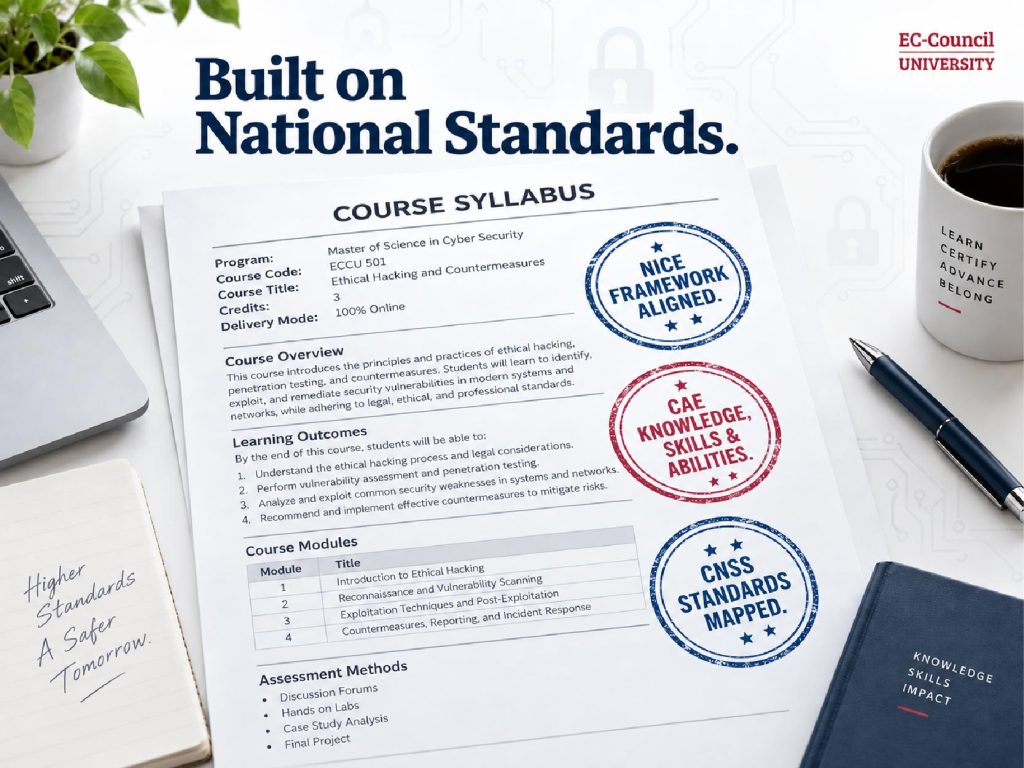
Several federal programs shape how strong cybersecurity education looks today. The NSA and CISA jointly run the Centers of Academic Excellence in Cyber Defense program. It recognizes schools whose programs meet strict federal standards.
Not every strong cybersecurity university holds this specific badge. Many instead build their courses directly around the same national frameworks. At ECCU, several core courses map to the NICE Cybersecurity Workforce Framework and to Center for Academic Excellence knowledge, skills, and abilities. Select courses also align with older CNSS national security standards. This keeps the curriculum grounded in recognized, federally shaped benchmarks, whether or not a school carries the formal CAE badge.
Certifications Built into the Degree
Most students earn a degree first, then chase certifications separately later. That path costs extra time, extra money, and extra exam prep. This gap hits computer science graduates especially hard, since their coursework rarely touches security certifications. ECCU flips this model by building certifications straight into coursework.
EC-Council, ECCU’s parent organization, created the CEH, CND, and CHFI certifications. Specific ECCU courses map directly to these exams, including:
- Managing Secure Network Systems, mapped to the CND exam.
- Ethical Hacking and Countermeasures, mapped to the CEH exam.
- Investigating Network Intrusions and Computer Forensics, mapped to CHFI.
- Conducting Penetration and Security Tests, mapped to the CPENT exam.
Students become exam eligible once they pass the matching course. Most of these exams carry no additional cost for enrolled students.
Hands On Labs and Closing the Experience Gap
Employers often complain that graduates know theory but not practice. A degree on paper does not always mean job ready skills. Real cybersecurity work demands comfort with actual tools under pressure.
ECCU addresses this through a dedicated virtual lab environment. Students practice network defense, incident response, and threat assessment safely online. This hands on approach helps close the gap between classroom and job floor.
Cybersecurity vs Computer Science: Choosing the Right Path

Choosing between cybersecurity and computer science trips up many students. Computer science covers broad ground, including algorithms, software design, and general computing theory. Cybersecurity narrows that focus toward defense, threats, and risk management specifically.
At the bachelor’s level, ECCU offers a dedicated Bachelor of Science in Cyber Security. At the graduate level, students can choose between two distinct paths:
- The Master of Science in Cyber Security, with five specialization tracks.
- The Master of Science in Computer Science, built around broader computing leadership.
Someone who wants deep security specialization should lean toward cyber security. Someone chasing broader software or systems leadership may prefer the computer science route.
Beyond the Technical Track: Leadership and the MBA Path
The workforce gap is not only a technical problem. Organizations also need leaders who understand governance, risk, and business strategy. Someone has to translate technical risk into boardroom decisions.
ECCU’s Executive MBA addresses exactly this gap. It offers a Cybersecurity specialization and a separate Executive Leadership and Governance specialization. For those weighing the investment, a cybersecurity master’s degree often pays off through faster promotions and stronger pay. For professionals not ready for a full graduate degree, ECCU also offers standalone graduate certificates. These run shorter and cost less, while still building real, stackable credentials.
What This Means If You're Evaluating a Cybersecurity Degree Today
Choosing a program matters more than choosing a subject. A few practical checks can separate a strong choice from a weak one:
- Does the curriculum align with recognized national frameworks like NICE?
- Are real certifications embedded directly into coursework, not sold separately?
- Does the program include hands on labs, not just lectures?
- Can you study part time, online, or around a full time job?
A cybersecurity degree is worth it when it does real, measurable work. It should teach practical skills, not just theory. It should also connect directly to certifications employers already trust.
Ready to become part of the pipeline, not just watch the shortage from the outside? Explore ECCU’s Bachelor’s and Master’s programs in cybersecurity.
Frequently Asked Questions
Why is there a cybersecurity workforce shortage in the US?
Cloud adoption, AI driven attacks, and IoT devices keep expanding what needs defending. Training has not kept pace with that growth. Many security teams stay understaffed even when open roles exist. Graduates also often lack the hands on experience employers expect from day one.
How many cybersecurity jobs are currently unfilled in the United States?
Real job posting data points to roughly half a million open cybersecurity roles nationwide right now. This reflects actual employer demand, not a survey estimate. The number still signals steady, strong hiring across most industries and regions.
Do you need a degree to work in cybersecurity?
No single path guarantees entry into the field. Some analysts start with certifications and hands on projects alone. Most employers still prefer candidates with a formal degree behind them. A degree also tends to open doors to leadership roles faster.
Is a cybersecurity degree worth it?
It depends heavily on the program’s rigor and real outcomes. A degree that embeds actual certifications adds practical value quickly. Paired with hands on labs, it shortens the path from classroom to job. Weigh cost, format, and career goals carefully before deciding.
How do I get into cybersecurity with no experience?
Start by building foundational IT and networking knowledge first. Add skills through labs, entry level certifications, or short focused courses. Internships and virtual lab environments help close the experience gap fast. Many entry level cybersecurity roles look for exactly this kind of preparation.
What's the difference between a cybersecurity degree and a computer science degree?
Computer science covers broad software design, algorithms, and computing theory. A cybersecurity degree focuses specifically on defense, threats, and risk management.
Some schools also offer a computer science master’s with a security angle. Your career goal should guide which path fits you best.
Are certifications more valuable than a cybersecurity degree, or do employers want both?
Most employers want both, not one instead of the other. Certifications prove specific, current technical skills quickly and clearly. Degrees show broader knowledge, judgment, and staying power over time. Programs combining both give graduates a real hiring edge.
Does ECCU's cybersecurity curriculum align with NSA and NICE frameworks?
Yes. ECCU maps several core courses to the NICE Cybersecurity Workforce Framework directly. Select courses also align with Center for Academic Excellence knowledge, skills, and abilities. This keeps coursework grounded in recognized, federally shaped standards throughout the program.
Does ECCU embed CEH, CND, and CHFI certifications directly into its degree programs?
Yes. Specific bachelor’s and master’s courses at ECCU map directly to these ECCouncil certifications. Students become exam eligible right after completing the matching course. Most of these exams carry no extra cost for enrolled students.