
A Degree Dilemma: Cybersecurity or Computer Science?
If you’re at the start of your career or thinking about switching paths, you’ve probably run into a common dilemma: Should you pursue a degree in cybersecurity or computer science?
It’s not an easy call. Both fields offer strong job prospects, competitive salaries, and long-term growth. But they’re not interchangeable. Each comes with a different focus, skill set, and career trajectory.
To make the right choice, you need to think beyond job titles and ask yourself a few key questions:
- What kind of problems do you enjoy solving?
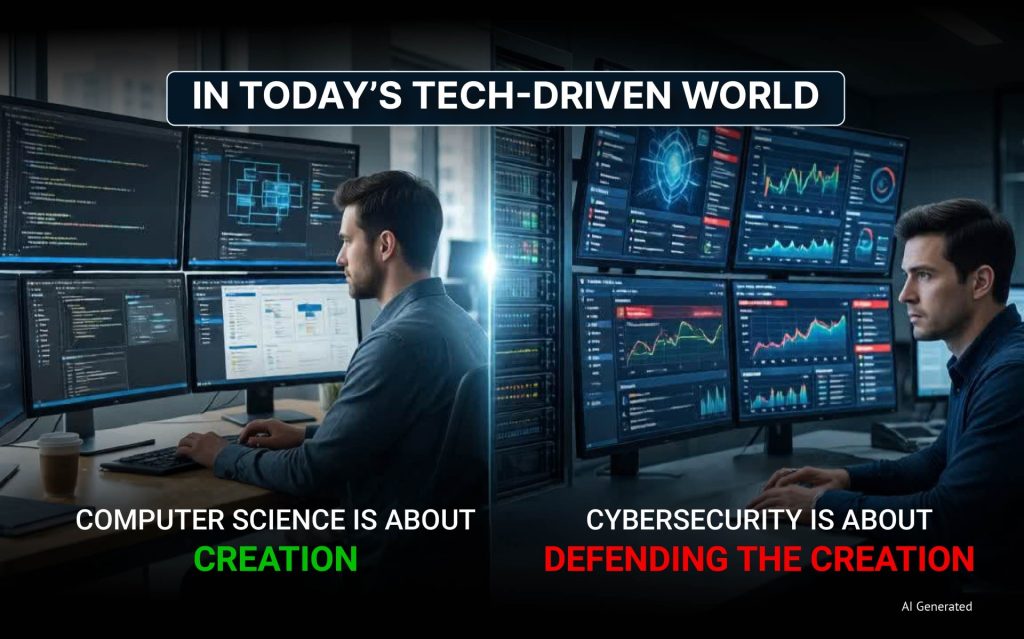
- Do you prefer building systems or protecting them?
- Where do you see your career in 5–10 years?
Let’s break it down so you can confidently choose the educational path that aligns with your career goals.
What is a Cybersecurity Degree?
A cybersecurity degree equips you with the skills, knowledge, and qualifications to protect systems, networks, and data from digital threats. You’ll learn how to identify vulnerabilities, respond to attacks, and design secure infrastructures.
Typical areas of study include:
- Network security
- Security analysis
- Ethical hacking and penetration testing
- Digital forensics
- Cloud security
- Risk management and compliance
- Incident response
Programs like the Bachelor of Science in Cyber Security (BSCS) and the Master of Science in Cyber Security (MSCS) from EC-Council University (ECCU) are designed to go beyond theory. These degrees emphasize hands-on, real-world skill development and include industry-aligned certifications as part of the coursework. This means you’re building job-ready expertise from day one, above conceptual learning.
What is a Computer Science Degree?
A computer science degree is broader in scope, focusing on the theory and practice of computing.
Core subjects typically include:
- Programming (Python, Java, C++)
- Data science
- Algorithm design
- Operating systems
- Artificial intelligence and machine learning
- Software engineering
ECCU’s Master of Science in Computer Science (MCS) degree provides the foundational and advanced skills needed to build applications, design algorithms and systems, analyze large datasets, and innovate with technologies like AI, robotics, blockchain, and more.
Key Differences Between Cybersecurity and Computer Science
At a high level, here’s how the two fields differ:
| Aspect | Cybersecurity | Computer Science |
|---|---|---|
| Focus | Protecting systems | Designing and building systems |
| Skill Type | Defensive and analytical | Logical and creative |
| Daily Work | Threat monitoring, testing, and response | Coding, debugging, and development |
| Industry Role | Risk mitigation | Innovation and maintenance |
Comparing Career Opportunities in Both Fields
Cybersecurity Careers
Cybersecurity roles are becoming increasingly specialized and critical. You can pursue the following jobs with a degree in cybersecurity:
- Cybersecurity Analyst
- Penetration Tester (Ethical Hacker)
- Network Security Engineer
- SOC Analyst
- Digital Forensics Investigator
- Cloud Security Architect
- Cybersecurity Manager
- Incident Responder
- Vulnerability / Risk Manager
- Chief Information Security Officer (CISO)
- Director of IT Security
- And many more
The U.S. Bureau of Labor Statistics (BLS) projects that jobs in the information security sector will grow by 29% from 2024 to 2034.
Computer Science Careers
With a degree in computer science, your career options are wide-ranging:
- Software Developer
- Full-Stack Engineer
- AI / Machine Learning Engineer
- Data Scientist
- Systems Architect
- Blockchain Developer
- Front-End / Back-End Developer
- Application Engineer
- IT Administrator
- UX / UI Developer
- Robotics Engineer
- And many more
As per the U.S. BLS, jobs in software development are projected to grow by 25% from 2022 to 2032.
Job Market and Salary Insights
Here’s where things get interesting.
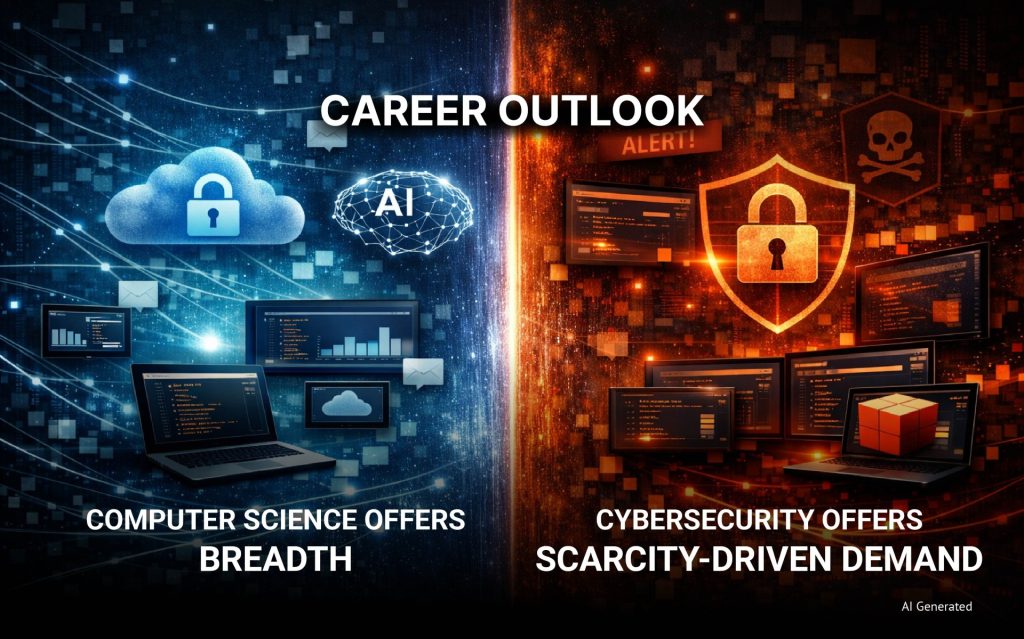
- There’s an estimated talent shortage of approximately 4.7 million cybersecurity professionals globally.
- Cybersecurity roles often command premium salaries due to this widening talent shortage.
- Computer science roles are abundant, but also more competitive at the entry level.
Which Degree Is Better for the Future?
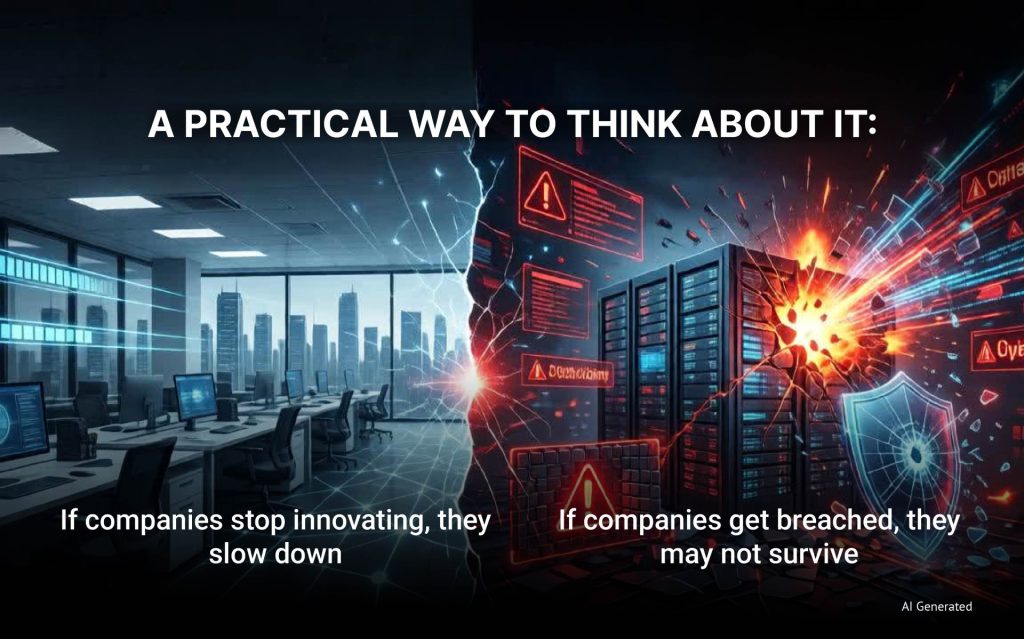
Both fields are future-proof, but not to the same extent. Every company today is in some way a tech company. But more importantly, every company is a target. Cybersecurity has become a non-negotiable layer across all industries, from healthcare and financial services to petrochemicals and education. The rise of cloud computing, AI-powered cyberattacks, and remote work environments has dramatically expanded the attack surface.
That’s why cybersecurity is increasingly viewed as a business-critical function, not just a subset of computer science. This makes it one of the most resilient and high-growth career paths available today.
Which is More Difficult: A Degree in Cybersecurity or Computer Science?
This question depends entirely on your learning strengths, aptitude, and commitment.
- Computer Science can be mathematically intensive, especially with algorithms, data structures, and theoretical computing concepts.
- Cybersecurity requires a deep understanding of systems, networks, and constantly evolving threats.
In practice:
- Computer science can be more difficult from an academic perspective.
- Cybersecurity is more challenging in reality because threats evolve daily.
Can You Transition Between Computer Science and Cybersecurity?
Good news! You’re not locked in one discipline forever.
Computer Science to Cybersecurity (Common Path)
IT to cybersecurity is the more common transition. A strong programming and systems background makes it easier to understand:
- Application security
- Secure coding
- Threat analysis
- Operating systems
Cybersecurity to Computer Science (Possible Path)
This transition is possible, but may require:
- Additional programming skills
- Deeper theoretical knowledge
Why Cybersecurity is Gaining More Attention
Cybersecurity is exploding in relevance. Here’s why:
- Cybercrime is estimated to cost the global economy $10.5 trillion annually.
- High-profile breaches are now front-page news.
- Governments are enforcing stricter digital privacy and data protection laws.
- Organizations are investing heavily in proactive defense.
In other words, cybersecurity has shifted from a “nice-to-have” to a mission-critical priority.
EC-Council University: The Best of Both Worlds
If you’re still weighing up your options, here’s something worth considering.
EC-Council University (ECCU) is a world-renowned institution for cybersecurity-focused education, offering:
- Accredited degrees in cybersecurity and computer science
- Fully online, flexible, and asynchronous programs
- Industry-aligned curriculum with embedded cybersecurity certifications (CEH, CND, CHFI, CASE, CCISO, and more)
- A faculty of cybersecurity and computer science experts with decades of work and teaching experience
- Immersive, hands-on practice using the latest technology and tools in virtual lab environments
What sets ECCU apart is our focus on real-world readiness, especially for working professionals who need practical skills. If your goal is to build a future-proof career in high-demand fields like cybersecurity and computer science, ECCU is the place to go.
To know more about our degrees in cybersecurity and computer science:
Frequently Asked Questions (FAQs)
It depends on your goals. Cybersecurity offers higher demand and job security, while computer science provides broader career options.
Yes, and it’s a common path. Many cybersecurity professionals start with a background in computer science.
Both offer high salaries, but cybersecurity roles often command higher pay due to acute talent shortages.
Not necessarily. Computer science is typically more theoretical, while cybersecurity is more practical and constantly evolving.
Basic programming skills are helpful, especially for roles like ethical hacking and security engineering.
Computer science has more roles overall, but cybersecurity has a higher demand-to-talent ratio.
Absolutely. With cyber threats rising exponentially, it’s one of the most stable and future-proof career paths to consider.