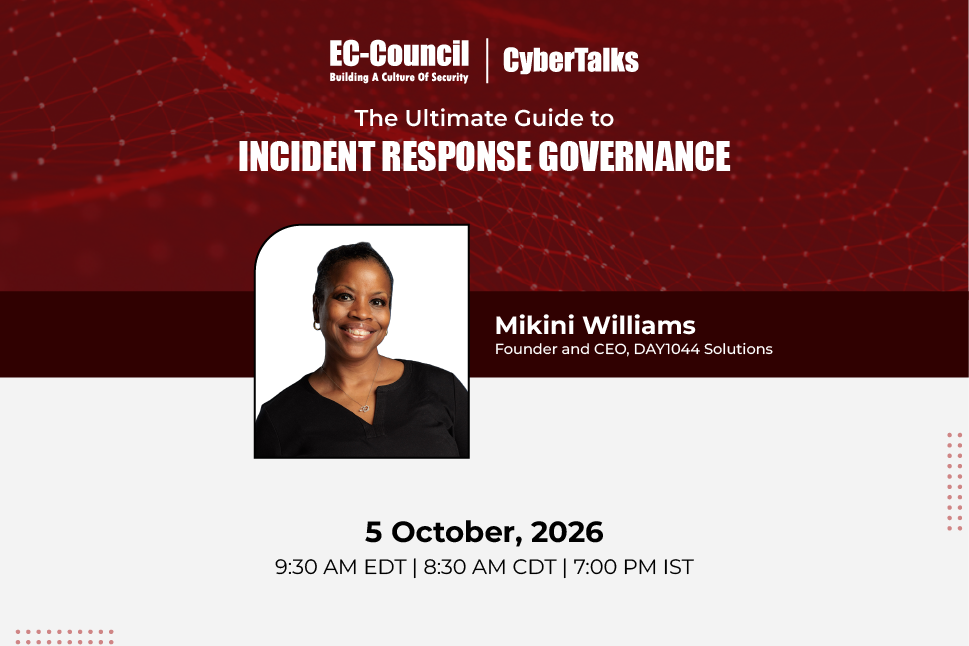
Topic: The Ultimate Guide to Incident Response Governance
Abstract: When a cyber incident occurs, the difference between a coordinated response and organizational chaos often comes down to governance. Organizations that have clearly defined structures for detecting, escalating, managing, and communicating incidents are far better positioned to contain damage, meet regulatory obligations, and maintain stakeholder trust.
This session examines the foundational elements of incident response governance, including how to define roles and responsibilities, establish escalation paths, assign decision-making authority, and build communication protocols that work under pressure. It will also explore how security, legal, compliance, privacy, and executive teams can be aligned before an incident occurs, rather than coordinating for the first time during a crisis.
Beyond structure, the session addresses how organizations can continuously strengthen their incident readiness through meaningful metrics, tabletop exercises, and post-incident reviews. Attendees will leave with practical guidance for building a governance model that supports faster, more accountable decisions and provides the documented evidence that regulators, auditors, and senior leadership require.
Key Takeaways:
- Essential components of an effective incident response governance framework.
- Importance of clear roles, responsibilities, ownership, and decision-making authority during a cyber incident.
- Establishing effective incident classification, severity levels, escalation paths, and response triggers.
- Aligning incident response with enterprise risk management, business continuity, and crisis management.
- Strategies for coordinating security, legal, compliance, privacy, communications, and executive stakeholders.
- Preparing for regulatory notification, documentation, evidence preservation, and audit requirements.
- Incident response metrics and KPIs to measure readiness, response effectiveness, and resilience.
- Building a continuous improvement cycle using post-incident reviews and actions.
Speaker:
 Mikini Williams, Founder and CEO, DAY1044 Solutions
Bio: Mikini Naomi Williams is a senior technology leader, certified AI consultant, and founder known for building durable systems, technical, organizational, and human, at the intersection of cybersecurity, artificial intelligence, and strategic execution. Drawing on more than 20 years of experience across government agencies, consulting firms, and enterprise organizations, Mikini brings both strategic depth and operational clarity to every engagement. She ensures that technology adoption is not only innovative but also governed, sustainable, and aligned with organizational objectives. Her approach to emerging technology, especially AI, is rooted in practical risk awareness, real-world execution, and a commitment to long-term value.
As the Founder and CEO of DAY1044 Solutions, she applies an operator’s mindset to every challenge, prioritizing outcomes that are measurable, defensible, and built to last. Her work centers on helping organizations, entrepreneurs, and institutions implement AI and security capabilities that respect constraints, protect trust, and enhance decision-making rather than replace it. She is particularly skilled at guiding nontechnical leaders through high-stakes technology decisions with confidence and fluency.