
You trust many digital systems before lunch. Your bank app, inbox, and work laptop all hold valuable data. A cyberattack is someone trying to break that trust on purpose. These attacks hit hospitals, pipelines, carmakers, and small offices alike.
This guide explains what a cyberattack really is. It shows how attacks differ from threats and vulnerabilities. You will learn why attackers strike and which methods they favor. We also cover real incidents, their costs, and how professionals stop them.
Key Takeaways
- A cyberattack is a deliberate attempt to harm digital systems or data.
- Vulnerabilities are weak spots, threats exploit them, and attacks are the action.
- Money drives most attacks, but politics, spying, and grudges matter too.
- Unpatched software now beats stolen passwords as the top entry point.
- Education faces the most attacks, while healthcare breaches cost the most.
- Prevention lowers risk, but only a tested response plan limits damage.
What Is a Cyberattack?
Why Do Cyberattacks Happen?
- Financial gain: Criminals sell data, drain accounts, or demand ransoms.
- State goals: Governments disrupt rivals or prepare for conflict.
- Espionage: Spies steal trade secrets and research.
- Hacktivism: Activists leak data or deface sites to push a cause.
- Personal motives: Insiders seek revenge, and some hackers want bragging rights.
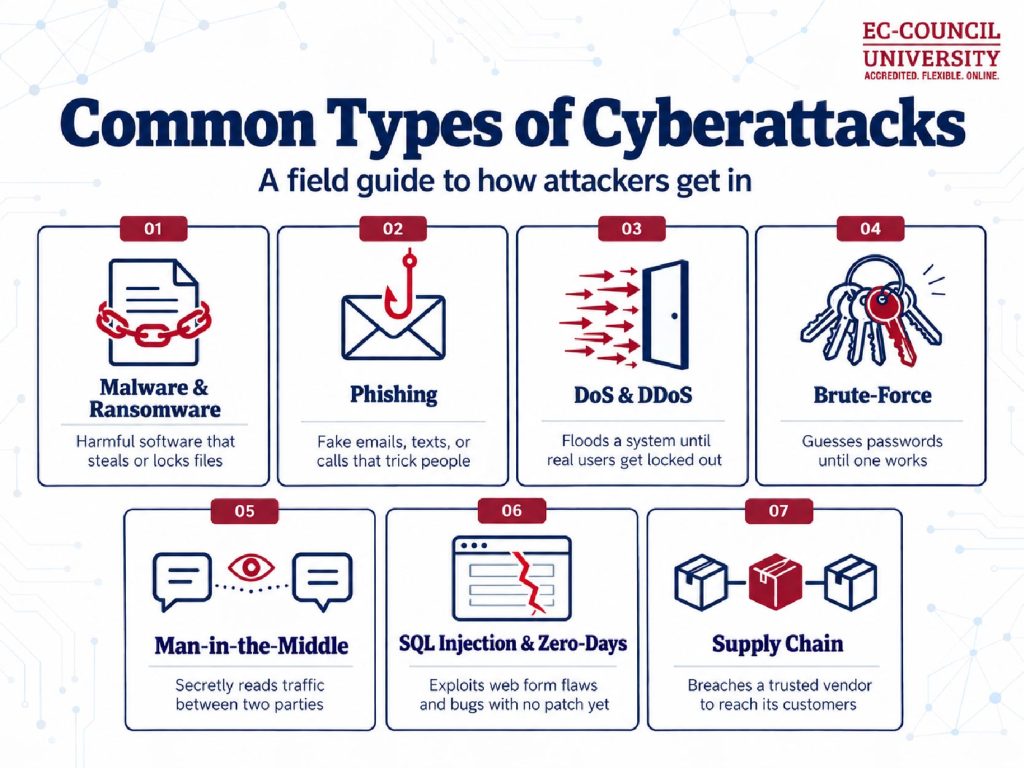
Common Types of Cyberattacks
Malware and Ransomware
Phishing and Social Engineering
DoS and DDoS Attacks
Brute-Force and Credential Attacks
Man-in-the-Middle Attacks
SQL Injection and Zero-Day Exploits
Supply Chain Attacks
Where ECCU Training Fits
| Attack Family | MSCS Specialization | Core Skills |
|---|---|---|
| Brute force, SQL injection, MITM, zero-days | Security Analyst | Vulnerability assessment, penetration testing |
| Malware and network intrusions | Digital Forensics | Intrusion investigation, evidence handling |
| Ransomware and DDoS response | Incident Management and Cyber Operations | Incident handling, disaster recovery |
| Cloud and supply chain exposure | Cloud Security Architect | Enterprise cloud defense |
| exposure |
Who Gets Targeted and What a Cyberattack Costs
Common targets include financial accounts, personal data, intellectual property, and critical infrastructure. Volume and cost tell different stories, though.
Check Point counted 2,336 weekly attacks per organization in July 2026. Education took the most hits, averaging 4,848 a week. Government came second at 3,044.
Healthcare breaches cost the most, at $6.64 million on average. Finance follows at $6.29 million. IBM puts the global average at $4.99 million. U.S. firms average $11.5 million. Breaches also took 247 days to find and contain.an average of $6.64 million
ow buy cyber insurance to share this risk. Weighing that risk is the daily work of GRC professionals.
Major Cyberattacks That Shaped Cybersecurity
- NotPetya (2017): This fake ransomware simply destroyed data worldwide. Losses reached an estimated $10 billion.
- Colonial Pipeline (2021): Ransomware shut a major U.S. fuel pipeline for days. The company paid about $4.4 million in bitcoin.
- Change Healthcare (2024): Attackers entered through a remote portal without MFA. The breach exposed data on about 192.7 million people.
- Jaguar Land Rover (2025): An attack halted the carmaker’s production for weeks. It cost the UK economy an estimated £1.9 billion.
Preventing and Responding to Cyberattacks
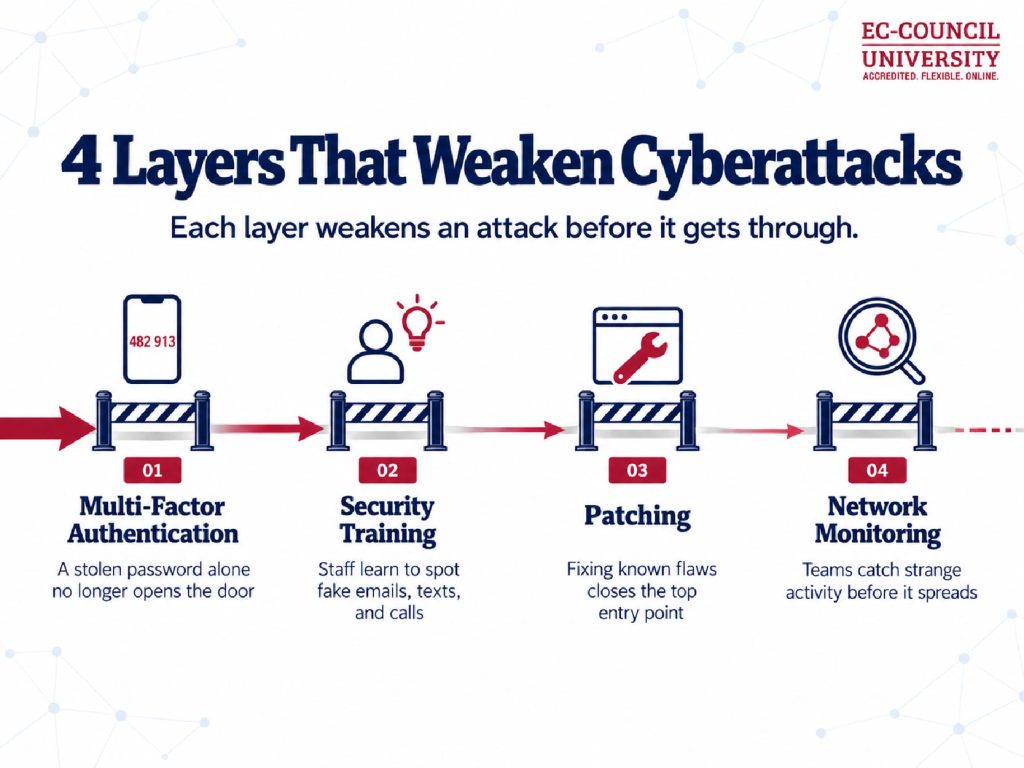
No single tool stops every attack. Strong defense layers proven habits:
- Multi-factor authentication: A stolen password alone no longer opens the door.
- Security training: Staff learn to spot fake emails, texts, and calls.
- Patching: Fixing known flaws closes the top entry point.
- Network monitoring: Teams catch strange activity before it spreads.
ECCU’s Master of Science in Cyber Security builds these exact skills. Every student studies network defense and ethical hacking.
Building an Incident Response Plan
Even good defenses fail sometimes. An incident response plan spells out who does what during an attack. It covers detection, containment, recovery, and lessons learned. Small firms need one as much as large enterprises.
This is why incident responders are in such demand. ECCU’s Incident Management and Cyber Operations specialization trains you for this work.
What This Means for Your Cybersecurity Career
Start Your Path With ECCU
Ready to move from understanding attacks to stopping them? Explore ECCU’s online Master of Science in Cyber Security. Start with the Security Analyst or Incident Management and Cyber Operations specialization. No prior cybersecurity experience is required to apply.Frequently Asked Questions
Q1. What is the difference between a cyberattack, a threat, and a vulnerability?
Q2. What is the difference between a cyberattack and a data breach?
A cyberattack is the attempt or the act itself. A data breach happens when information is actually exposed or stolen. Many attacks cause breaches, but not all of them. A DDoS attack, for example, disrupts service without stealing data.
Q3. Why do cyber attackers commonly use social engineering?
People are easier to fool than strong encryption is to crack. One convincing message can hand over a password or payment. Verizon linked a human element to 62% of breaches. That makes trust the cheapest way through most defenses.
Q4. What are the most common types of cyberattacks?
Phishing, malware, and ransomware top the list. DDoS floods, credential attacks, and software exploits follow close behind. Supply chain attacks are rising quickly too. Most real incidents combine two or more of these methods.
Q5. What is a DDoS attack?
A DDoS attack overwhelms a website or network with fake traffic. The traffic comes from a botnet of hijacked devices. Real users can no longer reach the service. Attackers use DDoS for extortion, protest, or simple disruption.
Q6. What is a brute-force attack?
A brute-force attack guesses login details through constant trial and error. Automated tools try common passwords and endless variations. Long, unique passwords make this far harder.
Multi-factor authentication blocks entry even when a guess is right.
Q7. How many cyberattacks happen per day?
No one can count every attack worldwide. Security vendors only see attacks on the networks they protect. Check Point recorded 2,336 weekly attacks per organization in July 2026. That works out to roughly 330 attacks per organization each day.
Q8. How much does a cyberattack cost a business on average?
IBM’s 2026 report puts the global average breach at $4.99 million. U.S. organizations averaged
$11.5 million per breach. Costs include investigation, downtime, lost customers, and legal fees. Faster detection and containment lower the bill.
Q9. What industries are most targeted by cyberattacks?
By volume, education faces the most attacks, followed by government. Check Point counted 4,848 weekly attacks per education organization. By cost, healthcare leads at $6.64 million per breach. Financial services come next at $6.29 million.
Q10. How can a cyberattack be prevented?
No method stops every attack, but layered defenses cut the risk. Start with multi-factor authentication and regular patching. Train staff to spot phishing and suspicious calls. Then monitor networks so teams catch problems early.
Q11. What is a cyberattack incident response plan, and does my business need one?
An incident response plan sets out what to do during an attack. It assigns roles, lists steps, and explains how to restore systems. Every business needs one, whatever its size. Test it with practice drills so people know their parts.
Q12. Do small businesses need cyberattack insurance?
Many small businesses buy cyber insurance to cover recovery costs. Policies can pay for investigations, legal fees, and lost income. Coverage and prices vary widely between insurers. Compare policies carefully and ask an advisor about your specific risks.
Q13. What was the biggest cyberattack in history?
No single answer fits every measure. NotPetya is often called the costliest, at about $10 billion. Change Healthcare caused the largest U.S. healthcare breach, exposing 192.7 million people.
Jaguar Land Rover’s attack became the UK’s most damaging cyber event.