
The cybersecurity job market is one of the most consistently active in tech. Across every industry, organizations are competing for professionals with verified, up-to-date skills, and cybersecurity certifications remain one of the most reliable ways to signal those skills to employers. Whether you are entering the field for the first time or looking to move into a more specialized or senior role, understanding which certifications matter and why can shape how effectively you invest your time and money.
This guide walks through the value of cybersecurity certifications, the credentials worth considering in 2026, how to navigate beginner options, what to look for in online programs, and how to build a certification path that matches your goals.
Key Takeaways
- 4.8 million cybersecurity roles sit unfilled globally. Certified professionals have never been more in demand.
- Certified professionals earn a 37% pay advantage over non-certified peers on average, with measurable salary increases at every career level.
- ISO/IEC 17024-accredited credentials carry significantly more employer weight than unaccredited alternatives.
- Several certifications are mandatory, not just preferred, for U.S. government and defense roles under DoD Directive 8140.
- A university degree paired with industry certifications opens doors that neither credential unlocks alone.
What Is a Cybersecurity Certification Program?
A cybersecurity certification is a credential awarded by an accredited body that validates a professional’s knowledge and applied skills across domains such as network security, ethical hacking, risk management, digital forensics, and incident response. Earning one typically involves completing a structured curriculum and passing one or more proctored exams, often including a practical performance component. Most certifications also require periodic renewal through continuing education, ensuring holders stay current as the threat landscape evolves.
Unlike a general IT qualification, a cybersecurity certification is tightly focused on jobrelevant skills and can be completed in weeks or months. This makes it practical for career changers, recent graduates, and working professionals who want to specialize without pausing their careers. Many professionals also pursue certifications alongside an accredited university degree program, where coursework and exam preparation can reinforce each other.
Why Cybersecurity Certifications Matter for Career Advancement
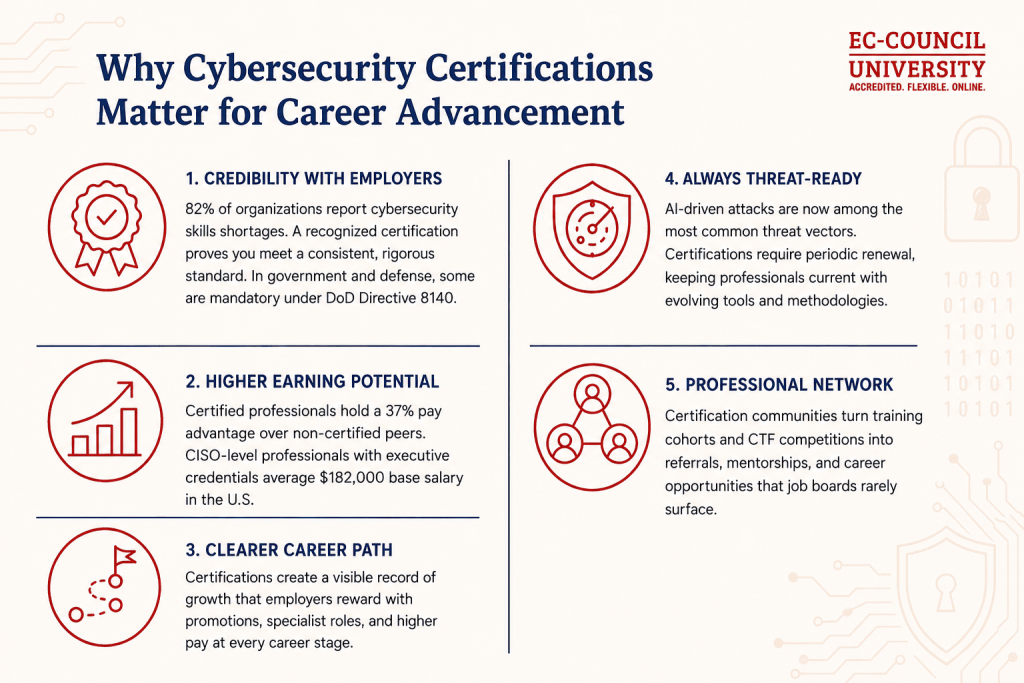
Credibility with Employers
Certifications give hiring managers a standardized way to evaluate candidates. With 82% of organizations reporting cybersecurity skills shortages, employers cannot afford to rely solely on self-reported experience. A recognized certification shows that a candidate has been assessed against a consistent, rigorous standard. In government and defense contracting, certain certifications are not just preferred but required under U.S. DoD Directive 8140.
Higher Earning Potential
Certified professionals consistently earn more than their non-certified counterparts. Industry data shows that certified cybersecurity professionals have an average 37% pay advantage. At the senior end, CISO-level professionals with the right executive credentials earn base salaries averaging around $182,000 in the U.S.
A Clearer Path to Career Advancement
Certifications create a visible record of professional growth. A thoughtfully sequenced cybersecurity certification path signals both technical depth and genuine commitment to the field, which employers reward with promotions, specialist responsibilities, and access to higher-paying roles. Unlike general IT experience, certifications give you something concrete to point to at every stage of your career.
Keeping Pace with the Threat Landscape
Cyber threats evolve faster than most fields. And AI-driven attack techniques now rank among the most common threat vectors. Quality cybersecurity certificate programs require periodic renewal through continuing education, keeping certified professionals up to date with the tools and methodologies employers actually need.
Professional Networking
The communities that form around certification programs connect practitioners across industries and roles. Relationships built through training cohorts, global CTF competitions, and professional networks regularly lead to referrals, mentorships, and career opportunities that job boards rarely surface.
Top Cybersecurity Certifications in 2026
The certifications below represent the most widely recognized credentials across experience levels in 2026, from early-career professionals through to security executives. Each one is internationally accredited and actively sought by employers in government, enterprise, and regulated industries.
Certified Ethical Hacker (CEH)
One of the most recognized intermediate certifications globally, now in its 13th version with AI-integrated content. The CEH covers 20 domains, 221 hands-on labs, and over 550 attack techniques. It satisfies DoD 8140 requirements and appears consistently in job postings for penetration tester, red team analyst, and security assessor roles. A separate practical exam component allows candidates to earn CEH Master status by demonstrating skills in a live cyber range environment.
Certified Network Defender (CND)
Built for blue-team professionals responsible for protecting and monitoring network infrastructure, the CND covers threat detection, network security controls, incident response, and disaster recovery planning. It aligns with DoD 8140 requirements and is a natural progression for network administrators moving into dedicated security roles.
Computer Hacking Forensic Investigator (CHFI)
The CHFI validates the skills needed to investigate cyberattacks, preserve digital evidence, and support legal proceedings. It is sought after by law enforcement agencies, government security units, and enterprise incident response teams. The credential is approved by the American Council on Education for college credit and carries DoD recognition.
Certified Incident Handler (ECIH)
As organizations build out dedicated incident response capabilities, the ECIH has become a high-value credential for analysts who manage and contain security events. It covers incident handling across malware, web application attacks, cloud-based incidents, and network intrusions, and satisfies DoD 8140 requirements for relevant roles.
Certified Penetration Testing Professional (CPENT)
An advanced, fully performance-based credential conducted on a live cyber range. CPENT covers IoT, OT/SCADA systems, cloud environments, and Active Directory exploitation, going significantly beyond the scope of intermediate certifications. Top scorers earn the Licensed Penetration Tester (LPT) Master designation. It is designed for experienced professionals with an established offensive security background.
Certified Chief Information Security Officer (CCISO)
The executive-level benchmark for current and aspiring CISOs, developed by sitting CISOs to address the governance, risk, strategy, audit, and financial dimensions of security leadership. An Associate CCISO track is also available for professionals building toward the executive experience requirements.
Best Cybersecurity Certifications for Beginners
Starting in cybersecurity means building a verified foundation before specializing. The priority at this stage is a credential that covers multiple domains, tests practical skills rather than just theoretical knowledge, and feeds naturally into more advanced pathways.
Certified Cybersecurity Technician (CCT)
The most comprehensive entry-level option currently available. The CCT is the world’s first multi-domain entry-level cybersecurity certification, covering network defense, ethical hacking, digital forensics, and security operations within a single program. It includes 85 hands-on labs assessed on a live cyber range, which is three times more lab content than most comparable entry-level credentials. 67% of CCT holders report successfully transitioning into cybersecurity roles after earning the credential. Students in ECCU’s Bachelor of Science in Cyber Security program cover the same foundational domains throughout their coursework.
Ethical Hacking Essentials (EHE)
A self-paced introductory credential that covers hacking concepts, attack methodologies, and defensive techniques. It is well suited for candidates exploring offensive security before committing to the full CEH pathway, and for those who want a structured introduction without the cost or time commitment of a full certification program.
Digital Forensics Essentials (DFE)
Covers forensic investigation concepts, evidence collection, and analysis tools in an accessible format. A practical first step for anyone interested in the digital forensics track before pursuing the CHFI, and one that also complements coursework in ECCU’s Digital Forensics graduate certificate program.
Regardless of where you begin, pairing certification study with hands-on lab practice and, where possible, an accredited cybersecurity online certificate program will strengthen both your exam readiness and your longer-term career positioning.
What to Look for in Online Cybersecurity Programs
Most cybersecurity certification programs online are now delivered through self-paced or instructor-led virtual formats, giving working professionals flexibility without sacrificing depth. A few factors consistently separate programs worth investing in from those that are not.
- Accreditation: For academic programs, regional accreditation is the standard that employers and other universities recognize. On the certification side, credentials accredited to ISO/IEC 17024 by a recognized body such as ANAB carry more formal weight than unaccredited alternatives.
- Hands-on lab access: Practical readiness comes from applied practice, not reading alone. Programs that include virtual labs, live cyber ranges, or simulated environments produce measurably better-prepared candidates for both exams and real-world roles.
- Alignment with industry frameworks: Programs built around certifications that satisfy DoD 8140 or other regulatory standards give candidates dual value: they prepare for the exam and signal compliance alignment to employers in regulated sectors.
- Stackable credentials: Some programs allow certificate credits to count toward a degree, which avoids duplicated effort and maximizes return on educational investment. EC-Council University’s Graduate Certificate Programs are structured this way, with credits applicable toward a master’s degree.
How to Choose the Right Cybersecurity Certification
With dozens of credentials available, the right choice is rarely the most prestigious one. It is the one that fits your current experience level, matches what your target roles require, and feeds naturally into your next step. A few practical questions help clarify the decision.
- Where are you in your career? Beginners should start with an entry-level multidomain credential before specializing. Mid-career professionals targeting analyst, forensics, or engineering roles should look at intermediate certifications that align with their specific domain. Senior professionals with management goals should look at advanced or executive-level credentials rather than adding more intermediate ones.
- What do your target job postings actually require? Review current listings for roles you are aiming for. Certifications appear in postings for a reason; when the same credential shows up repeatedly for the same type of role, that is a strong signal. Matching your credential to what employers are actively asking for is more effective than chasing general prestige.
- Do you meet the prerequisites? Some advanced certifications require verifiable professional experience in specific domains before you are eligible to sit the exam. Pursuing a credential you are not yet qualified for wastes time and money and delays the credentials that would actually move your career forward.
- Does your industry have compliance requirements? In U.S. government and defense, certain certifications are mandatory under DoD 8140. Healthcare, finance, and critical infrastructure sectors often have their own regulatory considerations that make specific credential types more relevant than others.
- Do you want your credentials to count toward a degree? If long-term academic investment matters, look for programs where certification study and university coursework are aligned. EC-Council University’s Graduate Certificate Programs are structured so credits stack toward a master’s degree, making each step forward count twice.
A common and well-regarded cybersecurity certification path for most professionals: start with an entry-level multi-domain credential to build a solid foundation, then move into either offensive or defensive specialization depending on your interests, and pursue advanced or governance-level credentials as your experience deepens.
Conclusion
Cybersecurity certifications are one of the most practical investments professionals can make in their careers. They validate technical competence, improve hiring outcomes, and create a structured framework for keeping skills current in a field that changes faster than most. With a global workforce gap of approximately 4.8 million unfilled roles, the demand for verified expertise is not going to ease anytime soon.
The certifications covered in this guide span the full career spectrum, from foundational multi-domain entry points through to advanced technical credentials and executive leadership programs. Whichever stage you are at, a clearly sequenced certification path will do more for your career than a collection of unrelated credentials. And for professionals who want their industry credentials to sit alongside formal academic qualifications, a university program that aligns with the same curriculum is worth the additional investment.
Explore EC-Council University’s programs to find the path that fits your goals.
Frequently Asked Questions
The most recognized and actively hired credentials in 2026 include the CEH, CND, CHFI, ECIH, CPENT, and CCISO. The right choice depends on your experience level and the type of role you are targeting. Entry-level candidates should start with the CCT; mid-career professionals should align their credential to their specialization; senior professionals should look at advanced or executive-level options.
The CCT (Certified Cybersecurity Technician) is the most comprehensive entry-level option available, covering multiple security domains through 85 hands-on labs on a live cyber range. The Essentials Series credentials, including Ethical Hacking Essentials and Digital Forensics Essentials, are also accessible starting points for candidates exploring specific tracks before committing to a full certification program.
Yes. Certified professionals earn a 37% pay premium over non-certified peers on average, and certifications are a standard filtering criterion in most cybersecurity hiring processes. They also provide a structured framework for advancing into specialist and leadership roles over time, which general work experience alone rarely delivers as clearly.
At the intermediate level, the CEH is one of the most globally recognized credentials, with holders across more than 140 countries. At the executive level, the CCISO is the benchmark for security leadership roles. Both are ISO/IEC 17024-accredited and satisfy U.S. DoD Directive 8140 requirements for relevant positions.
Significantly. The average salary increment per certification is approximately $18,000 across the field. At the senior end, CISO-level professionals with executive credentials earn base salaries averaging around $182,000 in the U.S. Even entry-level credentials provide a measurable advantage in starting salary negotiations compared to uncertified candidates applying for the same roles.
EC-Council University offers fully online, regionally accredited programs in Digital Forensics, Security Analysis, Enterprise Security Architecture, and Incident Management and Business Continuity, among others. Graduate certificate credits stack toward a master’s degree, and coursework aligns with the same certification curriculum covered throughout this guide.
Healthcare, financial services, manufacturing, government, and education are among the most targeted sectors. Healthcare consistently records the highest average breach cost, reaching $9.77 million per incident according to the IBM Cost of a Data Breach Report 2024. These industries are targeted because they hold large volumes of sensitive personal data and because disruptions to their services put maximum pressure on them to pay ransoms.
For most candidates new to the field, the CCT is the right starting point. It covers multiple domains, includes substantial hands-on lab content, and feeds naturally into more specialized certifications like the CEH or CND. Candidates who already have IT or networking experience may be ready to move directly into an intermediate credential, depending on where their interests lie.