

In 2026, cyber threats have grown more relentless, more automated, and harder to outpace than ever before. AI in cybersecurity has moved from an experimental advantage to an operational necessity, forming the backbone of how organizations detect attacks, predict threats, and respond before damage spreads.
In the United States alone, cyberattacks target critical infrastructure, hospitals, financial institutions, and federal agencies daily. The organizations holding their ground share a common thread: they have integrated AI into the heart of their security operations.
At the same time, cybercriminals have not ignored AI. The same technology powering your defenses is being weaponized to craft more convincing phishing emails, build malware that evades detection, and automate attacks at machine speed. This dual nature of AI, its capacity to both protect and threaten, defines the cybersecurity landscape of 2026.
Key Takeaways
- AI in cybersecurity is now an operational necessity, not a competitive edge.
- Traditional security tools cannot keep pace with today’s attack volume. AI closes that gap through speed, behavioral analysis, and automation.
- Cybercriminals are using the same AI technologies as defenders, making AIpowered defense unavoidable.
- Organizations with AI and automation spend an average of $1.9 million less per breach.
- The global cybersecurity workforce gap stands at 4.8 million unfilled roles. AI extends what smaller teams can manage, but cannot substitute for skilled professionals.
- AI/ML is the number one hiring skill in cybersecurity. Professionals who build AI fluency now are positioned for the roles that matter most.
What Is AI in Cybersecurity?
AI in cybersecurity refers to the use of machine learning, deep learning, natural language processing (NLP), predictive analytics, and autonomous systems to detect, prevent, respond to, and anticipate cyber threats.
What sets AI apart from earlier security tools is adaptability. Traditional systems rely on fixed rules and known attack signatures. AI-powered systems learn continuously from patterns and behaviors, allowing them to flag anomalies, recognize emerging attack techniques, and automate responses in ways that would overwhelm any human team working alone.
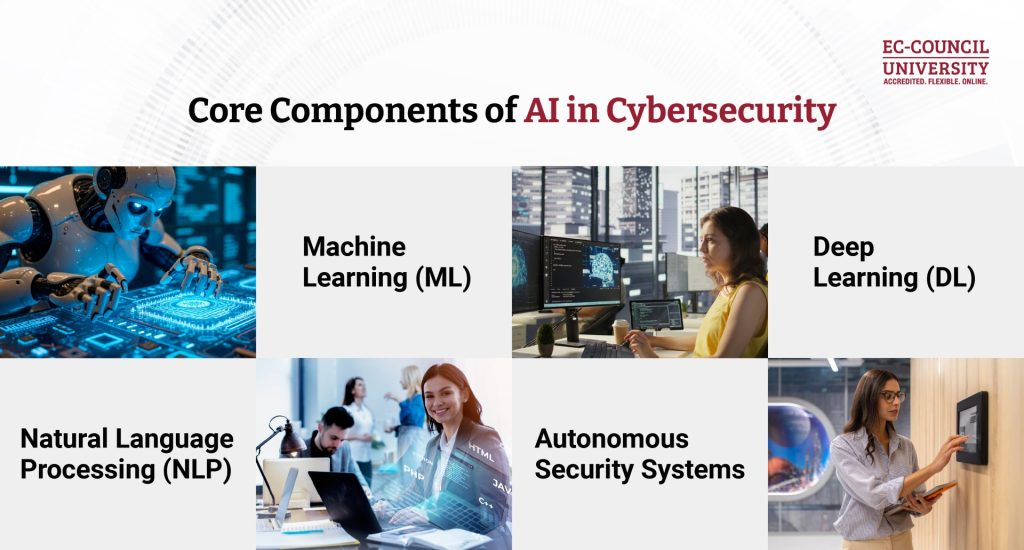
The Core Components of AI in Cybersecurity
1. Machine Learning (ML)
ML algorithms train on historical security data to identify anomalies, classify threats, and refine detection accuracy over time. As they ingest more data, they become sharper at separating real threats from false positives.
2. Deep Learning (DL)
A more advanced subset of ML, deep learning processes complex, high-dimensional data such as network traffic logs, email content, endpoint telemetry, and user behavior, uncovering threat patterns that simpler models would miss.
3. Natural Language Processing (NLP)
NLP enables AI systems to read and interpret human language, making it invaluable for analyzing phishing emails, parsing malicious scripts, and generating threat intelligence reports that security teams can act on quickly.
4. Autonomous Security Systems
These systems close the loop between detection and response. Rather than flagging a threat and waiting for a human to act, autonomous systems isolate compromised endpoints, block suspicious IPs, trigger multi-factor authentication challenges, and roll back unauthorized changes in seconds, not hours.
Together, these components give AI-powered security three capabilities that define modern cyber defense: speed, precision, and adaptability.
AI vs. Traditional Cybersecurity Approaches
To understand why AI has become the cornerstone of modern cyber defense, it helps to look at where traditional approaches fall short.
Traditional cybersecurity tools, including firewalls, antivirus software, intrusion detection systems, and SIEM platforms, were built around a reactive model. They identify threats by matching activity against known attack signatures and rule sets. When those rules are accurate, they work well. When attackers do something new, they often do not.
Cyberattacks increased by 87% in 2025, overwhelming security teams relying on legacy systems.
Here is how the two approaches compare across the dimensions that matter most:
Detection speed: Traditional tools flag threats after the fact, based on signatures already in their database. AI tools analyze behavior in real time and catch threats, including novel ones, as they unfold.
Zero-day threats: Signature-based systems are blind to unknown exploits until a patch is released. ML models detect anomalous behavior regardless of whether the attack pattern has been seen before.
False positives: Rule-based systems generate a high volume of alerts, many of which are irrelevant, creating alert fatigue for security teams. AI-driven tools improve signal quality by learning what normal looks like in a specific environment.
Scalability: Traditional tools struggle to keep pace with the volume of modern security events, as US enterprises now generate billions of events daily. AI processes this data at a scale no human team can match.
Response: Traditional systems detect and alert. Autonomous AI systems detect, decide, and act, isolating compromised endpoints and neutralizing threats without waiting for human intervention.
That said, traditional tools are not obsolete. Many organizations in 2026 are running a layered model, using AI to augment and accelerate existing SIEM, EDR, and network monitoring infrastructure rather than replacing it entirely. The gains are measurable.
IBM’s 2026 Cost of a Data Breach report shows that organizations with extensive AI and automation pay 34% less per breach compared to those without it, with costs averaging $3.62M versus $5.52M respectively.
The World Economic Forum’s May 2026 report, developed with KPMG, confirmed that 94% of cyber leaders identify AI as the biggest driver of change in the field, and 77% of organizations are already using it in their security operations.
Why AI in Cybersecurity Has Become NonNegotiable in 2026
The shift toward AI-driven security is not a technology trend. It is a response to measurable, escalating pressure on every front.
1. Threat Volume Has Outpaced Human Capacity
US enterprises generate billions of security events every day. No team of analysts, however skilled, can manually review that volume. AI filters, prioritizes, and escalates only what matters.
2. Attack Sophistication Has Crossed a New Threshold
AI-driven phishing campaigns now produce messages that are nearly indistinguishable from legitimate communication. Polymorphic malware rewrites its own signature to evade detection. Automated ransomware moves from initial compromise to data exfiltration in minutes. These are not hypothetical scenarios; they are the documented threat environment of 2026.
3. The Skills Gap Is Widening
The global cybersecurity workforce gap stands at approximately 4.8 million unfilled roles. Organizations maintain only a 72% fill rate for cybersecurity positions globally. AI does not replace cybersecurity professionals, but it extends what a smaller team can effectively manage.
4. Zero Trust Architectures Depend on AI
Zero trust security, the model now mandated by US federal agencies and widely adopted across enterprise, requires continuous verification of every user, device, and access request. AI-powered behavioral analytics make this feasible at scale. Without AI, zero trust frameworks are too resource-intensive to maintain.
5. Regulation and Compliance Are Tightening
Across banking, healthcare, and critical infrastructure, compliance mandates are increasingly requiring AI-enabled monitoring. The EU AI Act’s full compliance deadline falls in August 2026. In the US, CISA, NIST, HIPAA, and PCI DSS frameworks are integrating AI-based threat detection requirements.
How Cybercriminals Are Using AI in 2026 (Offensive Strategies)
Understanding AI in cybersecurity means understanding both sides of the equation. Threat actors have access to the same underlying technologies as defenders, and they are using them systematically.
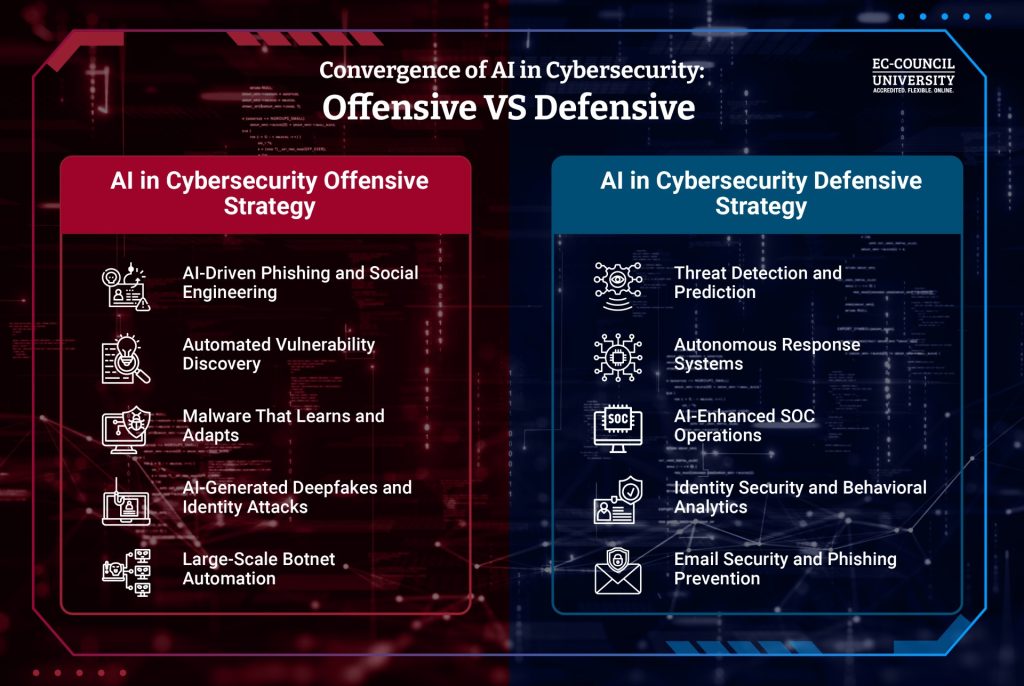
How Attackers Weaponize AI
1. AI-Driven Phishing and Social Engineering
AI makes phishing campaigns hyper-targeted and harder than ever to identify. Attackers now use:
- Deepfake voice calls impersonating executives (CEO fraud, BEC attacks)
- NLP-generated phishing emails tailored to specific individuals using publicly available profile data
- Automated social profiling from LinkedIn, corporate websites, and news sources
Learn More: The Rising Threat of AI–Powered Phishing: What It Is, How to Detect It, and How to Prevent It
2. Automated Vulnerability Discovery
AI accelerates the attacker’s reconnaissance phase dramatically. Automated tools now:
- Scan for security misconfigurations across thousands of systems simultaneously
- Identify zero-day vulnerabilities and rank exploits by probability of success
- Compress the time between vulnerability discovery and active exploitation from weeks to hours
3. Malware That Learns and Adapts
AI-powered malware introduces a new category of threat: software that evolves in response to defensive countermeasures. These variants:
- Mutate their signatures to bypass signature-based detection
- Learn from failed intrusion attempts and adjust their approach
- Conceal themselves inside legitimate system processes (fileless malware)
4. AI-Generated Deepfakes and Identity Attacks
Deepfake technology has become a mainstream attack vector. Cybercriminals use it to:
- Create synthetic video and audio of executives to authorize fraudulent transactions
- Generate fake biometric data to bypass authentication systems
- Build synthetic identities for financial fraud at scale
Deepfake-as-a-service platforms are now accessible on the dark web, lowering the barrier for attackers without technical expertise.
5. Large-Scale Botnet Automation
AI has made botnets significantly more capable, enabling:
- Autonomous command-and-control decision-making without human operators
- Real-time DDoS adaptation in response to target defenses
- Automated credential stuffing at previously impossible scale
The result has been a measurable rise in AI-powered DDoS extortion campaigns targeting financial services, healthcare, and utilities.
How AI Powers Cyber Defense in 2026 (Defensive Strategies)
As offensive AI has grown more capable, defensive AI has kept pace. In 2026, AIpowered security systems form the operational backbone of enterprise and government cyber defense in the United States.
Core AI-Driven Defensive Capabilities
1. Threat Detection and Prediction
AI correlates signals across multiple data sources, including network logs, user behavior, endpoint telemetry, cloud traffic, and email, to identify anomalies and flag threats before they escalate. Predictive models use historical attack patterns and threat intelligence feeds to anticipate likely attack vectors.
2. Autonomous Response Systems
When a threat is confirmed, AI-powered security platforms respond in seconds rather than waiting for analyst review. Autonomous actions include:
- Isolating compromised endpoints from the network
- Blocking malicious IP addresses
- Terminating suspicious processes
- Triggering MFA challenges for anomalous login attempts
- Rolling back unauthorized file changes
Reducing mean time to respond (MTTR) is one of the most significant ways AI lowers the financial and operational impact of a breach.
3. AI-Enhanced SOC Operations
Security Operations Centers face alert volumes that would paralyze any team without automation. AI helps by:
- Prioritizing alerts by severity and likelihood of true positive
- Reducing false positives to focus analyst attention where it matters
- Correlating attack signals across systems to reconstruct attacker behavior
- Providing real-time forensic insights that accelerate investigation
This is not about replacing analysts. It is about making them far more effective, which matters critically given the global talent shortage.
4. Identity Security and Behavioral Analytics
User and Entity Behavior Analytics (UEBA), powered by AI, establishes a baseline of normal behavior for every user and device on a network. Any deviation, such as accessing unusual systems at unusual hours, sudden privilege escalation, or lateral movement, triggers an alert. This makes AI the engine behind effective zero-trust security, catching:
- Insider threats
- Compromised account takeovers
- Lateral movement by attackers already inside the network
- Privilege escalation attempts
5. Email Security and Phishing Prevention
AI scans email content, metadata, sending domains, link destinations, and attachment behavior to identify phishing attempts that traditional filters miss. The ability to analyze linguistic patterns and sender reputation in real time has significantly reduced phishing success rates for organizations with AI-powered email security deployed.
Explore: Proactive Security with AI: Predicting and Preventing IT Incidents
What Are the Key Benefits of AI in Cybersecurity?
The case for AI-powered security is no longer theoretical. Organizations deploying it are seeing measurable returns across speed, accuracy, cost, and resilience.
Faster Threat Detection
AI identifies threats in near real time. IBM’s 2026 data shows AI cuts average breach detection time from 181 days to 51 days, a dramatic improvement that limits attacker dwell time and reduces damage scope.
Greater Accuracy, Fewer False Alarms
Machine learning reduces alert noise by learning what normal looks like in a given environment. Analysts spend their time on threats that actually matter.
Reduced Operational Burden
Automation handles high-volume, repetitive tasks such as log monitoring, alert triage, and routine incident response, freeing security professionals to focus on complex investigations and strategic work.
Proactive, Predictive Defense
Predictive analytics enable organizations to identify likely attack vectors before they are exploited, shifting security posture from reactive to anticipatory.
Stronger Zero-Trust Implementation
AI enables continuous identity verification, behavioral monitoring, and access decisioning at the speed and scale zero-trust frameworks require.
Faster Incident Response
Autonomous systems execute containment in seconds. For modern attacks that move from access to exfiltration in under an hour, that speed is the difference between a contained incident and a serious breach.
Protection Against Evasive Threats
AI catches polymorphic malware, fileless attacks, and unknown exploits that signaturebased tools cannot detect.
Measurable Cost Savings
Lower breach costs, reduced downtime, and fewer analyst hours spent on false positives translate to ROI that security leaders can quantify.
Top AI-Powered Cybersecurity Tools in 2026
AI-powered tools now span every layer of enterprise security, from individual endpoints to network traffic, cloud environments, identity systems, and email infrastructure.
1. Endpoint Detection and Response (EDR)
EDR tools run on individual devices to detect and stop threats using AI behavioral models rather than static signatures.
- CrowdStrike Falcon: AI/ML engine that analyzes endpoint behavior and cloud telemetry to block malware and emerging threats
- SentinelOne Singularity: Autonomous detection and remediation with ransomware rollback capability
- Sophos Intercept X: Deep learning-based detection for previously unknown threats
2. Network Traffic Analysis (NTA) and Intrusion Detection
These tools use AI to understand normal network behavior and flag deviations that indicate sophisticated threats.
- Darktrace: Self-learning AI that models normal behavior and detects anomalies in real time
- Vectra AI: AI-driven detection of lateral movement and hidden attacker activity
3. Security Information and Event Management (SIEM) + UEBA
AI enhances SIEM platforms by correlating millions of log entries, reducing false positives, and surfacing high-risk activity. UEBA models flag unusual user behavior indicating insider threats or compromised accounts.
- IBM QRadar AI: AI-enhanced event correlation and threat prioritization for SOC teams
- Splunk UBA/SIEM: ML models that analyze behavior across users and devices
- Exabeam Security Management Platform: Behavioral analytics with automated response workflows
4. Extended Detection and Response (XDR) / Cloud AI Defense
XDR platforms unify signals from endpoints, networks, cloud environments, identity systems, and applications. AI interprets this data to detect complex attacks, automate responses, and reduce alert fatigue.
- Palo Alto Networks Cortex XDR/XSIAM: Unified threat detection with AI orchestration
- Microsoft Defender for Endpoint and Security Copilot: AI-driven coverage across identity, endpoint, and cloud with AI agents that assist with threat triage
5. Phishing Detection and Email Security
AI-powered email security tools analyze content, metadata, sending reputation, links, and attachments to catch phishing campaigns that rule-based filters miss, including highly personalized spear-phishing attacks.
6. Deepfake Detection and Identity Security
As deepfake-based fraud has scaled, dedicated AI tools for synthetic media detection have become part of enterprise security stacks.
- Vastav.AI: AI-based deepfake detection for audio and video authenticity verification
7. Security Orchestration, Automation, and Response (SOAR)
SOAR platforms use AI to coordinate across security tools, execute automated playbooks for known threat scenarios, and assist analysts in triaging and prioritizing response actions.
Why AI Skills Matter in Cybersecurity
The integration of AI into security operations has changed what it means to be a cybersecurity professional. Technical skills alone are no longer sufficient. Organizations need people who understand both the threat landscape and the AI systems defending against it.
ISC2 identifies AI/ML as the number one skill in cybersecurity hiring for 2026, cited by 41% of security teams as their top requirement.
That demand has consequences. The 2026 SANS/GIAC Cybersecurity Workforce
Research Report found that the real crisis is not just unfilled headcount; it is the skills gap within existing teams. AI is automating entry-level tasks that historically trained junior analysts, accelerating the need for professionals who can operate and interpret AI-driven security systems from earlier in their careers.
What AI-Fluent Cybersecurity Professionals Need to Know
- Managing and configuring AI-powered security platforms (EDR, XDR, UEBA, SOAR)
- Interpreting AI outputs and investigating the threats AI surfaces
- Understanding the limitations of AI models, including adversarial attack vectors that target the AI itself
- Responsible and ethical use of AI in security operations
- Prompt engineering for generative AI tools used in threat analysis, reporting, and remediation
- AI governance and compliance, particularly as regulatory mandates expand
Demand for AI-capable security professionals far outstrips the current training pipeline. Organizations that invest in upskilling existing teams, and professionals who build AI competencies proactively, are positioned to lead in the next decade of cybersecurity.
Across industries, the sectors with the highest demand for AI-integrated cybersecurity expertise include financial services, which leads with an 82% AI integration rate, alongside healthcare, government and defense, and technology.
Explore EC–Council University’s Cybersecurity and AI Programs
The Future of AI in Cybersecurity: Key Trends for 2026 and Beyond
The trajectory of AI in cybersecurity points toward greater autonomy, deeper integration, and higher stakes on both sides of the threat landscape.
1. AI-First Security Architectures
Organizations are redesigning security infrastructure with AI at the center, not as a layer added on top of legacy systems, but as the core decision-making engine.
2. Fully Automated SOC Operations
Security Operations Centers are moving toward AI handling alert triage, initial investigation, forensic analysis, and threat hunting. Analysts will focus on highcomplexity cases and strategic decisions that require human judgment. This is augmentation, not replacement.
3. AI-Powered Zero-Trust Frameworks
The next generation of zero-trust security will be AI-native, using behavioral analytics, continuous authentication, and real-time risk scoring to enforce access policies dynamically rather than periodically.
4. The Generative AI Arms Race
Defenders are using generative AI for automated reporting, malware analysis, and threat intelligence generation. Attackers are using it to build more convincing social engineering campaigns and create adaptive malware. This dynamic will define the cybersecurity frontier for years ahead.
5. Regulatory Expansion
US federal and state mandates for AI-based monitoring are expanding, particularly in critical infrastructure. The EU AI Act’s August 2026 compliance deadline sets a global precedent, requiring adversarial testing of high-risk AI systems and increasing accountability for AI-driven security decisions.
6. Quantum-Aware AI Security
As quantum computing capabilities advance, AI will be essential for managing the transition to quantum-resistant cryptographic standards and anticipating the security implications of quantum-enabled attacks.
How Businesses Can Adopt AI in Cybersecurity in 2026
Integrating AI into your security posture is not a single purchase decision. It requires assessment, sequencing, governance, and ongoing optimization.
1. Start with an AI Readiness Assessment
Before deploying AI security tools, evaluate your current security posture, data maturity, cloud infrastructure, and the compatibility of existing tools with AI integration. This determines where AI will deliver the fastest ROI.
2. Prioritize High-Impact Use Cases First
Start with applications that produce immediate, measurable results: AI-powered email security, endpoint detection and response, behavioral analytics, and automated incident response. These tend to deliver the fastest returns and build organizational confidence in AI-driven operations.
3. Integrate AI into Your Zero-Trust Framework
Use AI for continuous authentication, access decisioning, and privilege monitoring. AI makes zero-trust practical at enterprise scale.
4. Invest in Team Upskilling
Your AI tools are only as effective as the people operating and interpreting them. Ensure your security team has training in managing AI systems, understanding AI outputs, responsible AI use, and prompt engineering for generative AI-based tools. Increasingly, employers are prioritizing candidates with demonstrated AI fluency alongside traditional cybersecurity credentials.
5. Establish AI Governance and Ethical Controls
Define data privacy policies, bias detection mechanisms, model transparency requirements, and responsible use guidelines before deploying AI at scale. This prevents misuse, supports regulatory compliance, and maintains stakeholder trust.
6. Choose Vendors Carefully
Evaluate AI security vendors on model accuracy, integration ease, real-time response capabilities, cloud compatibility, and alignment with US compliance frameworks including HIPAA, NIST, CISA, and PCI DSS.
7. Continuously Monitor and Optimize AI Performance
AI security systems require ongoing performance monitoring and fine-tuning. Detection accuracy, false positive rates, and response effectiveness should be tracked and improved iteratively as your threat environment evolves.
Read: Generative AI for Business: What Every Business Leader Should Know
AI as the Cornerstone of Cyber Resilience in 2026 and Beyond
In 2026, AI stands at the center of both cybersecurity innovation and the evolution of cybercrime. Attackers are using it to scale, personalize, and accelerate. Defenders are using it to anticipate, automate, and respond faster than any human team could alone.
For US organizations, adopting AI in cybersecurity is no longer a question of competitive positioning. It is foundational to regulatory compliance, operational resilience, and long-term digital trust. Organizations that build AI-driven security strategies now will be better prepared for the challenges of the next decade, where speed, intelligence, and automation determine the difference between a contained incident and a catastrophic breach.
The professionals who will lead that defense are the ones developing AI competencies alongside deep cybersecurity expertise today.
EC-Council University’s Master of Science in Computer Science is built precisely for this moment, with a curriculum that bridges cybersecurity, artificial intelligence, blockchain, and advanced computing. As the academic arm of EC-Council, the global leader in cybersecurity certifications, ECCU equips graduates with the hands-on expertise to lead, innovate, and defend at the forefront of global cybersecurity.
Explore the Master of Science in Computer Science at EC–Council University
Frequently Asked Questions
AI in cybersecurity refers to the application of machine learning, deep learning, natural language processing, and autonomous systems to detect, prevent, predict, and respond to cyber threats. Unlike traditional rule-based security tools, AI-powered systems learn from data and adapt to new threat patterns over time.
AI analyzes large volumes of security data, including network traffic, user behavior, endpoint activity, and email content, to identify patterns that indicate a threat. It does this in real time, flagging anomalies, correlating signals across systems, and predicting attack vectors before they are exploited. Detection times that once averaged 181 days have been reduced to 51 days in organizations with mature AI deployments.
Key benefits include faster threat detection and response, greater accuracy with fewer false positives, reduced analyst workload through automation, proactive defense via predictive analytics, stronger zero-trust implementation, and measurable cost savings. IBM’s 2026 data indicates a 34% reduction in breach costs for organizations with extensive AI and automation.
AI significantly improves phishing prevention. AI-powered email security tools analyze language patterns, sender reputation, link destinations, and metadata to catch phishing attempts that rule-based filters miss, including highly targeted spear-phishing and AIgenerated campaigns. While no tool eliminates risk entirely, AI dramatically reduces phishing success rates when combined with user awareness training.
AI security systems face several risks: adversarial attacks that deliberately manipulate AI models, bias in training data that leads to inaccurate detection, over-reliance on automation that reduces analyst skill development, and governance challenges around model transparency and accountability. Organizations must pair AI deployment with strong governance frameworks, ongoing model performance monitoring, and clear human oversight.
Machine learning is used across multiple security domains: classifying malware by behavioral signature, detecting anomalous network traffic, identifying compromised user accounts through behavioral analytics, reducing false positives in SIEM platforms, and prioritizing vulnerabilities for remediation. ML models improve over time as they process more security event data.
Financial services leads AI cybersecurity adoption with an 82% AI integration rate, driven by regulatory requirements and the high value of data. Healthcare, government and defense, technology, retail, and critical infrastructure are all major adopters. The global AI cybersecurity market was valued at approximately $44.24 billion in 2026, with strong double-digit growth projected through 2034.
The future of AI in cybersecurity includes AI-first security architectures, fully automated SOC operations, AI-native zero-trust frameworks, a generative AI arms race between attackers and defenders, expanding regulatory requirements for AI-based monitoring, and quantum-aware AI security models. The World Economic Forum’s May 2026 report found that 94% of cyber leaders identify AI as the biggest driver of change in the field, and this trajectory will only accelerate.