AI now writes code, sorts alerts, and drafts incident reports. So a fair question keeps coming up. Will it take your cybersecurity job?
If you work in security, you have probably wondered. If you plan to join the field, you have wondered harder. The answer is more interesting than a simple yes or no. AI is changing the work itself. Some tasks are fading fast. Others matter more than ever. And brand new roles are showing up.
This blog looks at what the data actually says. First, you will see what hiring looks like right now. Then we compare the roles that are growing with those that are shrinking. Entry-level jobs get special attention. That is where the change bites hardest. You will also leave with a practical plan for the year ahead.
Key Takeaways
- AI is transforming cybersecurity jobs rather than eliminating them.
- U.S. cybersecurity job postings have declined significantly this year.
- AI security and GRC roles are growing, while traditional analyst roles are declining.
- Junior roles increasingly emphasize validating AI outputs and managing cases.
- Judgment, communication, and critical thinking are becoming more valuable.
- Specialized expertise offers an advantage over generic skills in an AI-driven job market.
- The right master’s degree specialization can help prepare you for roles that require uniquely human expertise.
The Short Answer: Will AI Replace Cybersecurity Jobs?
No, AI will not replace cybersecurity as a career. But it is taking over chunks of the daily work. Alert triage, log review, and report drafting are moving to machines. People are moving toward judgment, response, and oversight.
That shift creates clear winners. Professionals who direct and check AI gain ground fast. Those who only handle routine tasks feel the squeeze. So the useful question is different. Which parts of the job will AI reshape, and how fast?
What the Latest Data Says About Cybersecurity Jobs
Long-term demand for security talent still looks strong. The U.S. Bureau of Labor Statistics tracks information security analysts closely. It projects 29% job growth from 2024 to 2034. That is much faster than the average job. It also expects about 16,000 openings every year.
Employers feel the shortage right now. In ISACA’s latest survey, 58% of organizations called their security teams understaffed. The World Economic Forum shares that outlook. It ranks security management specialists among the top five fastest-growing roles.
Hiring Has Cooled in the Short Term
Now for the harder news. CyberSN tracks U.S. cybersecurity job postings month by month. From January to September 2026, postings fell 26.4% year over year. That is the lowest level in four years. Penetration testing and analyst roles took some of the biggest hits.
Keep two things in mind, though. Postings measure demand signals, not actual jobs held. And the report does not tie the drop to AI.
What Security Pros Say About AI
ISC2 surveyed security professionals who use AI in their work. About 48% said AI makes them more optimistic about their careers. Yet 89% have seen AI recommendations lead to wrong outcomes. That gap explains why humans still make the final call.
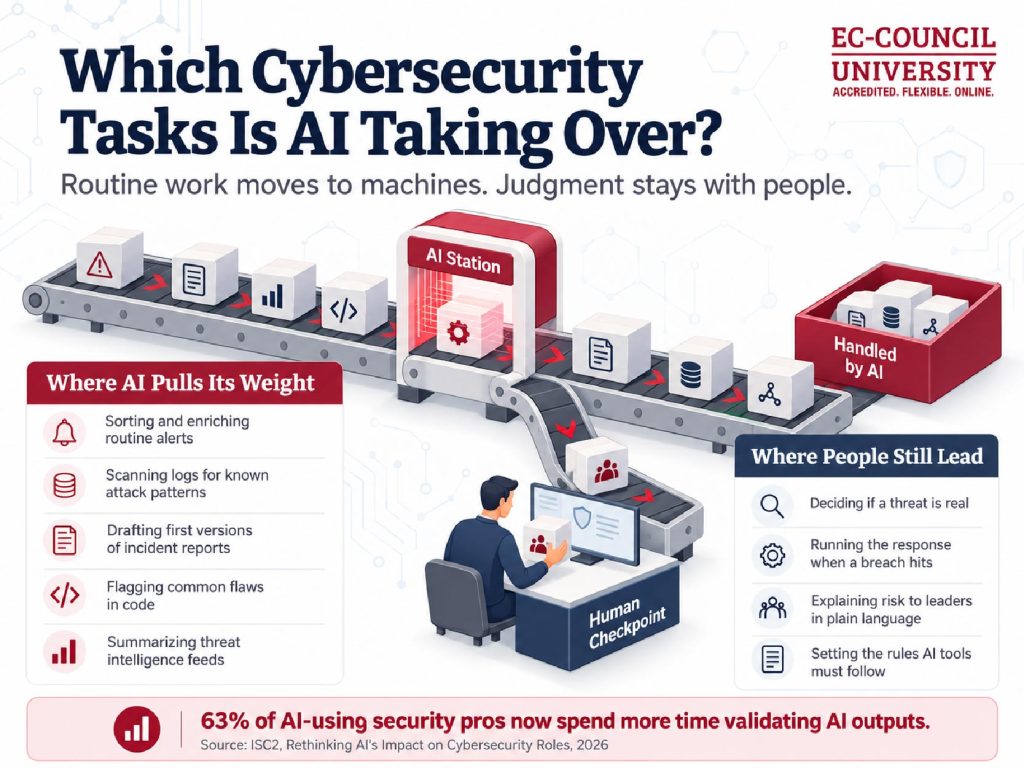
Which Cybersecurity Tasks Is AI Taking Over?
- Sorting and enriching routine alerts
- Scanning logs for known attack patterns
- Drafting first versions of incident reports
- Flagging common flaws in code
- Summarizing threat intelligence feeds
- Deciding if a threat is real
- Running the response when a breach hits
- Explaining risk to leaders in plain language
- Setting the rules AI tools must follow
Cybersecurity Roles Growing and Shrinking in 2026
Not every role faces the same future. CyberSN’s posting data shows a clear split across job types.
| Role | Trend | Change in U.S. Postings (Jan–Sep 2026 vs. 2025) |
|---|---|---|
| AI Security Engineer | Growing | +268.3% |
| Cyber Data Scientist | Growing | +203.5% |
| Cryptography / PKI Professional | Growing | +22.8% |
| Cybersecurity / Privacy Attorney | Growing | +9.1% |
| Security Analyst | Shrinking | -30.5% |
| Threat Hunter | Shrinking | -40.0% |
| Penetration Tester | Shrinking | -45.9% |
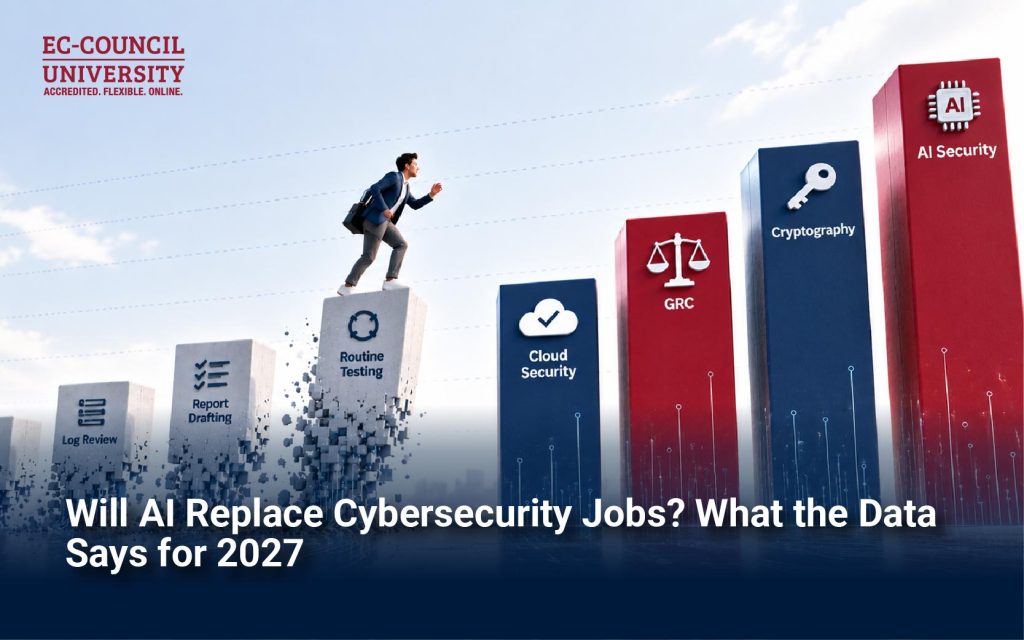
Look at what is rising. These roles secure AI, data, and encryption itself. Many grow from new agentic AI career paths. The shrinking roles lean on repeatable testing and triage.
The overall mix is shifting as well. Governance, risk, and compliance now holds 14.8% of postings. It held only 9.4% in 2023. In September, 20% of postings mentioned AI or machine learning.
Late 2026 brought some good news too. Security architect postings rose 14% from Q2 to Q3. Cloud security engineer postings climbed 8.9% over the same stretch.
What AI Means for Entry-Level Cybersecurity Jobs
Entry-level roles feel this shift first. 56% think AI reduced the need for entry-level roles. But 53% say AI is creating new kinds of entry-level work. And 62% say AI has not reduced the need for core skills.
A Stanford study offers wider context. Early-career workers in highly AI-exposed jobs saw a 13% relative employment drop. Experienced workers in the same jobs held steady or grew. That study looked at many fields, not security alone.
So what does the new first rung look like? Gartner offers a clue. By 2028, it expects SOCs to employ 50% more engineers than analysts. Analysts will own full cases instead of clearing alert queues. New hires will tune detections and test AI workflows.
The door into cybersecurity is still open. It now asks for stronger fundamentals and proof of real skill.
Skills AI Cannot Replace in Cybersecurity
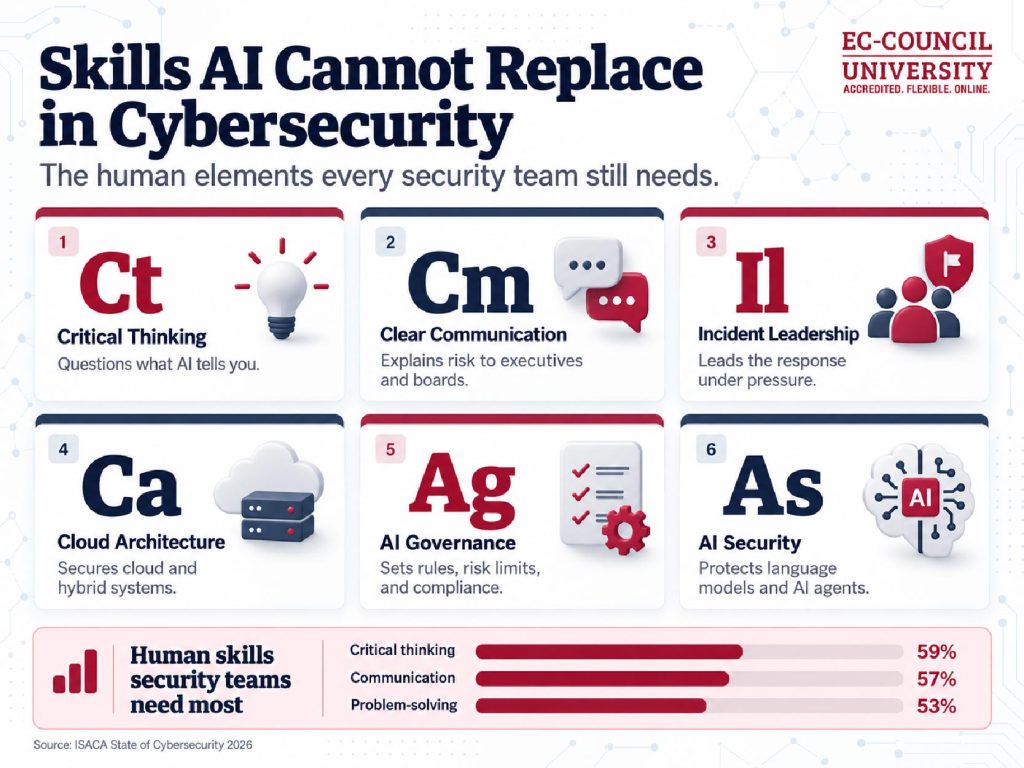
Some human skills grow more valuable as AI spreads. ISACA asked which human skills security teams still need most. Critical thinking led at 59%. Communication came next at 57%. Problem-solving followed at 53%.
Technical gaps are shifting too. 45% of ISACA respondents now see an LLM SecOps skill gap. AI also brings its own incidents. Gartner expects 50% of incident response to involve custom AI apps. That shift could land by 2028. Yet 64% of organizations have never run an AI incident drill.
Focus your growth on these areas:
- Critical thinking that questions AI output
- Clear communication with executives and boards
- Leading incident response under pressure
- Cloud and hybrid security architecture
- AI governance, risk, and compliance
- Securing large language models and AI agents
How to Future-Proof Your Cybersecurity Career for 2027
Start with one smart decision. Pick a specialty that AI makes more valuable. ECCU’s Master of Science in Cyber Security offers five focused tracks. Each one maps to skills employers are hiring for now.
Security Analyst: This track covers threat monitoring, vulnerability assessment, and SOC operations. You learn to supervise AI triage instead of racing it. That is the skill set the new SOC rewards.
Cloud Security Architect: You learn to design and secure on-premise and cloud infrastructure. Architect postings are rising again, and cloud skills travel well.
Digital Forensics: This track teaches you to investigate intrusions and preserve evidence. AI can surface clues fast. A trained investigator decides what holds up.
Incident Management and Cyber Operations: You train in incident handling, disaster recovery, and business continuity. When AI flags a real crisis, you lead the response.
Executive Leadership in Information Assurance: This track builds governance, strategy, and leadership skills. It also adds AI credentials like CAIPM and CRAGE. GRC demand keeps climbing, and AI policy needs leaders.
AI will keep changing this field every year. The people who thrive will pick a lane and go deep. Not sure which track fits you? Talk to an ECCU enrollment advisor and map your next step.
Frequently Asked Questions
Will AI completely replace cybersecurity jobs?
No. AI automates routine tasks like alert sorting and log review. Humans still judge threats, lead responses, and govern AI tools. The work changes, but the need for skilled people stays.
Is cybersecurity still a good career choice with AI?
Yes, if you build focused skills. Long-term demand projections remain strong. Short-term hiring has cooled, so generic profiles struggle more. Roles in AI security, cloud, and GRC look especially promising.
Which cybersecurity jobs are most at risk from AI?
Roles built on repetitive triage and testing face the most pressure. Think entry-level alert review and routine penetration tests. These jobs will not vanish overnight. They will simply demand more judgment and less manual effort.
Which cybersecurity jobs are safest from AI?
Jobs that need judgment and accountability hold up best. Security architects, incident leaders, and GRC professionals fit here. So do specialists who secure AI systems. Their work grows as AI spreads.
Can I still get an entry-level cybersecurity job?
Yes, but the first rung looks different now. Employers want strong fundamentals and hands-on proof. Expect to check AI output and own small cases early. Labs, certifications, and portfolio projects help you stand out.
What skills should I learn to stay relevant?
Build strong technical basics first. Then add cloud security, AI governance, or AI system security. Practice clear writing for non-technical audiences. Above all, learn to question what AI tells you.