The Cybersecurity Arms Race
Cybersecurity is no longer just a protective function. It’s become an arms race as attackers and defenders are in a constant tug-of-war, innovating, adapting, and exploiting every technological shift. As organizations sprint toward digital transformation, adversaries harness emerging technologies such as artificial intelligence (AI), advanced automation, and complex supply-chain ecosystems to launch attacks at unprecedented speed and scale.
A novel offensive breakthrough matches every defensive tactic. Today’s cybersecurity teams must outmaneuver threats that are self-propagating, AI-assisted, and highly targeted. To stay ahead, professionals must go beyond using tools and develop deep expertise, sharpen strategic foresight, and commit to continuous learning.
The 2026 Cyber Threat Reality
Understanding the broader context helps define the cybersecurity priorities for 2026. Here are five essential statistics:
- AI-Driven Attacks Are the Fastest-Growing Risk: 87% of organizations rank AI-related vulnerabilities as the fastest-growing cyber risk in 2025.
- Global Cyber Incidents Continue Rising: Over 7.5 million cyber incidents were recorded in 2025, up significantly from the prior year.
- Ransomware Dominates Attack Landscape: Ransomware-related attacks drove over half of all global cyberattacks.
- Phishing Still Leads as a Vector: 91% of successful breaches started with phishing.
- Vulnerability Volume Is Exploding: The CVE database holds over 305,000 recorded vulnerabilities, with projections of over 30,000 new disclosures in 2026 alone.
These numbers reflect a landscape in which automation, identity attacks, and large-scale extortion campaigns are reshaping how cybercriminals operate.
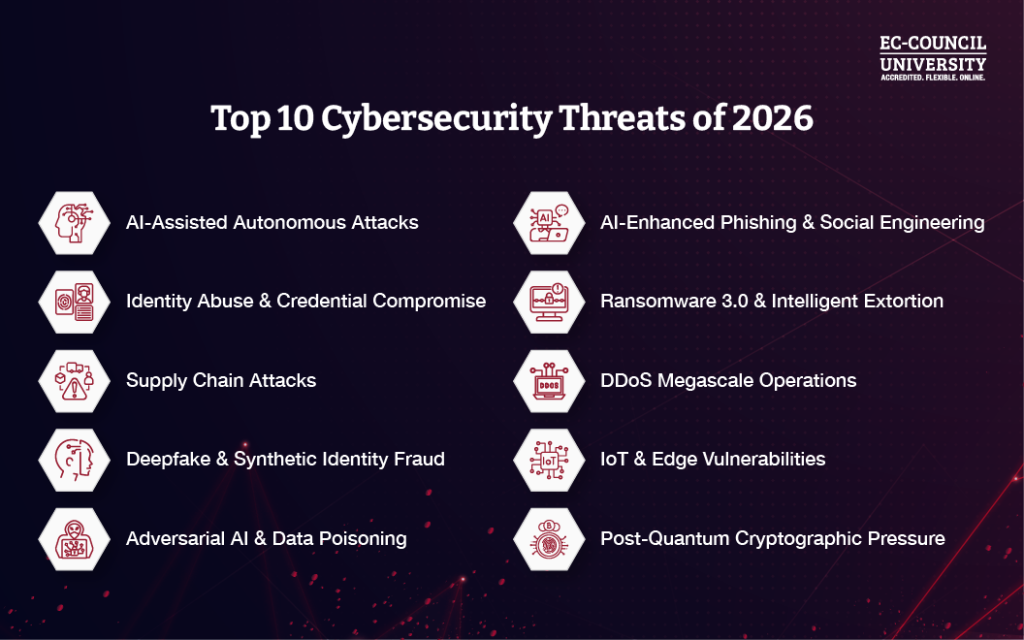
Top 10 Cybersecurity Threats of 2026
Below are the most consequential threat categories projected to define the cybersecurity battleground in 2026, along with descriptions, real-world context, key victims, and best practices for defenders.
1. AI-Assisted Autonomous Attacks
- Category: Automated Malicious AI
- Description: Attackers use AI agents to perform discovery, exploitation, and lateral movement autonomously, which drastically reduces reaction time.
- Example: AI malware uncovering and weaponizing OpenSSL vulnerabilities revealed using AI tools.
- Vulnerability: Large enterprises and cloud environments with legacy systems.
- Defense: Leverage defender-side AI for detection, adopt behavioral analytics, and constrain automated privilege escalation.
2. AI-Enhanced Phishing and Social Engineering
- Category: Social Engineering
- Description: GenAI enables highly personalized and convincing phishing content, increasing interaction rates.
- Example: Credential theft increased by 160% in 2025, driven by AI-enhanced campaigns.
- Vulnerability: Organizations without phishing-resilient MFA or ongoing awareness training.
- Defense: Enforce phishing-resistant MFA, regular red-team testing, and adaptive training.
3. Identity Abuse and Credential Compromise
- Category: Identity-Based Attacks
- Description: Compromise of tokens, service accounts, and federated identities equals malware as a top breach vector.
- Example: 75% of intrusions involve compromised identity credentials.
- Vulnerability: Cloud platforms, hybrid workforces, and unmanaged third-party accounts.
- Defense: Implement Zero Trust, continuous authentication, and strict identity governance.
4. Ransomware 3.0 and Intelligent Extortion
- Category: Ransomware/Extortion
- Description: Ransomware evolves beyond encryption to include data theft, deepfake blackmail, and individual coercion.
- Example: Record increases in ransomware victims and complex extortion demands.
- Vulnerability: Healthcare, manufacturing, critical infrastructure.
- Defense: Immutable backups, incident simulation, and segmented networks.
5. Third-Party or Supply Chain Attacks
- Category: Third-Party Risk
- Description: Attackers infiltrate trusted vendors and dependencies, affecting entire ecosystems.
- Example: Notepad++ supply chain compromise impacting targeted users.
- Vulnerability: Organizations relying on third-party software without provenance validation.
- Defense: Vendor security assessments, code integrity verification, and runtime attestation.
6. DDoS Megascale Operations
- Category: Network Disruption
- Description: Botnets launch record DDoS campaigns exceeding terabits per second.
- Example: Aisuru botnet launched a 31.4 Tbps DDoS attack that Cloudflare mitigated.
- Vulnerability: Telecoms, cloud platforms, gaming infrastructure.
- Defense: Distributed traffic scrubbing, real-time anomaly detection, and edge scaling.
7. Deepfake and Synthetic Identity Fraud
- Category: Impersonation Attack
- Description: Generative deepfakes create falsified videos or messages from trusted leaders.
- Example: Voice mimicking executives to authorize fraudulent transactions.
- Vulnerability: Enterprises lacking multi-factor verification tied to user behavior.
- Defense: Behavioral analytics, biometric safeguards, and multi-modal authentication.
8. IoT and Edge Vulnerabilities
- Category: Connected Device Exploits
- Description: IoT devices remain weak links due to poor patching and insecure firmware.
- Example: Consumer devices comprising botnet resources for DDoS campaigns.
- Vulnerability: Smart infrastructure, industrial IoT devices.
- Defense: Network segmentation, automated patching, and device identity validation.
9. Adversarial AI and Data Poisoning
- Category: AI Targeted Compromise
- Description: Attackers corrupt machine-learning models or manipulate inference outcomes.
- Example: Data poisoning, where models produce inaccurate or harmful outputs.
- Vulnerability: Enterprises reliant on unverified data pipelines.
- Defense: Secure training data, robust model testing, and adversarial detection.
10. Post-Quantum Cryptographic Pressure
- Category: Cryptography Risk
- Description: Quantum computing threatens existing encryption algorithms over the next decade.
- Example: Theoretical risk where quantum acceleration breaks RSA/ECC encryption.
- Vulnerability: Financial services, national critical infrastructure.
- Defense: Begin post-quantum algorithm planning and phased cryptographic transitions.
Why Cybersecurity Professionals Must Upskill
As threats evolve, static skill sets are no longer sufficient. Emerging attack techniques require cybersecurity professionals to be proficient in:
- AI and Machine Learning Security
- Zero Trust Architecture
- Threat Hunting and Incident Response
- Cloud and Identity Protection
- Cryptography
Professionals with advanced skills are better positioned to anticipate, mitigate, and recover, transforming reactive security into proactive defense measures.
ECCU: Your Strategic Partner in Cybersecurity Education
In this era of intensifying cyberwarfare, EC-Council University (ECCU) stands out as the ideal partner to advance your cybersecurity career. Our online degrees and certification courses are designed to address current and future threat landscapes with practical, hands-on learning.
At ECCU, you will:
- Master real-world defensive tactics
- Gain expertise in AI-driven cybersecurity
- Develop leadership skills for strategic roles
- Earn certifications recognized globally
Ready to gain the knowledge, skills, qualifications, perspective, and leadership capabilities to succeed when facing every type of cybersecurity challenge?
Frequently Asked Questions About Cybersecurity Threats in 2026
Yes. AI enables faster, more adaptive attacks, changing the speed and scale of threats.
Yes. Malware continues, but identity compromise and AI attacks are increasingly dominant.
Zero Trust enforces least-privilege access and continuous verification, which are crucial against identity attacks.
Ransomware has evolved into a multi-stage extortion scheme that combines data theft and operational disruption.
Yes. Insecure IoT devices often serve as botnet resources and as weak points in networks.
Absolutely. Cybercriminals use synthetic media to impersonate executives, manipulate individuals, and bypass security controls.
AI security, cloud security, zero trust, identity governance, cryptography, and threat hunting are key disciplines for cybersecurity professionals to focus on.
EC-Council University offers advanced learning, hands-on practice in virtual labs, future-proof coursework aligned to real-world cybersecurity applications, and industry-approved certifications along with degrees, ensuring professionals are equipped to tackle sophisticated cybersecurity threats.