Why it’s Crucial to Use Multiple Cybersecurity Tools in 2026
2026 is shaping up to be a seismic year in cybersecurity. AI-powered automated cyberattacks, deepfake-enabled social engineering, cloud-native cyber threats, and widespread supply chain vulnerabilities are among the most concerning cybersecurity challenges on the horizon. Defending digital ecosystems will require a broad arsenal of cybersecurity tools. Expertise in one or two solutions will no longer suffice, and you’ll need more than surface-level familiarity to leverage these tools properly.
Cybersecurity professionals should understand how each type of tool works, the problems it solves, the threat patterns it reveals, and how it integrates into cybersecurity workflows across SOC operations, IT security, cloud security, digital forensics, network defense, DevSecOps frameworks, and other relevant areas.
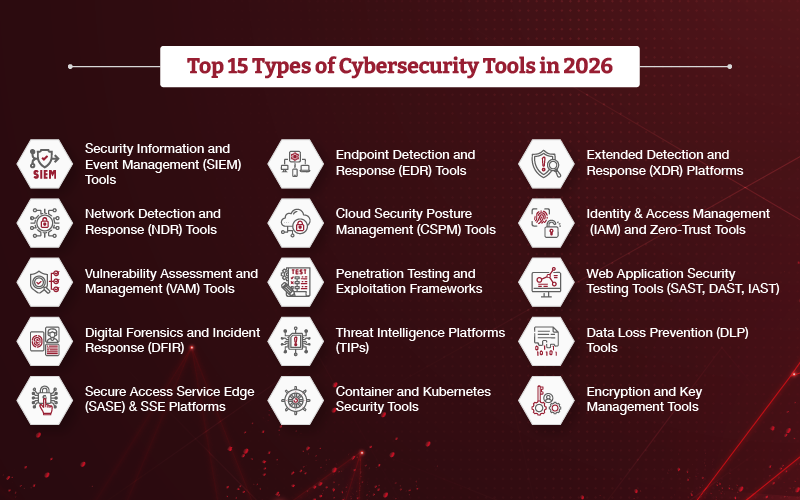
Top 15 Types of Cybersecurity Tools in 2026
Below are the 15 essential types of cybersecurity tools for cybersecurity professionals in 2026, along with descriptions, use cases, tasks performed, corresponding job roles, foundational technologies, and a popular software example for each category:
1. Security Information and Event Management (SIEM) Tools
- What These Tools Do: SIEM tools centralize logs, correlate events, and detect suspicious behavior across the environment.
- Use Cases: Detecting anomalous login patterns, correlating alerts from multiple sources, and supporting compliance audits.
- Best Tasks: Real-time threat detection, log analysis, and incident investigations.
- Job Roles That Utilize These Tools: SOC Analysts, Threat Hunters, Incident Responders.
- Technology Foundations: Big-data processing, AI analytics, correlation engines, SOAR automation.
- Popular Product: Splunk Enterprise Security
2. Endpoint Detection & Response (EDR) Tools
- What These Tools Do: EDR solutions offer continuous endpoint monitoring and automated threat containment.
- Use Cases: Blocking ransomware, investigating endpoint compromises, and monitoring suspicious processes.
- Best Tasks: Behavior analysis, endpoint forensics, and automated isolation.
- Job Roles That Utilize These Tools: SOC Analysts, Malware Analysts, MDR Specialists.
- Technology Foundations: Kernel telemetry, machine learning, behavioral threat modeling.
- Popular Product: CrowdStrike Falcon
3. Extended Detection & Response (XDR) Platforms
- What These Tools Do: XDR platforms unify endpoint, network, cloud, and identity telemetry for comprehensive detection.
- Use Cases: Correlating identity and endpoint abuse, tracking multi-stage attack campaigns, and automated SOC workflows.
- Best Tasks: Cross-domain detection, unified threat scoring, and coordinated response.
- Job Roles That Utilize These Tools: Threat Hunters, SOC Leads, Incident Response Specialists.
- Technology Foundations: AI correlation engines, data lakes, unified telemetry pipelines.
- Popular Product: Microsoft Defender XDR
4. Network Detection & Response (NDR) Tools
- What These Tools Do: NDR solutions detect threats in network traffic using deep visibility and behavioral analytics.
- Use Cases: Spotting lateral movement, detecting encrypted malicious traffic, and identifying command-and-control activity.
- Best Tasks: Packet inspection, flow analysis, and anomaly detection.
- Job Roles That Utilize These Tools: Network Security Engineers, SOC Analysts.
- Technology Foundations: Deep packet inspection (DPI), NetFlow analytics, machine learning (ML).
- Popular Product: Darktrace Network Detection
5. Cloud Security Posture Management (CSPM) Tools
- What These Tools Do: CSPM tools identify cloud misconfigurations and enforce secure cloud architecture.
- Use Cases: Detecting public S3 buckets, identifying excessive IAM privileges, and ensuring multi-cloud compliance.
- Best Tasks: Cloud configuration scanning, risk scoring, and automated remediation.
- Job Roles That Utilize These Tools: Cloud Security Architects, DevSecOps Engineers.
- Technology Foundations: API-based cloud scanning, policy-as-code, identity graphing.
- Popular Product: Prisma Cloud (CSPM module)
6. Identity & Access Management (IAM) and Zero-Trust Tools
- What These Tools Do: IAM and Zero-Trust platforms manage user authentication, enforce access policies, and secure identity flows.
- Use Cases: MFA enforcement, just-in-time access, and identity-based segmentation.
- Best Tasks: Identity governance, policy enforcement, and continuous assessment.
- Job Roles That Utilize These Tools: IAM Analysts, Security Architects, Compliance Officers.
- Technology Foundations: SAML/OAuth/OIDC, adaptive authentication, risk scoring.
- Popular Product: Okta Identity Cloud
7. Vulnerability Assessment & Management (VAM) Tools
- What These Tools Do: VAM solutions scan IT assets for vulnerabilities and prioritize remediation.
- Use Cases: Patch management, compliance monitoring, and attack surface analysis
- Best Tasks: Risk scoring, scheduled scanning, and remediation workflows.
- Job Roles That Utilize These Tools: Cyber Security Analysts, IT Engineers, Penetration Testers.
- Technology Foundations: CVSS scoring, asset discovery, automated scanning engines.
- Popular Product: Tenable Nessus
8. Penetration Testing & Exploitation Frameworks
- What These Tools Do: Penetration testing frameworks simulate real-world attacks to uncover weaknesses.
- Use Cases: Web and network penetration tests, red team operations, and security validation.
- Best Tasks: Recon, exploitation, post-exploitation, and privilege escalation.
- Job Roles That Utilize These Tools: Ethical Hackers, Penetration Testers, Red Teams, Security Consultants.
- Technology Foundations: Exploit modules, scripting engines, payload generators.
- Popular Product: Metasploit Framework
9. Web Application Security Testing Tools (SAST, DAST, IAST)
- What These Tools Do: These tools detect vulnerabilities in web applications and APIs.
- Use Cases: CI/CD pipeline security, detecting OWASP Top 10 risks, and secure code review.
- Best Tasks: Static analysis, dynamic testing, and API scanning.
- Job Roles That Utilize These Tools: Application Security Engineers, DevSecOps Professionals.
- Technology Foundations: Static code parsing, runtime instrumentation, AI vulnerability detection.
- Popular Product: Burp Suite (DAST)
10. Digital Forensics & Incident Response (DFIR) Tools
- What These Tools Do: DFIR tools collect evidence, analyze compromise details, and support investigations.
- Use Cases: Memory forensics, host artifact collection, and log timeline reconstruction.
- Best Tasks: Evidence preservation, forensic imaging, root-cause analysis.
- Job Roles That Utilize These Tools: Forensic Investigators, Incident Responders, Law Enforcement.
- Technology Foundations: File system analysis, memory analysis, forensic imaging.
- Popular Product: EnCase Forensic
11. Threat Intelligence Platforms (TIPs)
- What These Tools Do: TIPs centralize threat data, enrich IOCs, and automate intelligence sharing.
- Use Cases: Tracking threat groups, enriching SIEM alerts, and automating IOC blocking.
- Best Tasks: Threat feed ingestion, TTP analysis, and intelligence reporting.
- Job Roles That Utilize These Tools: Threat Intelligence Analysts, SOC Teams.
- Technology Foundations: STIX/TAXII, API enrichment, ML-based correlation.
- Popular Product: Recorded Future
12. Data Loss Prevention (DLP) Tools
- What These Tools Do: DLP tools prevent unauthorized data exposure and monitor sensitive information.
- Use Cases: Email data protection, end-user file monitoring, and sensitive document fingerprinting.
- Best Tasks: Sensitive data classification, policy enforcement, and content inspection.
- Job Roles That Utilize These Tools: Compliance Analysts, Cloud Security Engineers.
- Technology Foundations: Content-aware inspection, pattern matching, ML classification.
- Popular Product: Symantec DLP
13. Secure Access Service Edge (SASE) & SSE Platforms
- What These Tools Do: SASE tools integrate networking and security into cloud-native delivery models.
- Use Cases: Securing remote workforces, cloud firewalling, and secure web filtering.
- Best Tasks: Traffic routing, identity-based access control, and cloud proxy enforcement.
- Job Roles That Utilize These Tools: Network Security Engineers, Cloud Security Architects.
- Technology Foundations: Zero-trust network access, CASB/SWG integration, cloud proxies.
- Popular Product: Zscaler Zero Trust Exchange
14. Container & Kubernetes Security Tools
- What These Tools Do: These tools secure container images, Kubernetes clusters, and cloud-native workloads.
- Use Cases: Vulnerable image detection, pod misconfiguration analysis, and runtime anomaly detection.
- Best Tasks: Admission control, workload monitoring, and pipeline scanning.
- Job Roles That Utilize These Tools: DevSecOps Engineers, Cloud Security Architects.
- Technology Foundations: Sidecar agents, admission controllers, runtime instrumentation.
- Popular Product: Aqua Security
15. Encryption & Key Management Tools
- What These Tools Do: These tools secure data through encryption and manage cryptographic keys.
- Use Cases: Protecting PII and sensitive data, certificate lifecycle management, and secure key rotations.
- Best Tasks: PKI management, key vaulting, and encryption enforcement.
- Job Roles That Utilize These Tools: Cryptography Engineers, Cloud Security Analysts.
- Technology Foundations: AES, RSA, ECC, HSMs, PKI frameworks.
- Popular Product: HashiCorp Vault
Apart from knowing how to leverage multiple tools, cybersecurity professionals should also be proficient in programming languages to advance their expertise. Find out why:
https://www.eccu.edu/blog/best-programming-languages-to-learn-for-cybersecurity-professionals/
Master the Tools That Power Cybersecurity Careers at EC-Council University
In 2026, cybersecurity professionals must not only be aware of the tools available but also understand how to utilize them effectively. They must become skilled in using them to detect, prevent, respond to, and investigate threats in complex environments. EC-Council University (ECCU) offers the ideal platform for developing this expertise. Through learning options such as the Bachelor of Science in Cyber Security (BSCS), the Master of Science in Cyber Security (MSCS), Graduate Certificate Programs (GCP), and Non-Degree Courses (NDS), students gain hands-on experience with SIEMs, EDRs, forensics platforms, cloud security tools, penetration testing frameworks, and more. ECCU’s industry-aligned curriculum ensures that graduates are ready to operate fundamental tools, solve real incidents, and excel in high-demand cybersecurity roles.
Whether your goal is to become a Cyber Security Analyst, Security Engineer, Cloud Security Architect, Penetration Tester, or future CISO, ECCU gives you the technical mastery and strategic understanding needed to succeed.
For more information:
Common Questions About Cybersecurity Tools in 2026
SIEM, EDR, XDR, CSPM, IAM/Zero-Trust, and DFIR tools will be required for nearly all cybersecurity roles in 2026.
Yes. Modern cybersecurity relies on integrated, layered defenses. This means cybersecurity professionals must understand tools across identity, cloud, endpoints, and networks to effectively protect their organizations.
Absolutely. As most IT infrastructures shift to cloud-based environments, cloud security tools such as CSPM and Kubernetes security platforms have become essential to protect businesses from cyberattacks.
Penetration testing tools, DevSecOps tools, and some automation-heavy tools will require knowledge of coding languages such as Python, Bash, and PowerShell.
Hands-on labs, guided projects, academic programs taught by industry experts, and virtual cybersecurity ranges. EC-Council University offers all of these within its cybersecurity degrees.