Why Cybersecurity Is the Smartest Career Move for Working Professionals Right Now
Cybersecurity has quickly moved from a niche IT specialty to a critical function and an integral part of business across every industry. From healthcare and finance to retail and government, organizations across sectors require skilled professionals who can protect sensitive systems and data.
For working professionals, this shift presents a unique opportunity in cybersecurity, offering strong job security, competitive salaries, and long-term career growth. With this, earning a cybersecurity degree has become one of the smartest career investments for working professionals.
But here’s the challenge: How do you balance a full-time job with the demands of earning a cybersecurity degree?
If you’re already employed, especially in IT, networking, or a technical role, you may feel torn between career responsibilities, personal commitments, and academic goals.
The good news? With the right strategy and the right university, you can successfully manage your personal, professional, and academic commitments.
Why Working Professionals Are Choosing to Pursue Cybersecurity Degrees
Cybersecurity is no longer a niche field but a business necessity. Here are some reasons why you may be witnessing a growing trend of professionals pursuing an online cybersecurity degree while working:
- Career advancement and leadership opportunities
- Higher earning potential
- Transitioning into cybersecurity from IT or non-IT roles
- Staying relevant in a rapidly evolving digital economy
- Gaining globally recognized credentials
However, traditional on-campus programs often lack the flexibility required by working professionals. That’s where online cybersecurity degrees come in.
The Reality of Studying While Working Full-Time
Balancing a degree program with a full-time job is not easy, and anyone who says otherwise probably has not done it.
What Are the Common Challenges Working Professionals Face While Studying and Working Full-Time
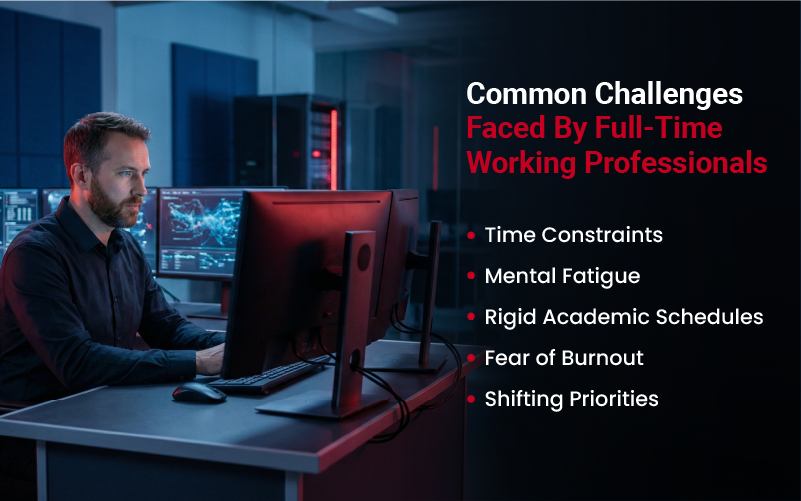
Let’s understand the real challenges professionals face:
- Time Constraints
Long working hours, commuting, and family obligations leave little room for studying. - Mental Fatigue
After a full workday, studying complex topics like cryptography, ethical hacking, or cloud security can feel overwhelming. - Rigid Academic Schedules
Fixed class times and in-person exams don’t work well for professionals with unpredictable workloads. - Fear of Burnout
Without proper balance, juggling work and education can impact performance in both areas. - Shifting Priorities
Family, career growth, and education all compete for attention
Why Traditional On-Campus Programs Don’t Work
Conventional, on-campus cybersecurity programs often assume students can:
- Attend fixed daytime classes
- Commit to rigid academic calendars
- Spend significant time commuting
For working professionals, these expectations are simply unrealistic. The key to success is choosing a program designed for working professionals, not one that fits into a rigid academic model.
What Working Professionals Need from a Degree Program
To succeed, working professionals need:
- Flexible scheduling that adapts to work demands
- Predictable weekly workloads
- Practical, job-relevant curriculum
- Online access to labs and resources
- Support designed for working professionals
How to Successfully Balance a Cybersecurity Degree with a Full-Time Job
1. Choose a 100% Online and Flexible Cybersecurity Program
Flexibility is non-negotiable when you are working full-time. A fully online program allows you to:
- Study from anywhere, and anytime
- Access lectures and materials as per your schedule
- Avoid commuting and relocation costs
- Learn at your own pace
Institutions like EC-Council University offer 100% online cybersecurity degree programs built specifically for professionals who need flexibility without compromising academic rigor.
2. Align Your Studies with Your Career Goals
Instead of viewing your degree as “extra work,” align it with your professional growth:
- Apply coursework concepts directly to your job
- Use real-world projects to solve workplace challenges
- Build expertise in high-demand areas like ethical hacking, cloud security, and risk management
EC-Council University’s cybersecurity bachelor’s and master’s degree curricula are industry-aligned, helping students gain practical, job-relevant skills while studying.
3. Create a Realistic Study Schedule and Stick to It
Time management is everything.
Tips for working professionals:
- Block study hours into your calendar like meetings
- Study in short, focused sessions (60–90 minutes)
- Use weekends for deeper learning or project work
- Avoid overloading courses per term
With flexible course structures, EC-Council University allows students to pace their learning to complement full-time employment.
4. Leverage Asynchronous Learning
Asynchronous learning means you’re not tied to live lectures or fixed class times.
Benefits include:
- Study early mornings or late nights
- Learn during travel or breaks
- Rewatch lectures for better understanding
EC-Council University’s online platform supports asynchronous learning, empowering professionals to study when they’re most productive.
5. Use Your Employer Experience as an Advantage
Many cybersecurity concepts become easier when you can:
- Relate theory to real incidents
- Understand organizational security challenges
- Build case studies from your work environment
EC-Council University encourages practical application, helping students turn professional experience into academic success.
6. Prioritize Self-Care to Avoid Burnout
Balancing work and study doesn’t mean sacrificing your health.
Best practices:
- Schedule breaks and downtime
- Get adequate sleep
- Exercise regularly
- Set boundaries with work and study time
Flexible online programs help reduce stress by eliminating unnecessary pressure and rigid deadlines.
Why EC-Council University Is Ideal for Working Cybersecurity Professionals
Designed for Professionals: How ECCU Makes It Work
EC-Council University’s 100% online and flexible cybersecurity programs are designed specifically for professionals like you. When it comes to balancing a cybersecurity degree with a full-time career, ECCU programs are the best option. This is mainly for professionals who want to upskill and advance without stepping away from their careers.
Flexible Learning Model
- 100% online coursework
- Asynchronous lectures, you can access them anytime
- No required campus visits
Career Focused Education
- Industry-aligned curriculum by cybersecurity experts
- Practical hands-on learning to develop real-world skills
- In-built EC-Council certifications embedded in your degree
Realistic Weekly Commitment
- Clearly defined weekly expectations
- Designed to fit around a standard full-time job
- No surprise workloads or last-minute exams
Modular Program Structure
- Courses broken into manageable modules
- Focused learning objectives each term
- Easier to plan and stay consistent
This structure helps professionals stay on track without sacrificing work performance or personal time.
A Week in the Life of an ECCU Cybersecurity Student
So, what does balancing work and study actually look like?
Monday–Friday
- Watch recorded lectures during evenings or lunch breaks
- Review reading materials or discussion posts
- Apply concepts directly at work when relevant
Weekend
- Complete hands-on labs
- Work on assignments or projects
- Prepare for the upcoming module
Most students find that consistent, smaller study blocks work better than cramming and making the workload feel manageable even during busy weeks.
Work + Study = A Real-World Advantage
One of the most significant benefits of studying cybersecurity while working is the ability to apply what you learn immediately.
Applying Classroom Concepts on the Job
- Security frameworks make more sense in real environments
- Risk management becomes tangible
- Policy and compliance concepts feel practical, not theoretical
Hands-On Labs That Reinforce Learning
ECCU’s programs emphasize applied learning through labs and simulations, helping students:
- Build confidence with tools and technologies
- Develop job-ready skills
- Bridge the gap between theory and practice
Who Should Consider ECCU’s Cybersecurity Programs?
ECCU’s programs are a strong fit for:
- IT professionals looking to specialize in cybersecurity
- Career switchers seeking a stable, in-demand field
- Working adults who need flexible, online education
- Professionals aiming for long-term career growth without career disruption
You Don’t Have to Choose Between Career and Education
Balancing a full-time career with a cybersecurity degree is absolutely achievable if you choose the right program. Advance your cybersecurity career without hitting a pause
With:
- 100% online delivery
- Flexible scheduling
- Industry-aligned coursework
EC-Council University empowers professionals to advance their education without putting their careers on hold.
If you’re ready to future-proof your career, enhance your cybersecurity expertise, and learn on your terms, an online cybersecurity degree from EC-Council University could be your most brilliant next move.
Ready to take the next step without stepping away from your career?
Explore ECCU’s cybersecurity programs and start building your future today-
Frequently Asked Questions
Most students plan for 10–15 hours per week, depending on the course and their familiarity with the material.
Yes. All ECCU cybersecurity programs are 100% online and asynchronous learning, designed for working professionals.
Absolutely. The program structure is built specifically for students balancing full-time employment.
Not necessarily. The BSCS is designed for those new to the field, while the MSCS is ideal for professionals with technical or IT backgrounds.