Duration
Mode of Study
Certification
Cost Per Credit Hour
"*" indicates required fields

10 modules featuring immersive video lectures and digital books for an in-depth understanding of every topic.

Simulate real-world scenarios for hands-on practice with the latest cybersecurity tools.

Engaging quizzes after each module that measure and reinforce your knowledge of the topics covered.

Interactive discussion boards where you exchange ideas and views on the course topics with your peers and professors.

Software tools that enhance your learning experience, such as Grammarly.

Round-the-clock online library with an expansive collection of free-to-use learning resources.

Includes EC-Council's industry-approved Certified Responsible AI Governance & Ethics (C|RAGE) certification.
The global AI governance market is expected to grow from $419.45 million in 2026 to approximately $4.8 billion by 2034. (Source: Precedence Research)
Build a foundational understanding of core AI concepts, architectures, lifecycle stages, and enterprise AI systems. You will explore how AI has evolved, how modern AI technologies work, and how organizations develop and operationalize AI solutions.
Develop an AI strategy that aligns with organizational priorities and enables responsible, scalable, and value-driven AI adoption.
Implement governance frameworks and responsible AI practices that ensure AI systems remain trustworthy, compliant, and sustainable throughout their lifecycle.
Evaluate the ethical, legal, societal, and regulatory considerations that govern responsible AI, and assess the compliance and lifecycle risks that organizations must manage when deploying AI systems.
Understand AI-related risks across the lifecycle, including security, privacy, compliance, and third-party exposures, and learn how to implement governance practices that ensure trustworthy, compliant, and sustainable AI solutions. Explore the growing risks posed by dependencies on third-party AI vendors.
Acquire deep knowledge on AI security principles, established architectural frameworks, considerations, and practical controls that protect AI systems from development to deployment.
Examine the foundational principles of AI privacy, trust, safety, and ethics, and evaluate how these pillars protect users and ensure responsible AI behavior throughout the system lifecycle.
Explore how organizations can prepare for, detect, and respond to AI-related incidents while maintaining business continuity. Learn how to assess lifecycle risks, implement governance frameworks, and establish response procedures that protect privacy, ensure compliance, and keep AI systems operating safely under stress.
Detect vulnerabilities, measure fairness and transparency, and apply governance-aligned audit practices that strengthen accountability across the AI lifecycle.
AI Policy Director
Head of Governance, Risk & Compliance (GRC)
GRC Manager
Director, Risk Management
Risk Manager
Head of Enterprise Risk Management (ERM)
Operational Risk Manager
Director, Compliance
Compliance Manager
Director, Regulatory Affairs
Regulatory Compliance Manager
Chief Privacy Officer
Director of Privacy
Privacy Program Manager
Data Protection Officer (DPO)
Data Governance Manager
Director, Data Governance
Internal Audit Manager (Technology/IT)
Technology Audit Manager
Director, Internal Audit
And Many More!
Fill out the NDS application form and submit it to our Enrollment Advisor.
Send us a scanned copy of your official government identification and documents showing proof of education.
Pay the one-time $100 application fee.
Here’s what our students say about this course and how it helped advance their cybersecurity careers.
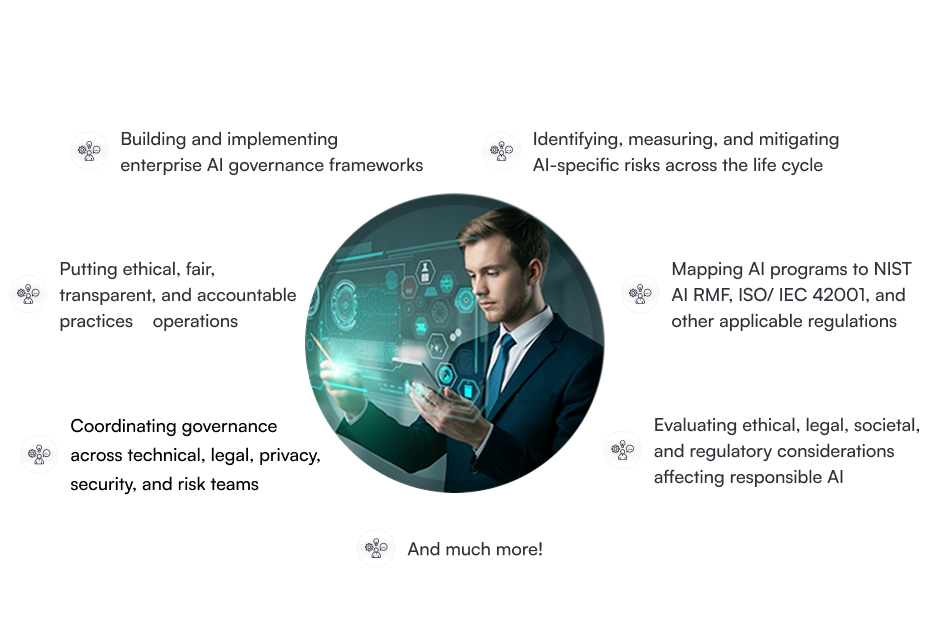
The Certified Responsible AI Governance & Ethics (C|RAGE) course trains professionals to lead AI governance practices, ensure compliance, and implement audit-ready AI programs.
C|RAGE is ideal for CISOs, GRC specialists, Data Protection Officers, Technology Auditors, AI Program Managers, and anyone responsible for AI governance, compliance, or policy creation at the enterprise level.
"*" indicates required fields