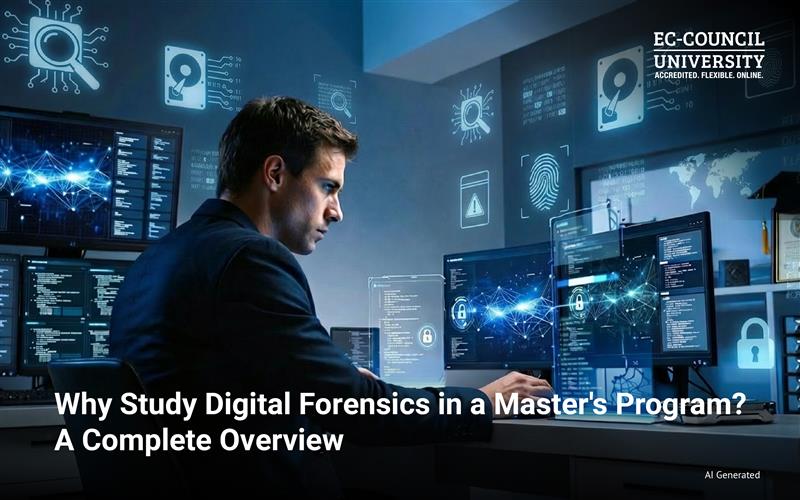
The Rising Importance of Digital Forensics
Cybercrime is a global reality in 2026. From ransomware attacks targeting hospitals to insider threats leaking sensitive corporate data, nearly every major cyber-attack or data breach incident leaves behind a trail of digital evidence crucial for investigation.
The surge in:
| ➢ Sophisticated ransomware campaigns | ➢ Large-scale data breaches |
| ➢ Insider threats and corporate espionage | ➢ AI-generated fraud and deepfake scams |
➢ Cloud and IoT vulnerabilities | |
Such incidents and attacks have made digital forensics a mission-critical discipline across enterprises, law enforcement agencies, and national security organizations.
Government bodies such as the Federal Bureau of Investigation are increasingly relying on digital evidence to solve crimes that originate in cyberspace. Meanwhile, corporate organizations are investing heavily in forensic readiness. This is to ensure quick response to incidents and reduced legal and financial damage.
What Is Digital Forensics and Why Does It Matter Today
Digital forensics is all about identifying, preserving, analyzing, and presenting digital evidence in a legally most admissible way.
It involves:
- Recovering deleted or encrypted files
- Analyzing network logs and intrusion artifacts
- Investigating mobile devices and cloud platforms
- Reconstructing cyberattack timelines
- Maintaining strict chain-of-custody documentation
In today’s landscape, digital forensics matters because:
- Every cyberattack requires investigation.
- Regulatory frameworks demand evidence-backed incident reporting.
- Courts require technically sound, defensible digital evidence.
- Organizations must understand root causes to prevent repeat attacks.
As cyber threats become more advanced and AI-powered, forensic investigators are those professionals who separate speculation from provable facts.
Digital Forensics Careers In-Demand That You Can Pursue
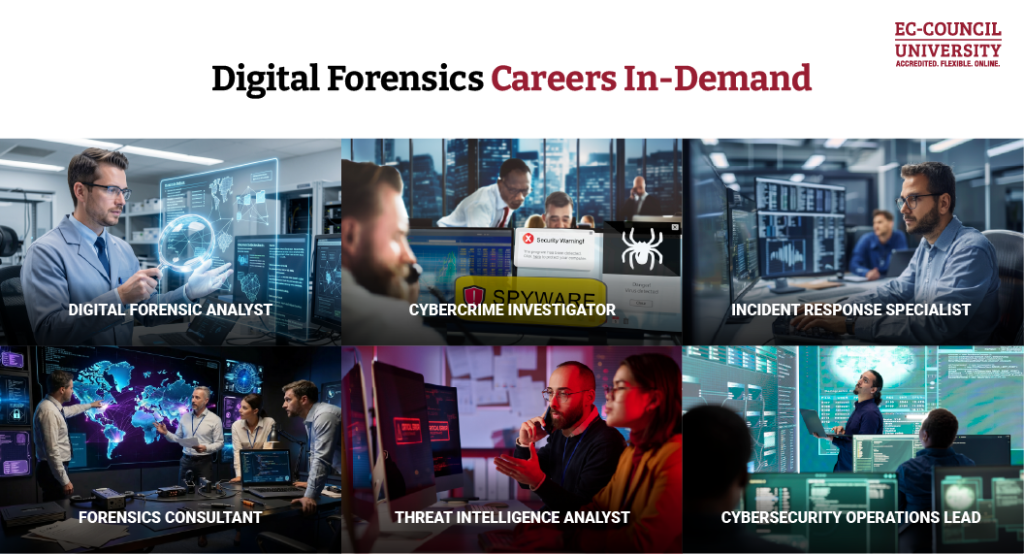
A Master’s in Digital Forensics opens doors of opportunities to in-demand roles such as:
Digital Forensic Analyst
Investigate cybercrimes, analyze data, and provide admissible evidence.
Incident Response Specialist
Lead responses to breaches and security incidents in corporate or government settings.
Cybercrime Investigator
Work with law enforcement or cybersecurity firms to track and crack down on digital offenders.
Forensics Consultant
Advise enterprises, law firms, or courts on digital evidence and investigations.
Threat Intelligence Analyst
Analyze cyber threat data to provide actionable insights and help prevent attacks.
Cybersecurity Operations Lead
Manage security operations, monitor threats, and coordinate incident response across the organization.
These roles exist across
|
|
With cyber incidents rising globally, skilled forensic professionals remain in high demand. Salaries for forensic professionals often exceed industry averages, especially when advanced degrees and specialized skills are involved.
Why a Master’s Degree in Digital Forensics Makes a Difference
While certifications and short courses can help you get into the industry, a Master’s degree in Digital Forensics provides depth, context, and leadership readiness.
A degree helps you:
- Develop advanced analytical thinking
- Understand cyber law and digital evidence admissibility
- Master forensic methodologies beyond tool usage
- Conduct structured, defensible investigations
- Lead incident response and forensic teams
A master’s degree is a testament to your preparedness for high-stakes investigations and strategic cybersecurity leadership.
In 2026, when digital cases often involve multi-jurisdiction legal complexity, this level of academic grounding can significantly elevate your credibility and career trajectory.
What Key Skills You Gain in Digital Forensics
A specialized graduate program equips you with both technical and investigative competencies, including:

Technical Skills
- IoT device forensics
- Network traffic and log analysis
- Malware investigation and reverse engineering basics
- Cloud and virtual environment forensics
- Evidence preservation and forensic imaging

Legal & Analytical Skills
- Chain-of-custody documentation
- Cyber law and compliance awareness
- Report writing for legal and executive audiences
- Courtroom-ready evidence presentation

Strategic Capabilities
- Incident reconstruction
- Threat attribution analysis
- Risk assessment and forensic readiness planning
- Collaboration with legal, compliance, and executive teams
These capabilities position graduates to handle both technical investigations and strategic decision-making roles.
How Does EC-Council University Teach Digital Forensics Differently
EC-Council University has a very different approach to cybersecurity education. 100% online and flexible
EC-Council University’s MSCS Specialization in Digital Forensics
The Master of Science in Cybersecurity (MSCS) at EC-Council University offers a focused specialization in Digital Forensics that blends academic rigor with industry application.
Rather than teaching isolated technical concepts, the program integrates digital forensics into a broader cybersecurity framework, ensuring students understand both attack and investigation perspectives.
1. Hands-On Virtual Labs
ECCU provides hands-on learning through:
- Virtual lab environments
- Simulated breach investigations
- Real-world case scenarios
Students don’t just read about investigations, but learn about the practical implications and workings in a controlled environment.
2. Integration of EC-Council Certifications
The curriculum integrates industry-recognized certifications from EC-Council, helping students prepare and align academic learning with globally respected credentials.
This integration enhances employability and demonstrates the validation of applied skills alongside academic achievement.
3. Curriculum Aligned with Current Cybercrime Trends
The program reflects the current industry trends and realities, including:
- Ransomware and advanced persistent threats (APTs)
- AI-enabled cybercrime and deepfake evidence
- Cloud-native investigations
- IoT device-related forensic challenges
- Global cybercrime frameworks and standards, and more.
4. Faculty with Real-World Experience
ECCU faculty provides real-world experience and insights on:
- Cybersecurity operations
- Law enforcement investigations
- Incident response leadership
- Digital evidence litigation support
This ensures students benefit from practical insights and not just theory.
Digital Forensics vs. General Cybersecurity Degrees
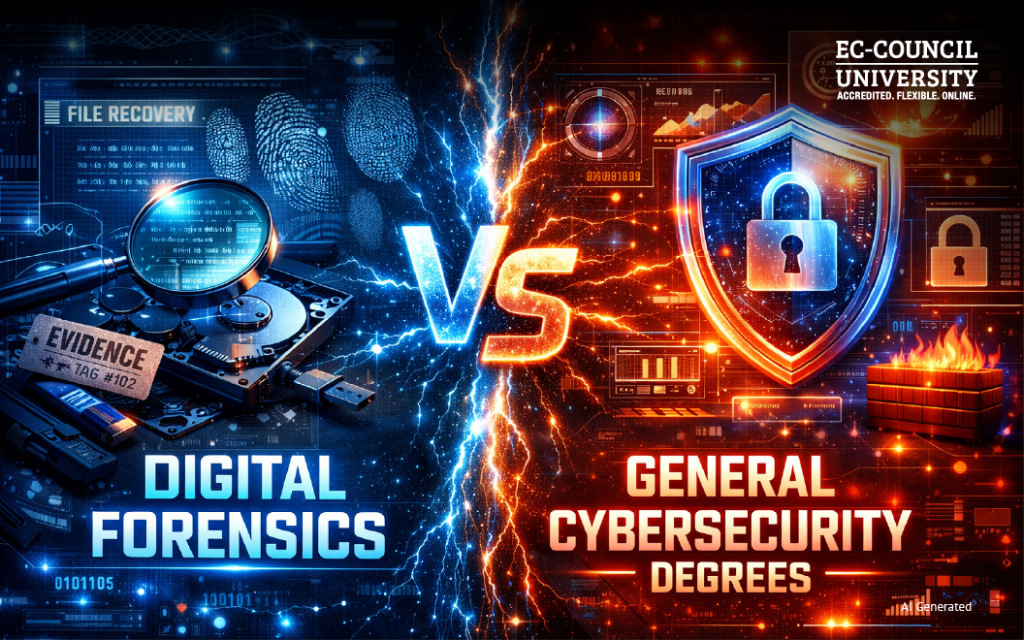
You may be wondering how a general Master’s in Cybersecurity is different from a Master’s in Cybersecurity with a digital forensics specialization. And will it at all have a significant impact on your career?
The Answer is a straight yes. A general Master’s in Cybersecurity provides broad knowledge of security principles, risk management, network defense, and leadership in protecting digital assets. In contrast, a Master’s in Cybersecurity with a Digital Forensics specialization goes deeper into investigative skills, evidence analysis, and legal frameworks, preparing graduates to analyze, reconstruct, and present digital evidence in legal and organizational contexts while maintaining an understanding of overall cybersecurity strategy.
When to Choose a Specialized Forensics Path
Choose digital forensics if you are drawn to:
- Investigative work
- Root-cause analysis
- Evidence handling
- Legal and compliance intersections
- Post-incident deep technical analysis
If you enjoy solving complex incident scenarios and reconstructing events, then forensics may be your ideal path.
How Digital Forensics Complements Broader Cybersecurity Leadership
Even for aspiring CISOs and security leaders, digital forensics provides good leverage in the job market. Understanding how investigations unfold enhances:
- Risk management decisions
- Breach response strategy
- Policy development
- Board-level reporting
ECCU’s Blended Approach for Leadership Roles with Specialization
ECCU combines specialization with holistic cybersecurity knowledge. Students gain:
- Technical depth in forensics
- Strategic cybersecurity frameworks
- Governance and compliance awareness
- Leadership-ready skill sets
This balanced approach ensures graduates are not siloed specialists — but well-rounded cybersecurity professionals with investigative expertise.
The Future of Digital Forensics and Why Now Is the Right Time
Talking about the future of Cybersecurity, the next wave of cyber threats will be shaped by:
- AI-generated attacks and synthetic identities
- Quantum-resistant encryption transitions
- Expanding digital privacy regulations
- Cross-border cyber investigations
- Autonomous systems and smart infrastructure
Digital evidence will only grow more complex.
Organizations that lack forensic expertise will struggle to respond effectively, making trained digital forensic professionals indispensable in 2026 and beyond.
There has never been a more strategic time to enter this field.
Is a Master’s in Digital Forensics Worth It in 2026?
Absolutely — if:
- You want a career at the intersection of technology, law, and investigation
- You value practical, high-impact skills with real legal and corporate demand
- You aim for senior or specialized roles early in your professional journey
A Master’s in Digital Forensics is a career accelerator in today’s most dynamic field of Cybersecurity. The digital forensics degree positions you at the forefront of cybersecurity investigations.
Ready to Lead in Digital Investigations?
Position yourself as a future-ready cybersecurity professional with EC-Council University’s Master of Science in Cybersecurity- Digital Forensics. A master’s degree designed to equip you with practical skills, integrated certifications, real-world lab experience, and faculty mentorship designed for today’s evolving cyber threat landscape.