If you are considering a graduate degree in tech security, chances are you have come across Master’s in Cybersecurity and Master’s in Information Security—and wondered, aren’t these basically the same thing?
They are closely related, yes, but not interchangeable. Choosing between them can shape not only what you study, but also how your career unfolds over the next decade.
Here is a clear breakdown of both cybersecurity career paths to help you decide which one truly fits your goals.
Cybersecurity vs Information Security: Closely Related, But Not the Same
At a glance, Cybersecurity and information security seem like two sides of the same coin. Both focus on protecting data, systems, and organizations from threats.
But here’s the key distinction:
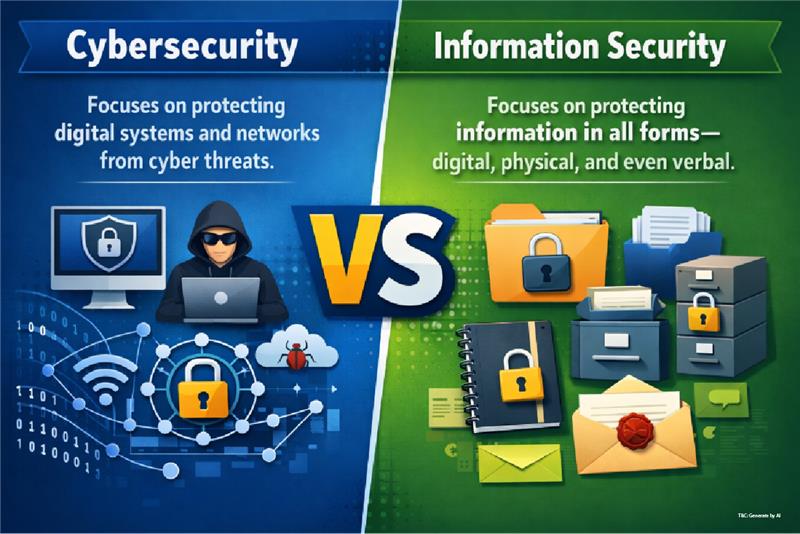
- Cybersecurity is primarily about protecting digital systems and networks from cyber threats.
- Information Security focuses on protecting information in all forms—digital and physical.
Think of it this way: Information Security is the big umbrella, and Cybersecurity is one of the most critical spokes under it.
Definition & Scope: Cybersecurity vs Information Security
What Is Cybersecurity?
Cybersecurity is all about defending systems against cyberattacks, breaches, malware, ransomware, and hacking attempts. It’s highly technical and fast-moving.
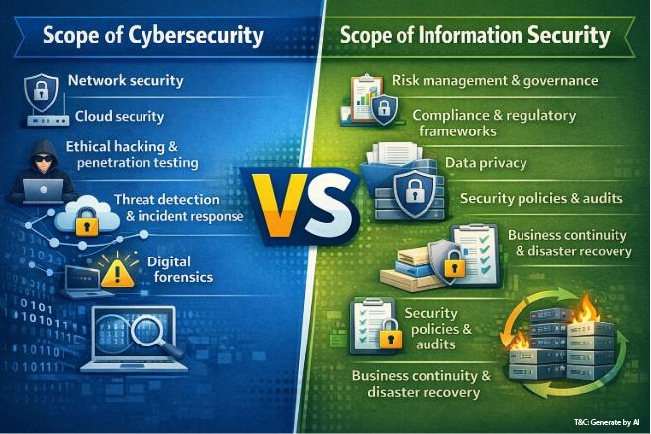
Scope includes:
- Network security
- Cloud security
- Ethical hacking & penetration testing
- Threat detection & incident response
- Digital forensics
A Master of Science in Cybersecurity program prepares you for the front line of digital defense, providing a blend of technology, strategy, and leadership.
What Is Information Security?
Information security takes a broader, more holistic approach. It protects data integrity, confidentiality, and availability, regardless of whether the data resides on a server, a laptop, a filing cabinet, or in transit.
Scope includes:
- Risk management & governance
- Compliance & regulatory frameworks
- Data privacy
- Security policies & audits
- Business continuity & disaster recovery
An Information Security degree blends technology with strategy, policy, and leadership.
Curriculum Comparison: What Will You Study?
Master’s in Cybersecurity – Curriculum Focus
A cybersecurity degree is deeply technical and hands-on.
You’ll typically study:
- Ethical hacking & penetration testing
- Cyber threat intelligence
- Network Security
- Cloud security
- Incident response & digital forensics
- Secure software development
Perfect for those who love technical problem-solving, technology, leadership, and enterprise-level security.
Master's in Information Security – Curriculum Focus
An information security course strikes a balance between technical expertise and organizational strategy.
You’ll typically study:
- Information risk management
- Security governance & compliance
- Privacy laws & regulations
- Enterprise security architecture
- Policy development
- Audits & security assessments
Ideal if you’re interested in audit, compliance, governance, leadership, and enterprise-level security.
Career Pathways: Where Can Each Degree Take You?
Cybersecurity Graduates
With a Master’s in Cybersecurity, you can pursue roles such as:
- Cybersecurity Analyst
- Penetration Tester / Ethical Hacker
- Security Operations Center (SOC) Analyst
- Cloud Security Engineer
- Incident Response Specialist
- Chief Information Security Officer (CISO)
- Chief Technology Officer (CTO)
- Chief Information Officer (CIO)
These roles are often hands-on, technical, and high-impact.
Information Security Graduates
An Information Security career opens doors to roles like:
- Information Security Manager
- Risk & Compliance Analyst
- Governance, Risk & Compliance (GRC) Specialist
- Security Auditor
- Chief Information Security Officer (CISO) (long-term)
- Chief Risk Officer (CRO)
- Chief Compliance Officer (CCO)
These positions often involve strategy, leadership, and policy oversight.
Quick Snapshot: Skills & Learnings Compared
| Area | Cybersecurity | Information Security |
| Focus | Digital threats & systems | Data protection across all forms |
| Technical Depth | Very high | Moderate to high |
| Policy & Governance | Limited | Strong emphasis |
| Ideal Personality | Technical Specialist, Leadership and Management | Strategic, Leadership and Management |
Industry Demand & Salary Insights
Good news: both fields are in massive demand.
- 32% projected growth by 2032 in employment for information security analysts.
- 4.8 million global cybersecurity workforce gap reflects the urgent demand.
Salary Insights (U.S. averages):
- Cybersecurity roles: $100,000 – $140,000+
- Information Security & management roles: $110,000 – $160,000+
Why ECCU’s Master’s in Cybersecurity Stands Out
The Master of Science in Cybersecurity (MSCS) is a blend of technical and organizational level strategy, designed to bridge theory and real-world practice. Ideal if you’re interested in decision-making, leadership, and enterprise-level security.
EC-Council University: Global Cybersecurity Professionals' Preferred Choice!
What makes ECCU Unique?
- Industry-aligned curriculum
- Hands-on labs & practical learning
- Strong focus on leadership in Cybersecurity
- Degree Programs combined with Industry Certifications
- Global alumni network
Learn Why EC-Council University Is The Right Choice for a Master’s Degree in Cybersecurity. Read the blog here
Success Story Spotlight: Peter Chukwu Kamani
Peter Chukwu Kamani, a proud ECCU graduate, leveraged the EC-Council University’s MSCS program to elevate his cybersecurity career and make a global impact.
Read Peter Chukwu Kamani’s Inspiring Success Story and Career Journey Here.
FAQs: Master of Science in Cybersecurity (MSCS)
A foundational understanding of IT helps, but ECCU’s program is structured to build skills progressively.
Absolutely. Many students transition from IT, networking, or even non-tech backgrounds into cybersecurity roles with ECCU’s Master of Science in Cybersecurity Degree.
Yes. Absolutely, the curriculum is a blend of technical and strategic learning, building core technical, strategic, and leadership capabilities.
The EC-Council University’s Master of Science in Cybersecurity (MSCS) Program duration is 2 years.
Final Thoughts: Which Degree Should You Choose?
Choose a Master’s in Cybersecurity if you:
- Love hands-on technical challenges
- Want to fight cyber threats directly
- See yourself as a digital defender
- Aspire to be in leadership roles like CISO, CTO, CIO, etc
Choose an Information Security degree if you:
- Enjoy strategy, risk management, and governance
- Interested in compliance, audit, and industry regulations and standards
- Aspire to be in leadership roles like CISO, CRO, CCO, etc
- Want a broader organizational perspective
Both paths are powerful. The right choice depends on how you want to make an impact on the security world.
Whichever path you choose, one thing is certain: the future needs security professionals—and it needs them now.